
YouTube TrueView ads give brands control over reach, cost, and viewer attention in one advertising format. They let users skip, which makes every view intentional. That single mechanic changes how ads should look, sound, and convert – because advertisers must communicate the entire message clearly, even if viewers only watch the first few seconds.
Below, you will find clear explanations and four strong examples of TrueView video ads. Each shows how YouTube TrueView ads work in real campaigns and why they convert.
What are YouTube TrueView Ads?
YouTube TrueView ads are skippable video ad formats where you pay only when viewers show real interest. They give viewers a choice. People can decide to keep watching or skip after a few seconds. You pay when they stay engaged or click, based on clear rules in Google Ads and Google Display Network.
There are two main TrueView video ad types that matter most for marketers: in-stream ads and in-feed ads.
TrueView in-stream ads
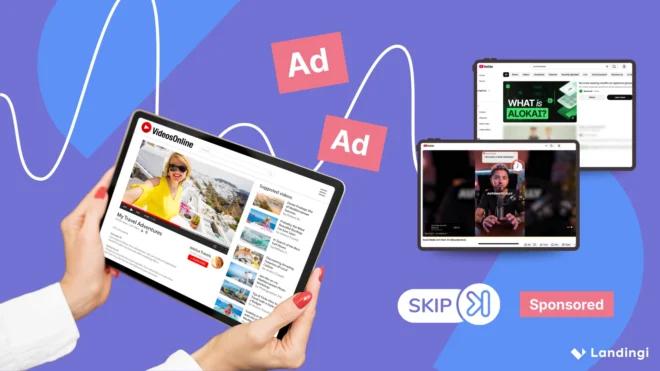
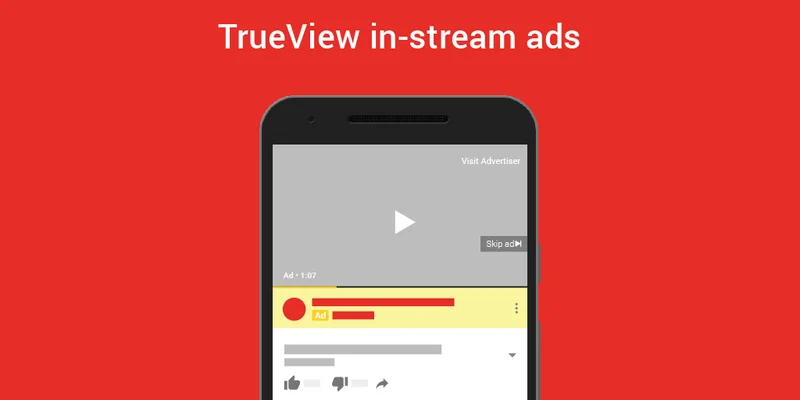
In-stream ads play before, during, or after another YouTube video. Viewers can usually skip after five seconds. You pay when they watch at least 30 seconds, watch the whole clip if it is shorter, or click. In-stream TrueView ads are stronger for direct response, because they support action-focused bidding and clear CTAs.
TrueView in-feed ads (former TrueView discovery ads)
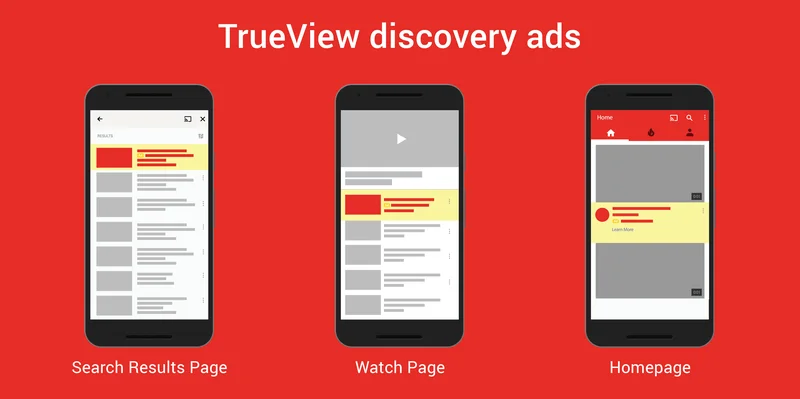
In-feed ads appear in YouTube search results, on the Home feed, or next to related videos. The ad looks like a regular video tile with a thumbnail, title, and short description. You pay when someone clicks to watch the video. In-feed TrueView ads are stronger for discovery and education, because they behave more like search results or suggested YouTube videos.
This structure makes YouTube TrueView ads flexible and easy to fit into a wider marketing strategy. They can work like search ads, social video, or classic pre-roll, depending on the format and the type of video content you promote.
TrueView views can build remarketing lists, so you can later reach people who watched your video with other campaigns.
Because you pay only for views or clicks that meet set rules, wasted spend is lower. People who skip in the first seconds usually do not cost you money. That alone is a strong reason many brands favor TrueView video ads.
Turn attention into action! Capture engaged visitors with landing pages that actually perform.
Setting up TrueView ads in Google Ads
Here are three core actions required to create video ads using the TrueView format in Google Ads:
- You create them under Video or Video action campaign types, link your YouTube channel, and select one or more videos.
- You choose a bidding strategy such as Maximize conversions, target CPA, or Maximize views, depending on your goal.
- You define audiences and ad placements by using keywords, topics, custom segments, and specific YouTube channels or videos.
Once these basics are in place, you can layer in frequency caps, devices, and schedules. Over time, you refine campaigns based on real performance data instead of guesses.
What is the Importance of YouTube TrueView Ads for Digital Marketers?
YouTube TrueView ads are important for digital marketers because they mix large reach, intent data, and control over how you pay.
You get access to YouTube’s huge audience and strong targeting at the same time. You can target by keywords, topics, interests, placements, and custom audiences. That lets you reach people based on what they watch, search, or plan to buy.
You also have control over how you pay. You pay for a view or click only when someone stays engaged long enough. Quick skips usually do not count as a paid view. This protects your budget from people who are clearly not interested.
TrueView video ads also support the whole funnel. You can:
- Use in-stream for clear offers, signups, and remarketing.
- Use in-feed for education, product demos, and content promotion.
You can track views, clicks, watch time, and conversions. That data helps you improve creative and targeting over time.
Finally, YouTube TrueView ads integrate well with landing pages and tracking. You can send viewers to a focused page, fire pixels, and measure revenue, not only views.
Turn views into signups! Send your TrueView traffic to a high-converting landing page.
4 Effective Examples of YouTube TrueView Advertising
These four YouTube TrueView ads are effective because they connect clear hooks, strong visuals, and intent-based targeting. Each example highlights a different strength of TrueView video ads: search intent, personal delivery, social proof, and clear outcomes. Use them as inspiration, then adapt the patterns to your brand and funnel.
1. Alokai – InFeed ad example
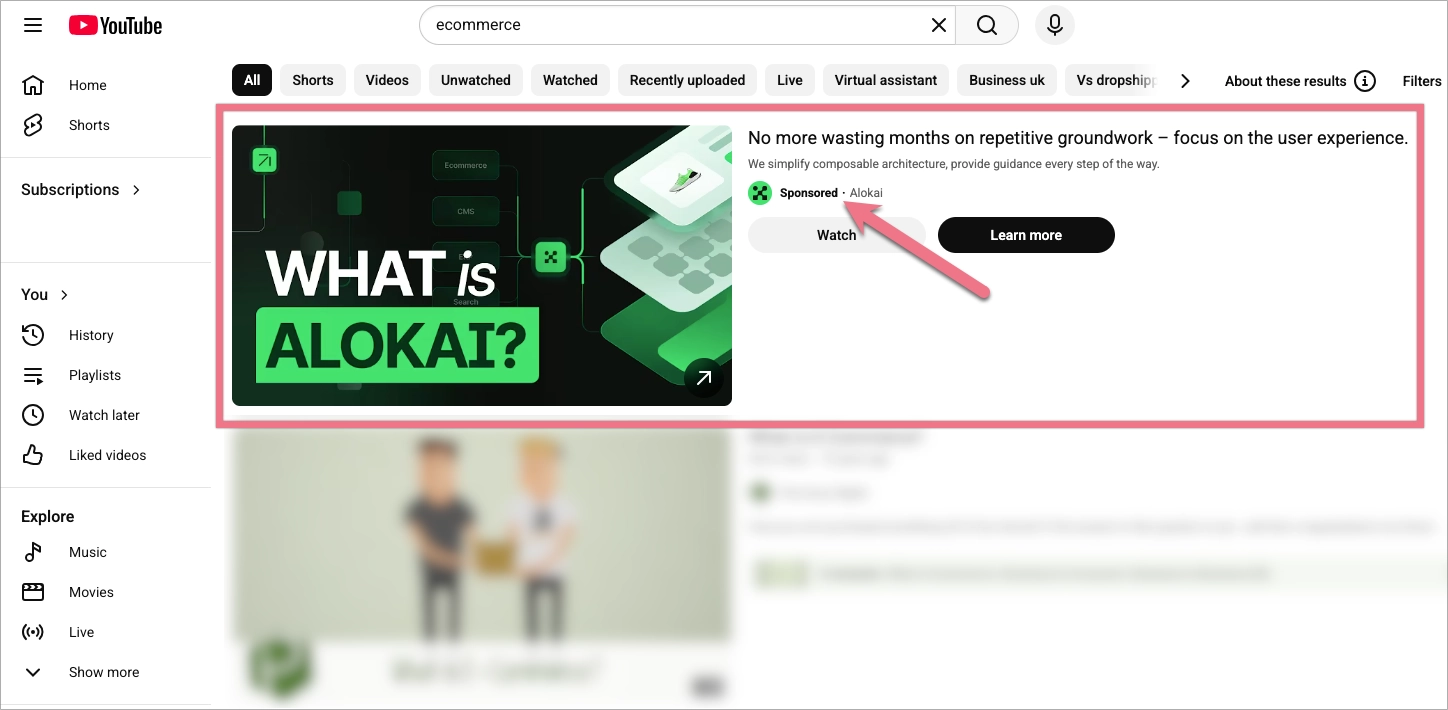
The Alokai in-feed TrueView video ad works because it puts a sharp promise next to high-intent search results.
The ad appears at the very top of YouTube results for the keyword “ecommerce.” This is a powerful spot. People searching for that term often work in online retail, product, or development.
The headline reads “No more wasting months on repetitive groundwork.” It attacks a very specific pain: slow, boring setup work in ecommerce projects. Right away, the viewer sees a clear gain. They can focus on user experience instead of plumbing and boilerplate.
The visual story supports this promise. Modern three-dimensional “blocks” show elements like CMS and ecommerce modules. The product feels modular, flexible, and current. Even without sound, the viewer understands the idea in seconds.
Why this Alokai ad works so well:
- It appears exactly where intent is strong: after a search for “ecommerce.”
- The value proposition is specific and problem focused, not fluffy.
- The design screams “modern tech” in an instant, which builds trust.
How to apply this in your campaigns:
- Pair in-feed TrueView video ads with high-intent keywords related to your offer.
- Use a headline that states the main pain and main outcome clearly.
- Choose a thumbnail and visual style that explain the product in under three seconds.
Stop wasting time on setup – explore ecommerce landing pages that just work.
2. Manychat – InStream ad example
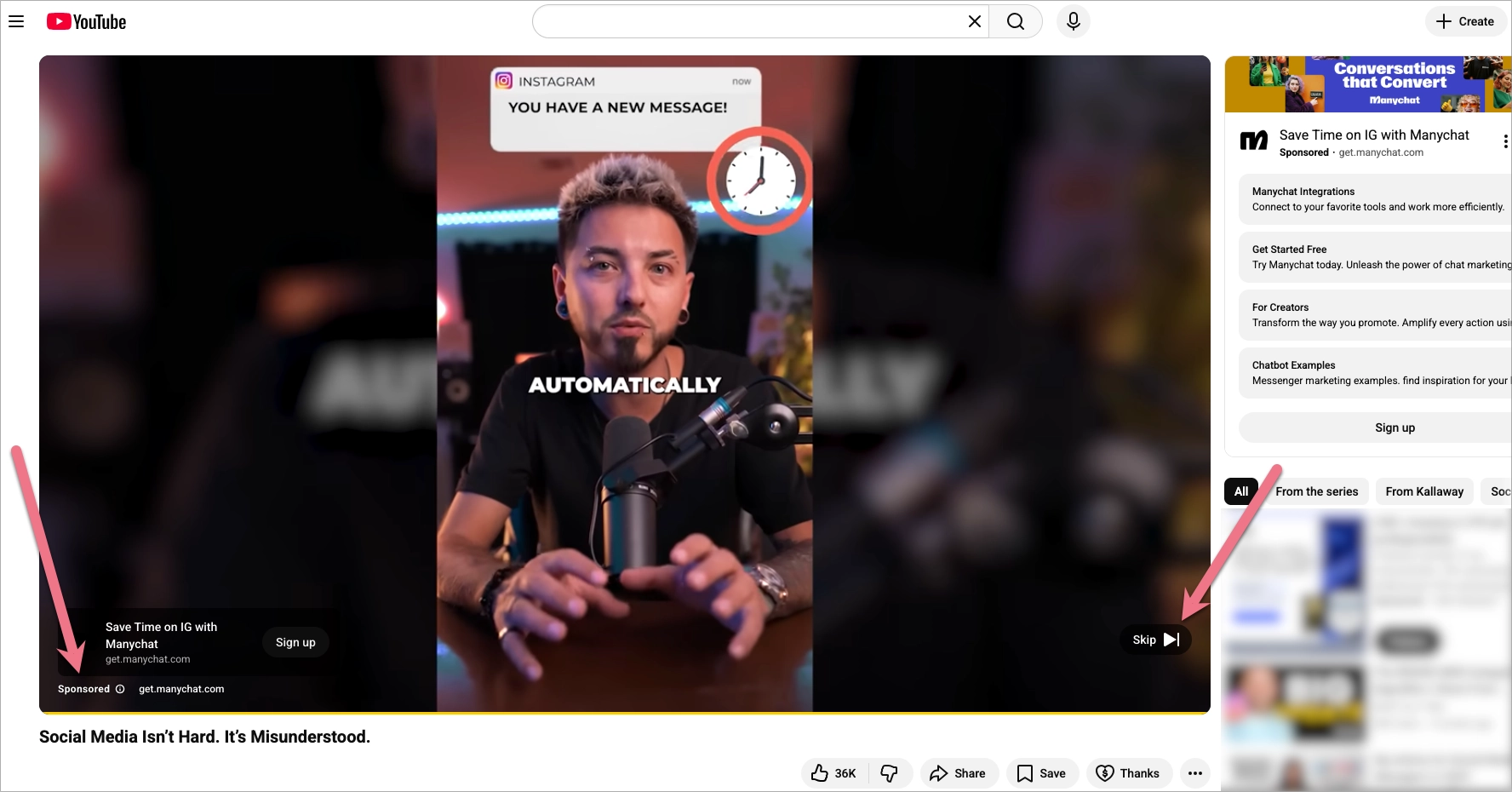
The Manychat in-stream YouTube TrueView ad works because it feels like native content and still drives a direct signup.
The format is classic skippable in-stream video. It interrupts the viewer, but it looks and sounds like a normal creator clip. A person talks face to camera, in a casual tone.
This format matters. “Face-to-camera” content builds quick trust. It mirrors typical YouTube app or Instagram content, so the ad feels less intrusive. Viewers are more likely to give you a few more seconds.
Manychat also uses strong visual overlays. You see an Instagram-style notification: “You have a new message!” There is also a clock icon that hints at saving time and faster responses. These graphics explain the product even if the sound is muted.
The ad uses a clear “Sign up” call to action. The button appears on the player and in the side panel. Wherever the viewer looks, the path to conversion is obvious.
What you can learn from the Manychat ad:
- Use face-to-camera clips for warmth and trust, especially for SaaS tools.
- Add overlays that show the core workflow or key benefit at a glance.
- Place a simple CTA like “Sign up” or “Start free trial” near the main visual.
- Write a script that speaks to one person, not a crowd.
3. HexClad – InFeed ad example
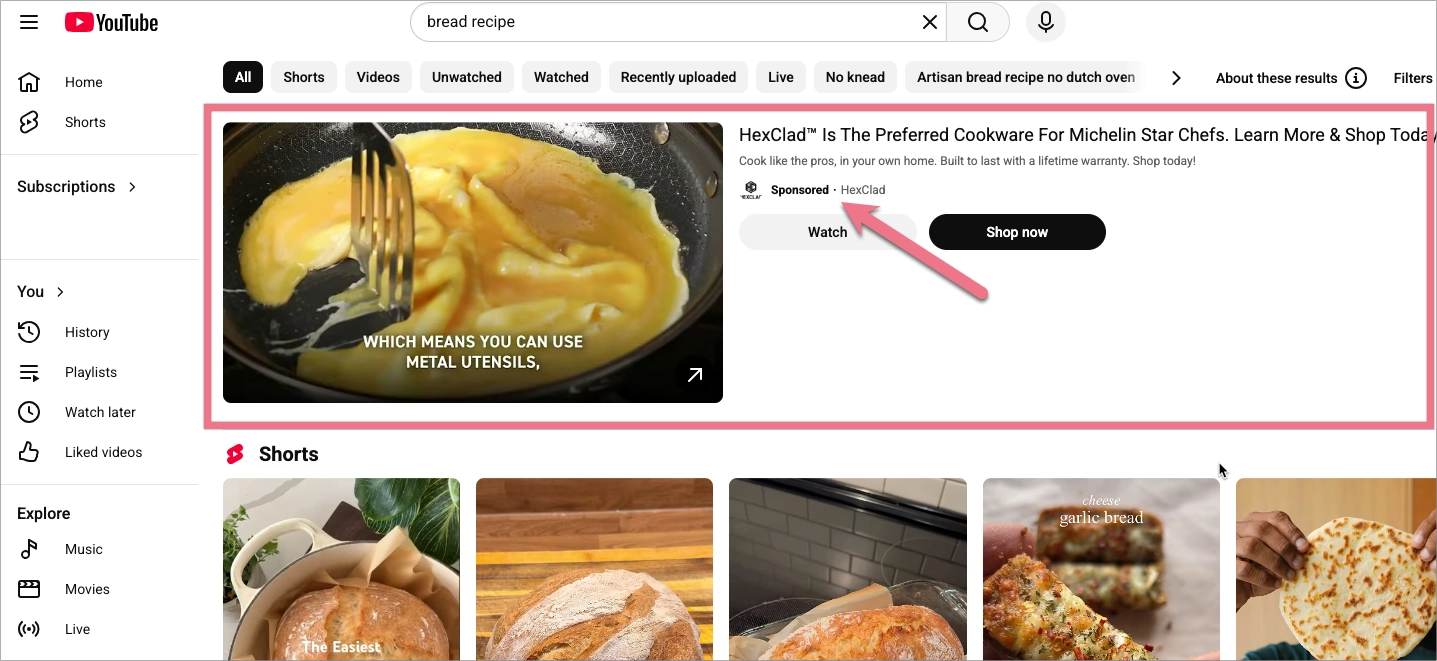
The HexClad in-feed TrueView video ad works because it connects search intent, social proof, and product proof in one frame.
The ad appears in YouTube search results for “bread recipe.” That is clever targeting. Someone searching for recipes is already in a cooking mindset. Showing premium cookware here fits the exact context.
The copy leans on strong social proof. The message explains that these pans are favored by Michelin-star chefs. That one line gives huge authority to the brand. Home cooks instantly think, “If top chefs use this, I can trust it.”
The image then proves a key feature. Metal utensils rest on the pan without visible damage. The viewer can literally see durability and scratch resistance. No long description is needed.
Lessons from the HexClad ad:
- Use in-feed placement with contextual keywords that match your product in real life.
- Lean on a clear credential: awards, experts, or big brands that use you.
- Let the thumbnail show the main benefit instead of just telling it.
- Think like the searcher: “What is in my head at the moment I see this?”
Make your landing page echo your video ad – perfectly matched, no surprises.
4. Meet Katie / Altahq – InStream ad example
The Meet Katie in-stream TrueView video ad works because it shows the end result for a very specific B2B role.
The creative promotes an AI agent that books meetings for sales teams. Instead of showing the interface first, it shows a packed calendar. Events like “Me <> Sid” and “Me <> Mike” fill the days.
For a sales development rep, a full calendar is the dream. This simple screen acts as a direct promise: more qualified meetings. The viewer can read the benefit in under a second.
The niche is also very clear. The ad focuses on an “SDR Agent,” not “AI for everything.” That focus calls out exactly the people who should care. The message is compact, targeted, and easy to remember.
The layout stays clean and minimal. There are no heavy animations or clutter. This helps the viewer get the message before the skip button appears.
What you can copy from the Altahq ad:
- Start with a visual of the outcome your tool creates: calendar, dashboard, or revenue chart.
- Speak to a single role or niche, like SDRs, founders, or marketers.
- Keep the frame clean, so the message lands before the skip.
- Use in-stream TrueView for fast promises tied to clear metrics.
What is the Difference Between YouTube TrueView and Other Ad Formats?
The difference between YouTube TrueView and other ad formats is how viewers interact and how you pay for exposure. With TrueView video ads, viewers usually have the option to skip after five seconds. You pay only when they keep watching or interact. This model filters out people who are not interested.
Here is how that differs from other main YouTube ad formats:
- Non-skippable in-stream ads. These force viewers to watch the full clip before the YouTube video. You pay based on impressions, not engaged views. They can work for reach, but they risk irritation.
- Bumper ads. These are very short, non-skippable clips, up to six seconds. They are great for quick reminders and brand recall. They are less suited for detailed offers or explanations.
- Masthead ads. These occupy premium space on the YouTube Home feed. They are strong for massive reach in a short time. They are also expensive and mostly used for big launches.
- Display and overlay ads. These show as banners or small overlays. They are cheaper but easier to ignore.
TrueView video ads sit in the sweet spot. You gain scale, targeting, and the chance to tell a fuller story. At the same time, you keep some control over cost through view-based pricing.
Another key difference is intent and engagement signals. A completed TrueView view or click shows interest beyond a forced impression. That makes the data more useful for remarketing and lookalike audiences.
Reach who wants to listen. Create pages that filter out the noise and speak to intent.
Turn YouTube TrueView Traffic into Conversions – With Landingi Landing Pages
YouTube TrueView ads are built to earn attention, not force it. Because viewers can skip, every paid view signals real interest. That makes TrueView video ads a strong traffic source – but traffic alone is never the goal. Conversions happen after the click, and that is where focused landing pages decide whether YouTube TrueView ads actually deliver business results.
A strong landing page continues the promise made in the video. It repeats the core message, removes distractions, and guides the viewer toward one clear action tailored to a specific target audience. When TrueView traffic lands on generic homepages or cluttered product pages, intent is wasted. When it lands on a page designed for one audience, one offer, and one goal, conversion rates improve fast.
Landingi helps bridge that gap between views and results. It lets marketers quickly build, duplicate, and test landing pages that match different TrueView video ads, audiences, and funnel stages. With built-in analytics, integrations, and conversion-focused templates, Landingi turns YouTube TrueView ads from awareness tools into measurable growth drivers.
If you want your YouTube TrueView ads to do more than generate views, try Landingi for free and start converting video traffic into real results!