ConvertKit (now branded as Kit) is an email marketing platform built primarily for creators who monetize newsletters, digital products, and simple funnels. It focuses on email delivery, tagging, and linear automations rather than landing page optimization or conversion testing.
This article compares the best ConvertKit alternatives in 2026 for teams that have outgrown an email-first setup. It explains when ConvertKit becomes limiting, which tools solve those limits, and how pricing, features, and real user feedback differ across platforms.

Why Should I Consider ConvertKit (Kit) Alternatives?
You should consider ConvertKit alternatives when email marketing stops being your main growth constraint. ConvertKit works well for sending newsletters and running basic automations, but it offers limited control over landing page structure, testing, and conversion analytics.
User comparisons and product reviews show that these gaps become visible once teams drive paid traffic, run multiple offers, or optimize funnels at scale. At that stage, email remains important, but landing pages and data quality start to matter more than email simplicity.
What Are the Best ConvertKit (Kit) Alternatives?
The best ConvertKit alternatives in 2026 are MailerLite, Landingi, and GetResponse. Each tool replaces ConvertKit from a different angle: lightweight email marketing, conversion-focused landing pages, or an all-in-one marketing suite.
| Alternative | Stand-out feature | Cost | Free plan |
| MailerLite | Simple email automation with a clean interface | From about $10 per month (annual billing) | Yes |
| Landingi | Advanced landing pages, A/B testing, and conversion analytics | From $24 per month (annual billing) | Yes |
| GetResponse | Email marketing combined with funnels and webinars | From about €13 per month (annual billing) | Trial only |
Each option addresses a specific limitation that ConvertKit users commonly report. The next section explains which alternative fits which use case and where the trade-offs appear in practice.
3 Top ConvertKit (Kit) Alternatives in 2026
The top ConvertKit alternatives in 2026 – MailerLite, Landingi, and GetResponse – solve different problems depending on where friction appears. Some tools simplify email marketing. Others improve landing page performance or bundle multiple channels into one system. The sections below explain where each tool fits, based on features, pricing, and user feedback.
1. MailerLite
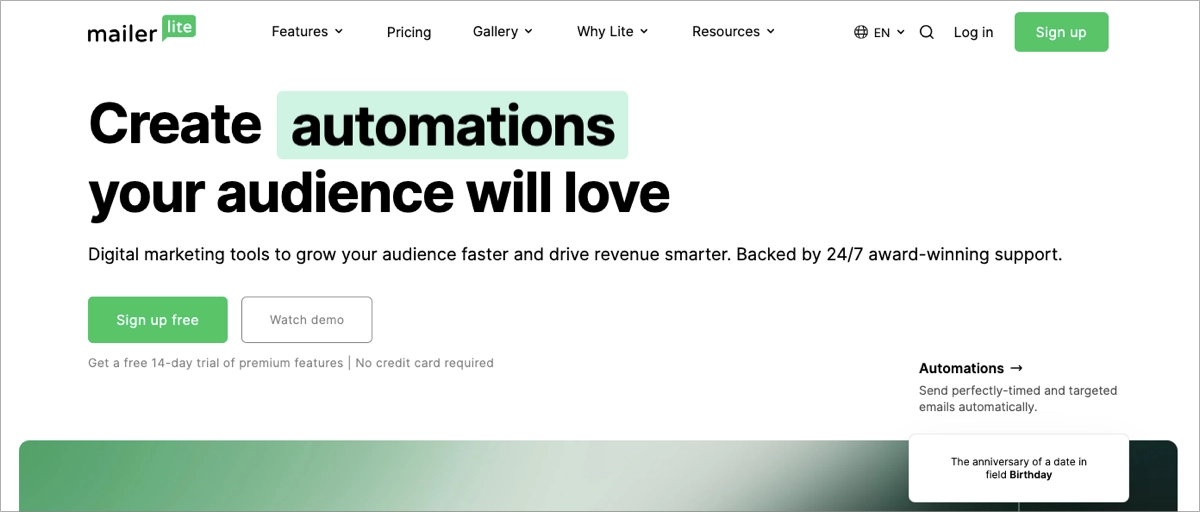
MailerLite is one of the most common ConvertKit alternatives for teams that want email marketing without complexity.
Pricing
Pricing in MailerLite is subscriber-based. The free plan supports up to 500 subscribers. Paid plans start at about $10 per month when billed annually and scale with list size. Enterprise plans are available for larger databases.
Key Features
MailerLite focuses on essential email functionality:
- Email campaigns and newsletters
- Visual automation builder
- Basic landing pages and forms
- Segmentation and performance reports
Best for
MailerLite is best for creators and small teams that want predictable pricing and fast setup.
Ratings
- G2: 4.6/5
- Trustpilot: 4.3/5
- Capterra: 4.7/5
What advantages do people point out in reviews?
Users consistently highlight ease of use and fast onboarding. Reviews often mention that MailerLite feels intuitive even for beginners and that campaigns can be launched without technical setup.

Another recurring advantage is pricing transparency. Compared to ConvertKit and other email tools, users appreciate that costs are easy to estimate and do not jump unexpectedly at small list sizes. This makes MailerLite feel safer for early-stage projects.
What disadvantages do people point out in reviews?
A recurring issue mentioned in reviews is account stability and enforcement. Some users report account suspensions or restrictions without clear explanations, even when sending legitimate campaigns. Support responses in such cases are often described as slow or generic.
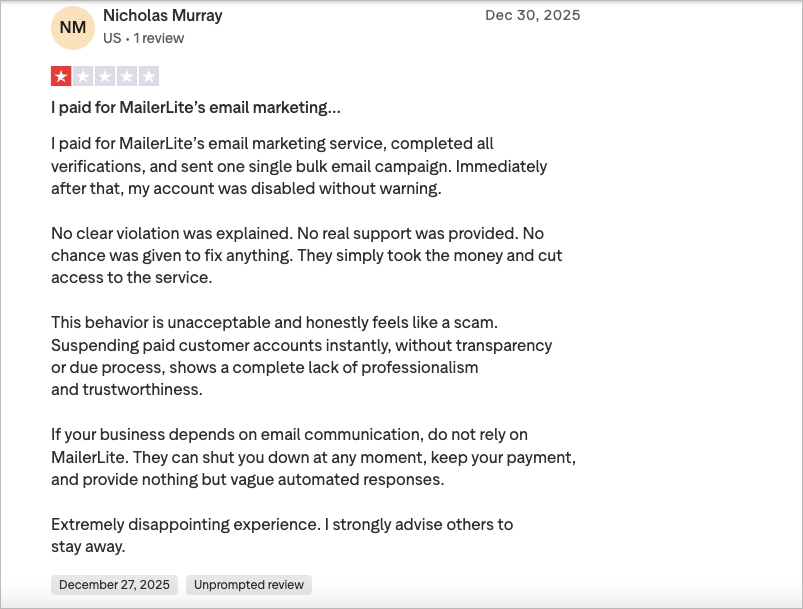
Reviews also point to limited flexibility. As automations grow more complex, users feel constrained by the workflow builder. Landing page customization and analytics depth are frequently described as insufficient once campaigns become performance-driven.
My opinion
MailerLite removes friction early, but adds it later. It works well until email becomes business-critical and workflows grow beyond simple campaigns.
ConvertKit (Kit) vs MailerLite
| Area | ConvertKit (Kit) | MailerLite |
| Core focus | Creators and newsletters | Simple email marketing |
| Automation depth | Moderate | Basic |
| Landing pages | Basic | Very basic |
| Analytics | Limited | Limited |
| Pricing clarity | Mixed | Clear |
| Scalability | Medium | Low to medium |
MailerLite is a solid replacement for ConvertKit when simplicity and cost control matter most. It is not designed for advanced funnels, heavy testing, or performance-driven landing page workflows.
2. Landingi
Landingi is a landing page platform designed for creating, testing, and optimizing conversion-focused pages at scale. It is used by marketing teams, agencies, and companies that run multiple campaigns and need full control over how traffic converts.

The platform centers on a visual, pixel-level editor that lets teams design pages without code, run A/B tests, and track user behavior directly on the page. Instead of treating landing pages as static assets, Landingi treats them as working parts of the funnel that change, iterate, and scale with campaigns.
Unlike email marketing tools, Landingi does not manage subscribers or send newsletters. Its role is earlier in the funnel: turning visits into leads or sign-ups and showing teams what happens on the page before a form is submitted.
Pricing
Landingi uses a usage-based pricing model that scales with traffic, features, and team needs.
- Free plan: $0/month – 5 pages, 100 visits/month
- Lite: $24/month – unlimited conversions, 5K visits – with 14-day free trial
- Professional: $57/month – 50K visits, 10 domains, A/B testing – with 14-day free trial
- Enterprise: $1,150/month – unlimited resources and SSO – with 14-day free trial

Key Features
- Pixel-perfect landing page builder with full drag-and-drop control
- 400+ templates for landing pages, pop-ups, and sections
- EventTracker for built-in analytics on scrolls, clicks, video views
- Programmatic landing pages for dynamic content at scale
- A/B tests (server-side)
- Smart Sections for mass-updating many pages
- Reverse proxy, PHP export, WordPress plugin
- Multi-language personalization and dynamic text replacement
- Advanced integrations with CRMs, ad platforms, and Google Analytics
- 170+ tools connected through native integrations or Zapier
Enterprise features
For larger teams, Landingi adds governance and collaboration features that are not common in standard landing page builders. These include Enterprise SSO, audit logs, domain whitelisting, advanced user permissions, and team workspaces.
Enterprise customers also get custom development options, a dedicated account manager, access to a Slack support channel, and compliance with GDPR and WCAG requirements.
Best for
Landingi is best for marketing teams and agencies that run paid traffic, manage multiple campaigns at once, or need consistent landing pages across products and regions. It fits companies that already use email tools like ConvertKit but need a stronger conversion layer before leads enter the list.
Ratings
- G2 – 4.5/5
- Trustpilot – 4.7/5
- Capterra – 4.8/5
What advantages do people point out in reviews?
Users consistently praise Landingi’s intuitive drag-and-drop editor, which allows them to create professional, conversion-focused landing pages without coding skills. Reviews often mention that the editor gives real design control while remaining accessible to non-technical users.
Many users also highlight the wide selection of modern templates and the ability to customize every element of the page. Integrations with email marketing tools, CRMs, and analytics platforms are described as smooth and reliable, which helps teams fit Landingi into existing workflows.

Built-in A/B testing and analytics, including EventTracker, appear frequently in positive feedback. Reviewers point out that being able to test variants and see how users interact with specific page elements makes optimization faster and more practical. Fast, human support is another recurring theme, especially in G2 reviews.
What disadvantages do people point out in reviews?
A common theme in reviews is that mobile views require manual adjustments, particularly on more complex pages. This is a direct result of the pixel-perfect editor, which prioritizes control over automation.
My opinion
Landingi stands out because it gives teams room to grow without forcing an early platform change. You can start with simple pages, then gradually add testing, analytics, and more advanced workflows as campaigns mature. That continuity matters once landing pages become part of daily operations, not one-off experiments.
What I value most is that Landingi does not box teams into predefined structures. It gives real control over layout and data, while still keeping the tool approachable for marketers who do not code. For teams that treat landing pages as a long-term asset rather than a temporary fix, that balance is hard to find.
ConvertKit (Kit) vs Landingi
| Area | ConvertKit (Kit) | Landingi |
| Primary role | Email marketing | Landing page optimization |
| Landing page control | Limited | Full, pixel-level |
| A/B testing | Limited | Native |
| Analytics | Email-centric | Event-level behavior data |
| Enterprise readiness | Low | High |
| Scalability | Medium | Strong |
Landingi does not replace ConvertKit’s email features. It replaces the conversion bottleneck that appears when landing pages start to matter more than sending emails.
3. GetResponse
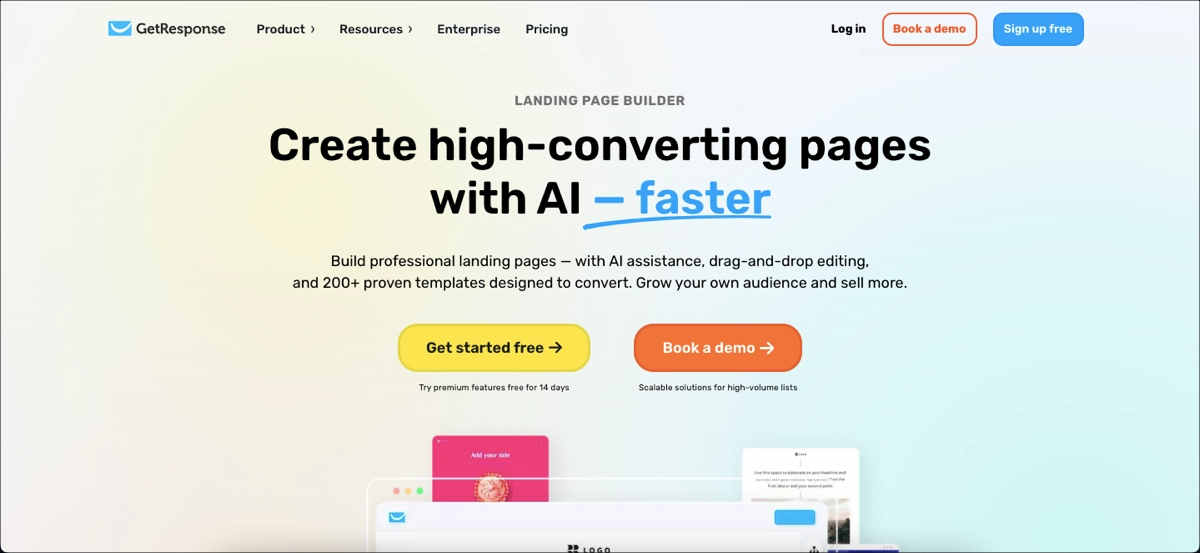
GetResponse is an all-in-one marketing platform with a strong focus on email marketing automation, segmentation, and funnels. It combines email campaigns, basic landing pages, CRM features, and webinars in a single system, which makes it appealing to teams that want to centralize their marketing stack.
Pricing
GetResponse does not offer a free plan. Instead, it provides a 14-day free trial that does not require credit card details.
Pricing on annual plans starts at:
- Starter: €13.12 per month
- Marketer: €44.28 per month
- Creator: €50.84 per month
- Enterprise: Custom pricing
The platform also offers a 50% discount for charities and NGOs. Pricing scales with list size and unlocked features, which can make long-term costs harder to predict as databases grow.
Key features
GetResponse focuses heavily on email and automation:
- Email marketing and advanced automation workflows
- AI landing page builder
- Built-in CRM and lead management
- SMS marketing
- Funnels and surveys
- Webinars
Best for
GetResponse is best for teams that prioritize email marketing software and automation workflows over landing page design and experimentation. It works well when email is the primary channel and landing pages play a supporting role.
Ratings
- G2: 4.3/5
- Trustpilot: 3.9/5
- Capterra: 4.2/5
What advantages do users point out?
Positive reviews frequently highlight ease of use, especially for beginners. Users appreciate that advanced email automation can be set up without deep technical knowledge.
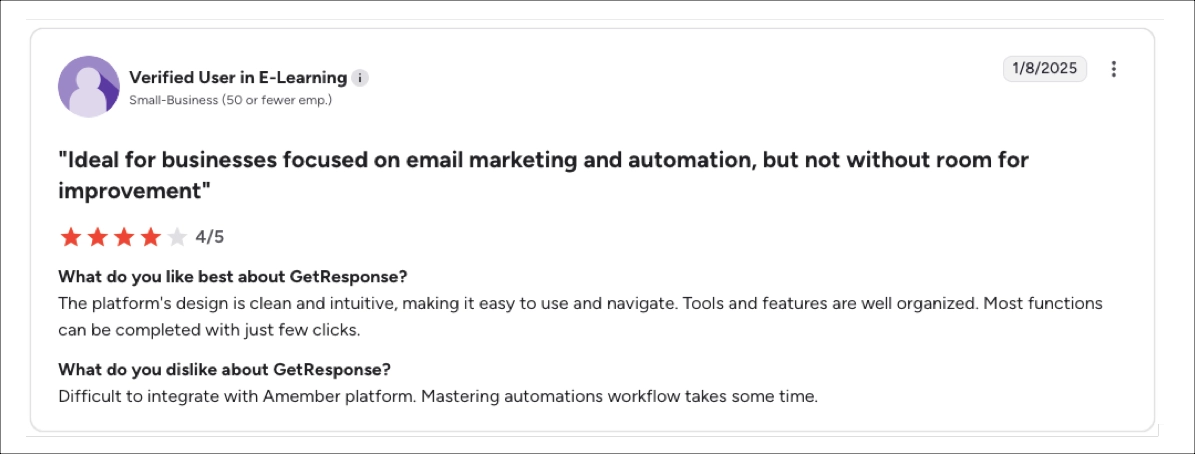
Many reviewers praise email deliverability, segmentation options, and prebuilt automation templates, which help launch campaigns faster. Customer support is also mentioned positively, with users describing responses as quick, helpful, and easy to understand, particularly during onboarding.
What disadvantages do users point out?
A common concern in reviews is billing and cancellation terms. Several users describe being charged for an additional billing cycle after attempting to cancel, due to notice periods outlined in the fine print. Some also mention persistent follow-up emails after initiating account closure.
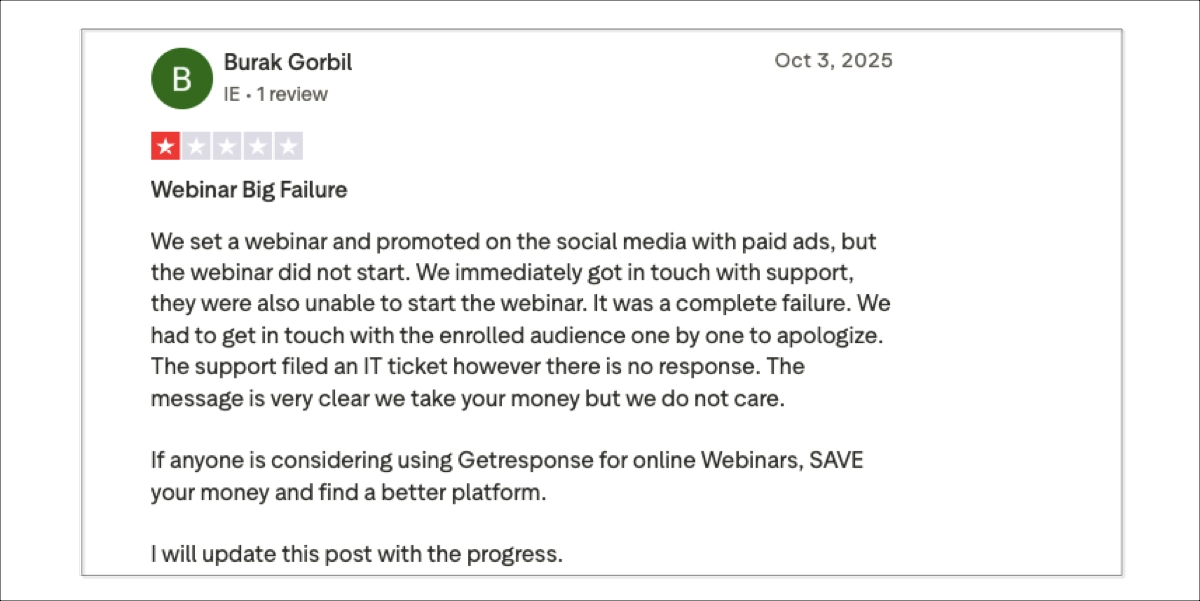
Another recurring issue is strict compliance and deliverability rules. Reviews report unexpected account or list blocks, even for legitimate senders, sometimes without clear explanations. When this happens, campaigns can stop abruptly, which makes the platform feel unpredictable for teams running time-sensitive promotions.
Pricing is also described as high relative to perceived value, especially when compared with simpler email tools that offer fewer features but lower complexity.
My opinion
GetResponse is a strong email engine with advanced automation and segmentation. It performs well when email is the core of your marketing strategy and when having everything in one dashboard feels more valuable than having best-in-class tools for each channel.
Where it falls short is landing pages. The builder is functional, but it lacks the flexibility and testing depth of dedicated platforms like Landingi. If landing pages are a key revenue driver, GetResponse often becomes a compromise rather than a long-term solution.
GetResponse vs ConvertKit (Kit)
| Feature | GetResponse | ConvertKit (Kit) |
| Core focus | Email automation & funnels | Creator-focused email marketing |
| Email marketing | Advanced | Strong |
| Automation depth | Advanced workflows | Moderate |
| Landing pages | Simple | Basic |
| CRM | Built-in | Limited |
| Segmentation | Advanced | Basic to moderate |
| Webinars | Included | Not available |
| Billing | Monthly or annual | Monthly or annual |
| Pricing entry point | Lower at start (€13.12/month) | Higher at comparable lists |
| Best fit | Automation-heavy email teams | Creators and small teams |

Choose the Best ConvertKit (Kit) Alternative
Choosing the right ConvertKit alternative depends on where your funnel starts to break. Email tools solve different problems than landing page platforms, and the wrong choice usually shows up as slower growth, not missing features.
Key takeaways:
- MailerLite works best for simple email campaigns and predictable pricing at small list sizes.
- GetResponse is a strong option when advanced email automation and segmentation are the main priority.
- ConvertKit remains solid for creators, but its built-in landing pages often become limiting as traffic grows.
- Landingi stands out when landing pages, testing, and conversion control drive results.
Once paid traffic, multiple offers, or high-volume campaigns enter the picture, the bottleneck is rarely email delivery. It is page structure, experimentation speed, and insight into user behavior.
Landingi does not replace your email platform. It strengthens the conversion layer that most email-first tools treat as secondary. For teams that rely on landing pages to turn traffic into revenue, this makes it the most future-proof choice among ConvertKit alternatives. Try Landingi for free and see how much faster you can build, test, and scale landing pages that convert.