Heyflow is a popular tool for building interactive lead funnels. It works well for quizzes and multi-step forms. But many teams outgrow it fast. Pricing scales with responses, core features are locked behind add-ons, and design control is limited.
This guide compares three strong Heyflow alternatives in 2026. Each option fits a different business stage and use case.

Why Should I Consider Heyflow Alternatives?
You should consider Heyflow alternatives if your funnels are becoming more complex, your costs are rising rapidly, or your team needs greater control over design and publishing. Heyflow is an interactive funnel builder built around multi-step flows, quizzes, and conditional logic. Pricing starts low, but it scales by responses, not traffic. Core features like A/B testing, custom CSS, or JavaScript require paid bundles, which pushes real costs much higher for active campaigns.
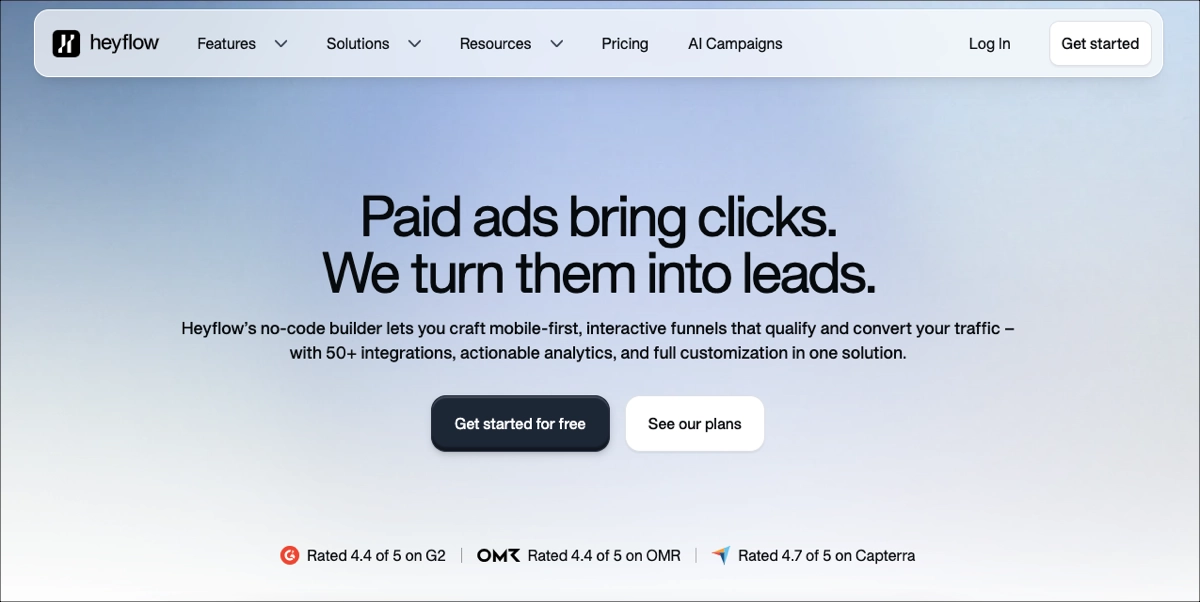
Heyflow works well for interactive forms and supports basic lead capture, but many teams hit limits once they scale campaigns or care about SEO, branding, and predictable pricing.
Below are the main reasons why teams start looking elsewhere.
High and Hard-to-Predict Costs
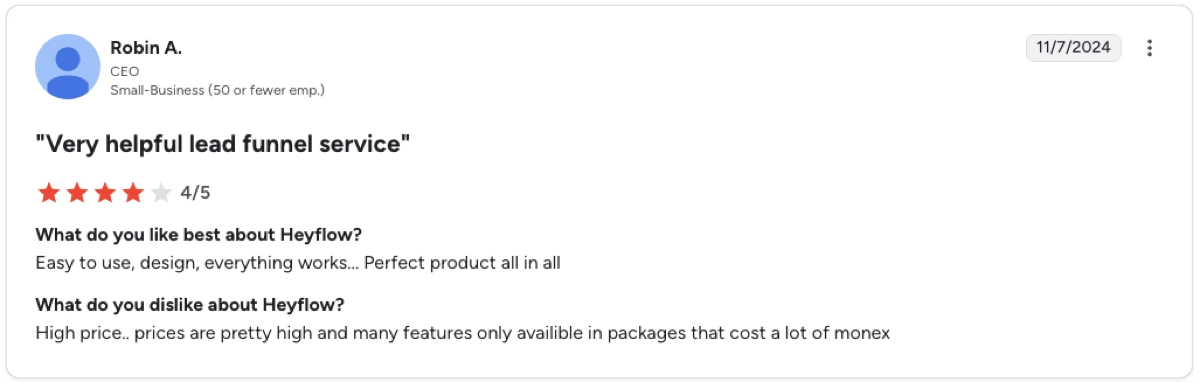
Heyflow’s pricing model is based on monthly responses, not visits. Costs increase quickly, especially when you add required bundles for testing, design control, or integrations. Many users report monthly bills far above the entry price, which makes budgeting difficult.
Limited Design Freedom
Heyflow is not a landing page builder in the classic sense. There is no pixel-perfect editor, no free element positioning, and no layered layouts. This limits brand consistency and makes CRO-focused design work harder for experienced teams.
Key Features Locked Behind Add-ons
Important capabilities like A/B testing, custom CSS, JavaScript, and advanced analytics are not included by default. They are sold as separate bundles, which increases complexity and total cost as your needs grow.
Strong for Forms, Weak for Full Landing Pages
Heyflow excels at interactive forms and quizzes. However, it lacks native thank-you pages, full landing page flexibility, and scalable page management. Teams running full-funnel campaigns often prefer tools built specifically for landing pages, testing, and personalization.
Because of these limits, many marketers, agencies, and SaaS teams move to platforms that offer full design control and clearer pricing – without sacrificing conversion performance.
Take your landing pages with you! We’ll move up to 3 landing pages for free to make switching easy.
What are the best Heyflow Alternatives?
The best Heyflow alternatives are systeme.io, Landingi, and Leadpages. Each replaces interactive funnels with broader landing page and conversion workflows.
| Alternative (Nazwa narzędzia) | Stand-out Feature | Cost (paid plans from) | Free Plan |
|---|---|---|---|
| systeme.io | All-in-one funnels with email & automation | $17/month | Yes |
| Landingi | Pixel-perfect landing pages + scalability | $24/month | Yes |
| Leadpages | Template-based pages with unlimited traffic | $37/month | No |
Each of these tools removes a key friction point users often face with Heyflow – whether that is response-based pricing, limited design control, or add-on–driven feature access. In the next section, we’ll break down how each alternative performs in real use cases and who it fits best.
3 Top Heyflow Alternatives in 2026
The top Heyflow alternatives differ in how they balance simplicity, flexibility, and scale. Some focus on all-in-one convenience, others on landing page performance or enterprise control.
The three tools below stand out because they address the most common limitations teams face with Heyflow: pricing that scales poorly, limited design freedom, and gaps in full-funnel execution. This short list will help you quickly identify which direction fits your needs:
- Systeme.io – best for low-cost, all-in-one funnel execution with minimal setup and predictable pricing
- Landingi – best for scalable lead generation, conversion optimization, and enterprise-grade landing page programs
- Leadpages – best for fast deployment of simple, template-based landing pages without advanced customization
Below, we move from this overview into a detailed, side-by-side breakdown – covering pricing, features, user feedback, and direct comparisons with Heyflow – so you can clearly see where each tool wins and where it falls short.
1. Systeme.io – Budget-Friendly, All-in-One Funnel Platform
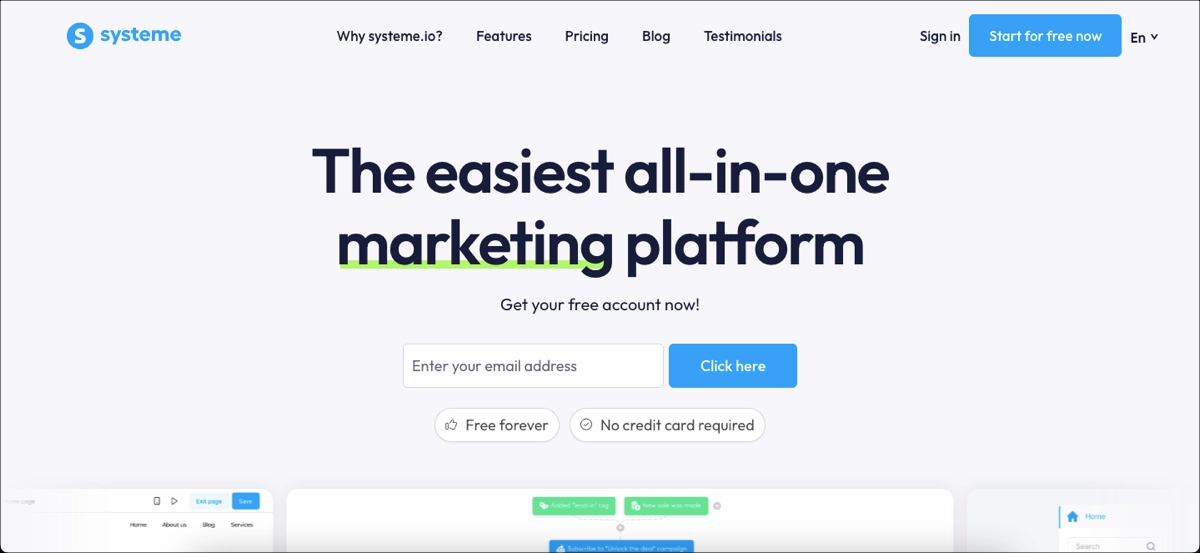
Systeme.io positions itself as a lightweight alternative to complex funnel tools like Heyflow. Instead of focusing on interactive flows or advanced logic, it aims to give small teams everything they need in one place at a very low cost. For many users, the appeal is not depth, but convenience and speed.
Pricing
Pricing is one of the strongest reasons people choose systeme.io. Paid plans start at $17 per month, and the platform also offers a free plan that doesn’t require a credit card. In user reviews, this pricing model is often described as low risk and fair.
Key features
The platform stands out as a cost-effective, scalable alternative to funnel-first tools because it combines multiple core marketing functions into a single system. Instead of focusing on advanced interaction logic, systeme.io prioritizes breadth and accessibility, making it easier for small teams to launch and manage end-to-end funnels without having to stack multiple tools.
Key features in systeme.io include:
- Landing pages, basic websites, and simple blog functionality
- Funnel builder with multi-step flows
- Built-in email marketing with automation rules and tagging
- Course hosting and membership areas
- Native payment processing with Stripe, PayPal, and Apple Pay
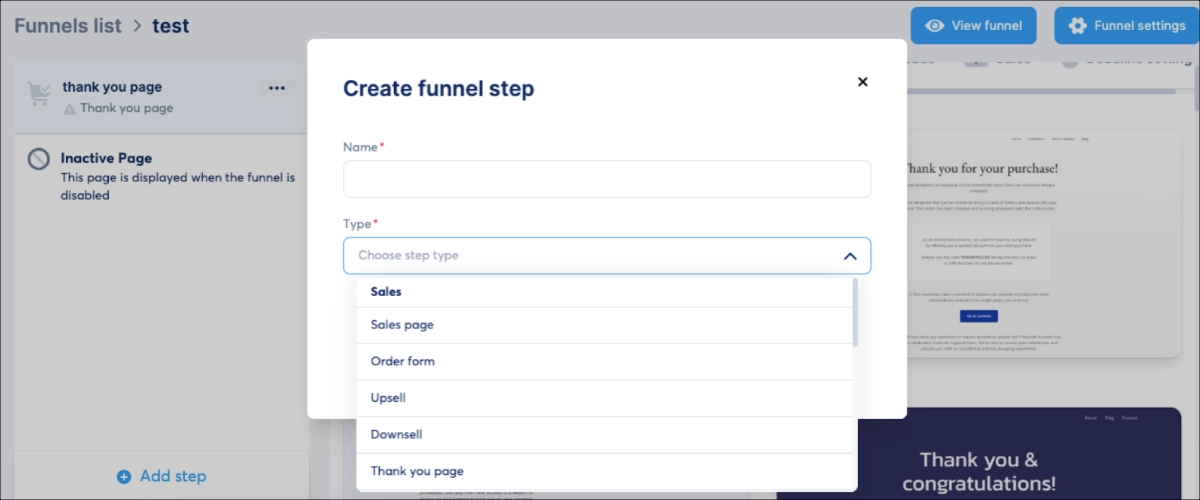
Systeme.io is well-suited for early-stage businesses that need functionality without financial risk. It supports quick launches and experimentation, as long as design precision and advanced optimization are not top priorities.
Ratings
- G2: 4.8/5
- Capterra 4.8/5
- Trustpilot: 4.8/5
What users criticize
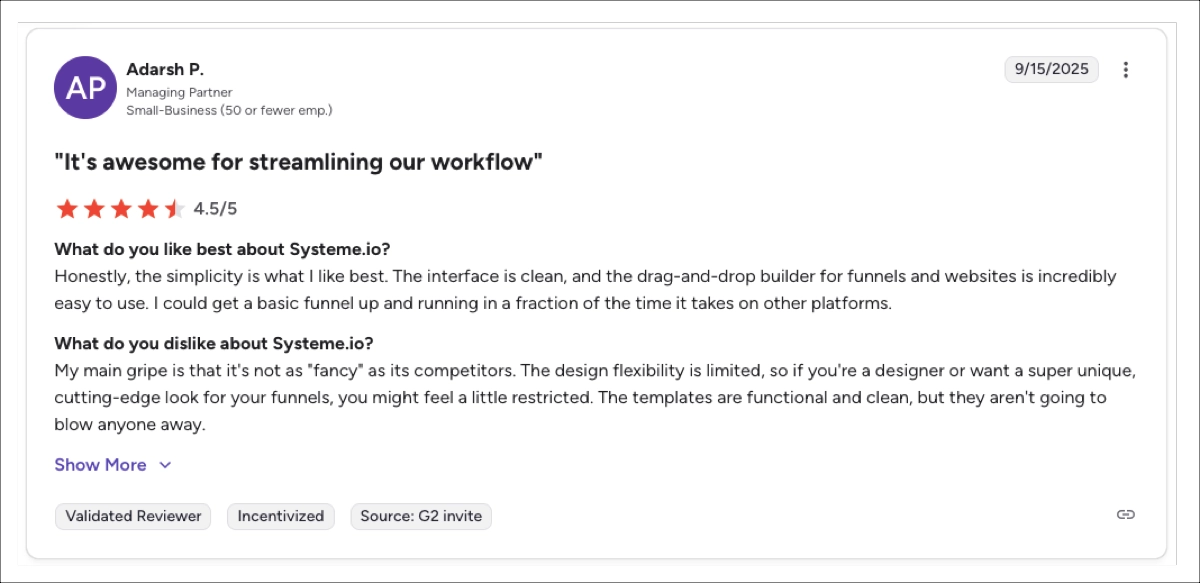
User reviews point out clear limits. The landing page builder is often described as basic or good enough, but not flexible. Users who care about branding, layout precision, or advanced CRO mention frustration with the editor and mobile adjustments. Analytics are also considered shallow, which pushes more advanced marketers to external tools.
What users praise
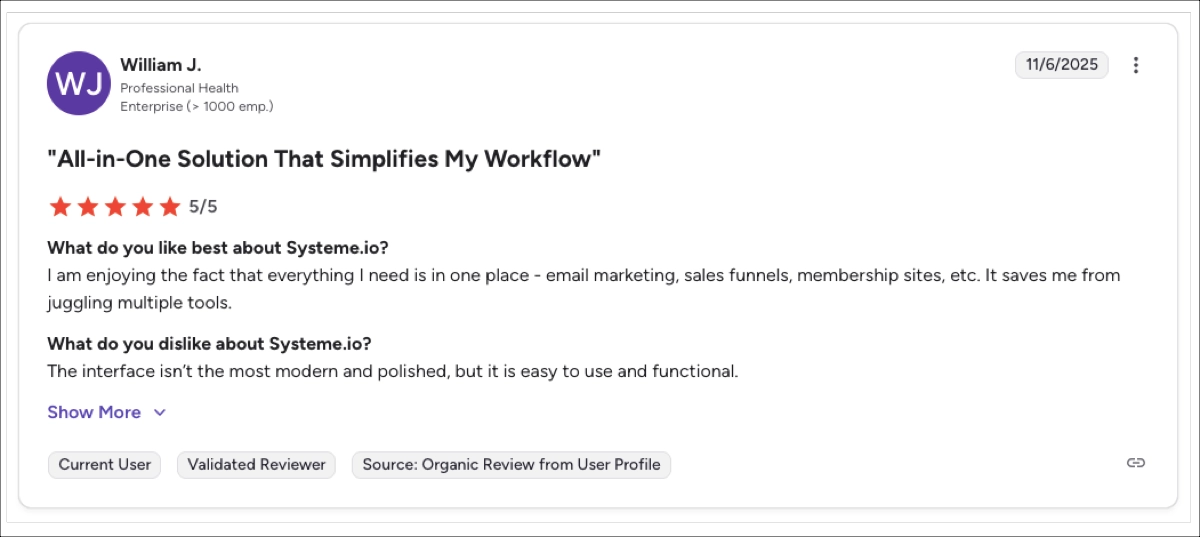
Users appreciate systeme.io for simplifying their workflow. Many mention that being able to manage funnels, emails, payments, and digital products in one system saves time and reduces tool sprawl. Setup is frequently described as fast, and templates are seen as practical rather than flashy.
Our take
From a practical standpoint, systeme.io works best when cost and simplicity matter more than design freedom. As a Heyflow alternative, it replaces interactive forms with broader funnel coverage, but it doesn’t aim to compete with specialized landing page platforms.
Systeme.io vs. Heyflow: Which One’s for You?
The comparison below highlights how systeme.io and Heyflow differ:
| Feature | Heyflow | systeme.io |
|---|---|---|
| Starting price | €49 | $17 |
| Free plan | No, 14-day trial only | Yes |
| Design freedom | Low | Medium |
| Email marketing | No | Yes |
| Best for | Interactive forms | Small all-in-one setups |
Compared to Heyflow, systeme.io trades advanced interactive logic for broader functionality at a much lower cost. It’s better suited for users who want a complete funnel setup with email, payments, and automation included, without worrying about response-based pricing. Heyflow remains stronger for complex, conversational forms, but systeme.io is the better choice for lean teams that want simplicity and predictable costs.
2. Landingi – Landing Page Automation Platform
Landingi is a dedicated landing page automation platform built for teams that need control, testing depth, and scalability. Unlike Heyflow, which centers on interactive forms, Landingi focuses on full landing pages designed for paid traffic, SEO, and long-term optimization.

Pricing
Landingi pricing starts at $24 per month for the Lite plan (annual billing), $57 for the Professional plan, and $1,150 for the custom Enterprise plan. In user opinions, this pricing is often described as predictable and easier to plan around than response-based models. Teams appreciate that higher traffic or conversion volume does not automatically increase costs. Landingi also offers a Free plan for users who need fewer landing pages, plus a 14-day free trial for anyone wanting to test the platform’s capabilities before committing.
Key features
Landingi stands out by treating landing pages as a scalable system rather than isolated assets. The platform is designed to support continuous testing, personalization, and cross-team collaboration.
Key features in Landingi include:
- Pixel-perfect drag-and-drop builder with full layout control
- Separate mobile view editor
- AI landing page tools for layout and copy generation, SEO, and image improvements
- Form Builder, Pop-up Builder, Lightboxes
- Server-side A/B testing and experimentation
- Automatic translation supporting 35+ languages
- Dynamic Text Replacement
- Smart Sections
- EventTracker for detailed behavior analysis
- Programmatic Landing Pages for large-scale campaigns
- Advanced integrations, webhooks, and custom scripts

Landingi allows teams to build and optimize landing pages without relying on coding knowledge, while still offering advanced functionality for more demanding use cases. It supports the full lead generation process, from traffic acquisition to post-click optimization, and gives marketers the tools needed for systematic conversion optimization through testing and personalization.
Detailed analytics, including event-level tracking, help teams understand not just what converts, but how users behave across each page. This combination makes Landingi suitable for both everyday campaign work and more complex setups that require precision, scale, and deeper insight.

Enterprise teams choose Landingi because it supports real operational scale, not just higher traffic limits. The platform is built to fit into structured marketing organizations, with secure access through Enterprise SSO, full visibility via audit logs, and controlled collaboration using team workspaces and granular permissions.
Advanced tracking with EventTracker gives teams insight into how users actually interact with pages, not just whether they convert. Custom integrations, reverse proxy publishing, and strict compliance with GDPR, WCAG, and DORA make Landingi suitable for regulated industries and SEO-sensitive deployments. These capabilities turn Landingi from a landing page builder into a reliable infrastructure layer for enterprise-level growth.
Explore all enterprise-level features Landingi offers. Make your platform decision with full clarity.
Landingi is best suited for agencies, SaaS companies, and enterprises that rely on landing pages as a core growth channel. It replaces Heyflow’s funnel-first approach with a more flexible system built for scale.
Ratings
- G2: 4.5/5
- Capterra: 4.8/5
- Trustpilot: 4.4/5
What users criticize
Criticism tends to focus on complexity rather than missing features. Some users note that mobile views require manual adjustments and that large projects can feel demanding at first. For smaller teams, the learning curve may feel steep. For experienced marketers, these trade-offs are usually acceptable.

What users praise
Across G2, Capterra, Trustpilot, and industry discussions, users frequently highlight design freedom as Landingi’s biggest advantage. The pixel-perfect editor is praised for enabling precise layouts that align with brand guidelines and CRO best practices. Agencies often mention that this level of control is critical when running campaigns for multiple clients. EventTracker is often seen as a differentiator, giving teams insight into real user behavior beyond simple conversion rates.

Our take
Landingi stands out as the strongest option for teams that take lead generation and long-term conversion optimization seriously. Its biggest advantage is the balance between power and accessibility: marketers can build advanced, high-performing pages without coding, while still having access to detailed analytics and advanced functionality when campaigns demand greater depth. The main trade-off is complexity – new users may need time to learn the platform. For teams that value control, testing, and scalability over speed alone, this trade-off is usually worth it.
Landingi vs. Heyflow: Which One’s for You?
Here’s how Landingi and Heyflow stack up against each other:
| Feature | Heyflow | Landingi |
|---|---|---|
| Starting price | €49 | $24 |
| Free plan | No, 14-day trial only | Yes; + 14-day trial |
| Design control | Low | Pixel-perfect |
| A/B testing | Paid add-on | Included |
| Enterprise features | Limited | Extensive |
Landingi differs from Heyflow by focusing on full landing pages rather than interactive flows. It offers significantly more design freedom, SEO-safe publishing, and deeper testing and analytics capabilities. Heyflow performs well for form-heavy, logic-driven experiences, while Landingi is the better option for teams running scalable lead-generation campaigns and needing long-term conversion optimization.

3. Leadpages – Simple Builder for Fast, Template-Based Pages
Leadpages is a landing page builder focused on speed and simplicity. It relies heavily on pre-built templates and a structured editor to help users publish pages quickly, even with limited technical experience.

Pricing
Paid plans start at $37 per month, with no free plan available. In user reviews, pricing is often described as acceptable for small projects but less competitive compared to newer tools offering more flexibility. Billing practices appear frequently in negative feedback, especially around renewals and cancellations.
Key features
Leadpages helps users publish pages that convert leads with minimal setup and decision-making. Its templates and built-in elements are designed to support high-converting forms without requiring advanced configuration or experimentation. This approach works well for straightforward campaigns where speed matters more than fine-grained control, but it leaves little room for tailoring page behavior beyond the basics.
Key features in Leadpages include:
- Large library of ready-made landing page templates
- Drag-and-drop editor with grid-based layout rules
- Unlimited traffic and lead collection on all plans
- Built-in pop-ups and alert bars
- A/B testing (available on higher-tier plans)
- Basic lead management and integrations
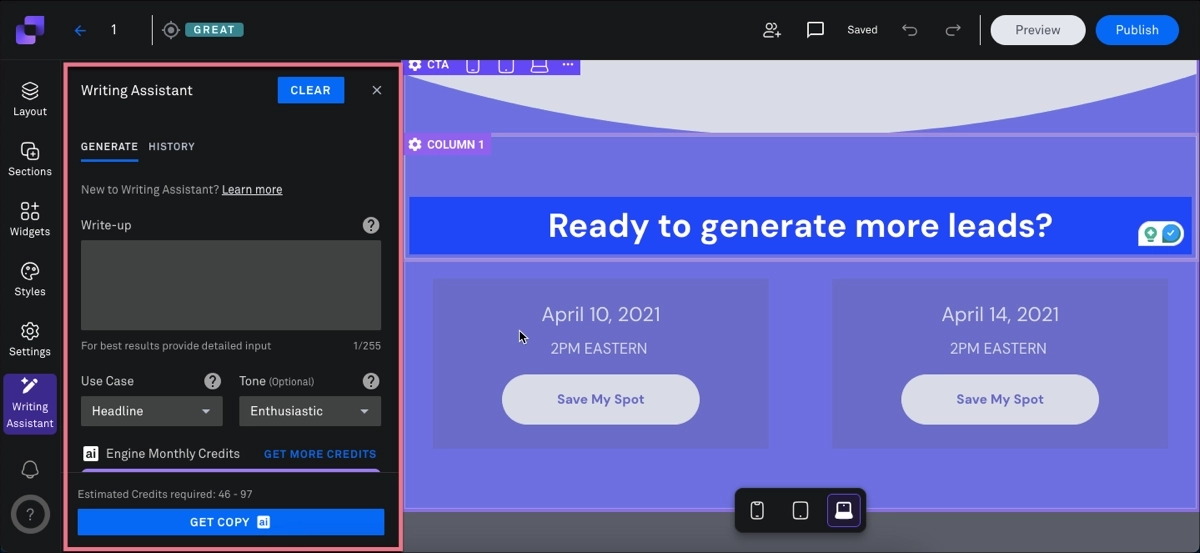
From an optimization perspective, Leadpages offers limited visibility into lead quality and relies on external tools for deeper insight. There is no detailed funnel analytics layer inside the platform, and most post-conversion workflows depend on CRM systems connected through direct integrations. This makes Leadpages less effective for teams that need richer data, tighter feedback loops, or more advanced optimization workflows.
Therefore, Leadpages is best for freelancers and small businesses looking to quickly launch simple landing pages. As a Heyflow alternative, it replaces interactive funnels with static pages but offers limited room for experimentation or long-term scaling.
Ratings
- G2: 4.3/5
- Capterra: 4.6/5
- Trustpilot: 2.8/5
What users criticize
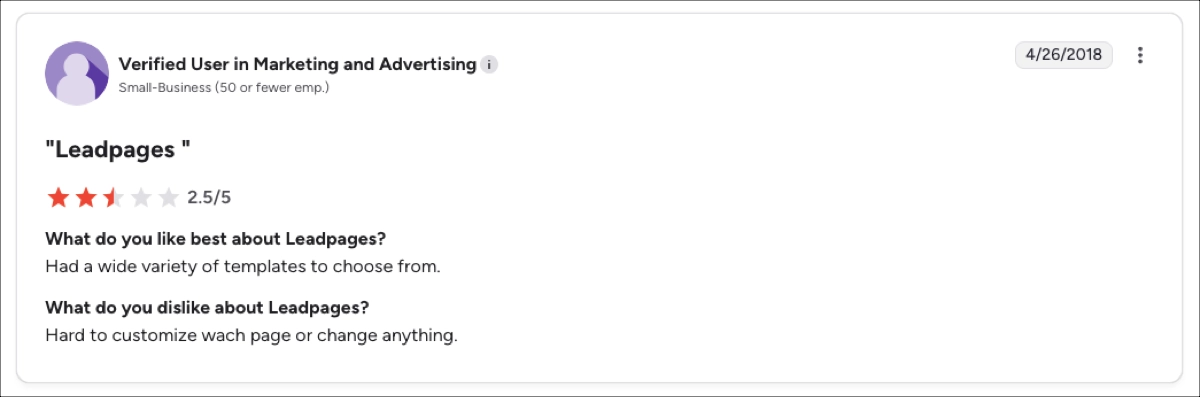
User opinions consistently point to limitations in customization. The grid-based landing page editor limits layout flexibility, frustrating users who want precise control or advanced testing. Marketers often describe Leadpages as suitable only for simple campaigns. Support quality is another recurring theme. While some users report helpful responses, others mention slow turnaround times and difficulty resolving billing issues.
What users praise
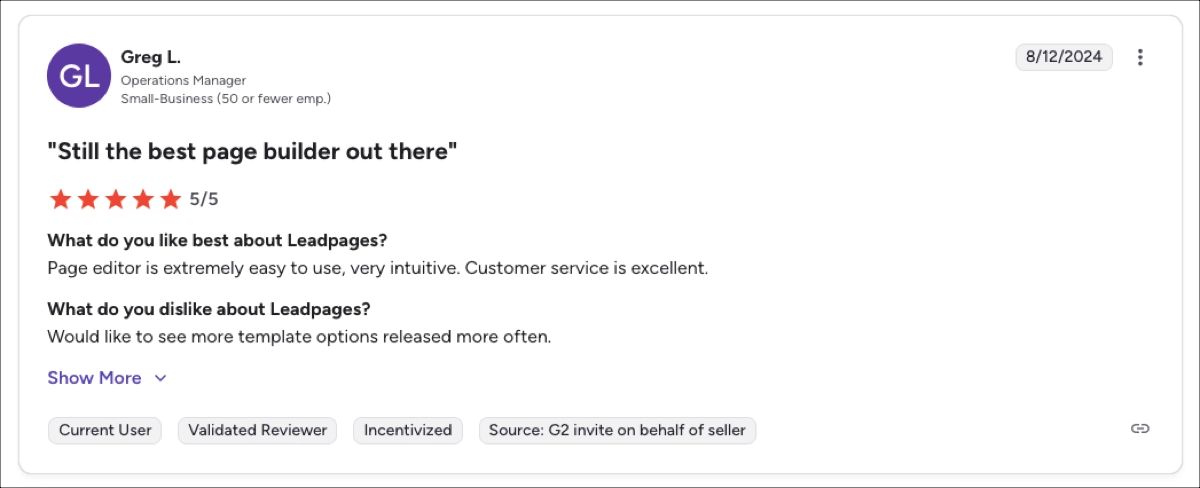
Users often praise Leadpages for its ease of use and quick learning curve. Templates are described as clean and conversion-focused, and many beginners appreciate being able to launch pages without design skills. Platform stability and page loading speed are also mentioned positively.
Our take
Leadpages is a practical choice for users who want to launch landing pages quickly with minimal setup and decision-making. Its main strength is ease of use: templates, hosting, and basic conversion tools work out of the box without requiring design or technical skills. However, as campaigns grow more complex, the rigid editor, basic testing, and slow product development become noticeable constraints. For freelancers and small businesses running simple, short-term campaigns, Leadpages does the job. For teams focused on ongoing conversion optimization and scalability, it tends to feel restrictive.
Leadpages vs. Heyflow: Which One’s for You?
Below is a comparison highlighting the key differences between Leadpages and Heyflow:
| Feature | Heyflow | Leadpages |
|---|---|---|
| Starting price | €49 | $37 |
| Free plan | No; 14-day trial only | No; 14-day trial only |
| Design freedom | Low | Low |
| Templates | ~35 | 260+ |
| Best for | Funnels | Simple pages |
Leadpages takes a simpler, template-first approach compared to Heyflow’s interactive funnels. It is easier to use for quick page launches and does not rely on response-based pricing, but it lacks advanced logic and customization. Heyflow is better for interactive lead capture, while Leadpages works best for basic campaigns where speed and ease of use matter more than flexibility.
Choose the Best Heyflow Alternative
The best Heyflow alternative depends on your lead generation priorities. Leadpages fits scenarios where speed trumps flexibility, and you’re building straightforward, template-based campaigns, while systeme.io works best for replacing multiple tools with a single, low-cost funnel setup focused on simplicity.
However, if landing page performance, design control, and scalable growth are your priorities, Landingi is the strongest alternative.
Unlike Heyflow’s form-first model, Landingi is built specifically for landing page optimization. It combines drag-and-drop precision, server-side A/B testing, deep analytics through EventTracker, and bulk page generation (no coding required). You also avoid Heyflow’s response-based pricing and iframe publishing issues, getting predictable costs and full control instead.
For teams and agencies seeking flexibility without sacrificing control, Landingi delivers the most effective long-term solution. It empowers marketers to build, test, and optimize at scale – without forcing them into a generic funnel builder that wasn’t designed for landing page excellence. Try Landingi now and start building landing pages built for results, not restrictions.