
Behavioral advertising is a type of online advertising that delivers ads based on what users actually do, not who they are. It uses signals like browsing history, clicks, product views, and past purchases to show highly relevant ads to people most likely to act.
It’s a proven strategy. According to ConsultTV, behavioral ads often achieve click-through rates 2–3× higher than non-targeted display ads, with conversion rates improving by up to 50% in personalized campaigns. The average ROAS is 4–5×, especially when first-party data is used in a privacy-conscious setup.
Key takeaways:
- Behavioral advertising relies on real-time user behavior, not demographics
- It powers high-impact strategies like retargeting, product recommendations, and dynamic ads
- Online behavioral advertising drives stronger engagement, higher CTRs, and better ROI
- Success depends on relevance and landing pages play a key role in converting clicks
Want to see how it works in practice and how to apply it in your own campaigns? Let’s read the full article.

What is Behavioral Advertising?
Behavioral advertising (also called online behavioral advertising or “OBA”) is a marketing method that shows ads based on users’ past online behavior, not general traits like age or location. It uses data such as pages viewed, products clicked, or apps used to serve ads that match real interest or intent.
If you’ve ever looked at a pair of shoes and then seen ads for that exact pair on other websites, that’s behavioral targeting in action. Platforms track user behavior (often through cookies or mobile activity) and group people by similar patterns. The goal is to show ads that feel relevant and timely, which increases the chance of engagement or purchase.
What are the Benefits of Behavioral Advertising?
The benefits of behavioral advertising include better targeting precision, more relevant ads, and higher conversion potential, all driven by real user actions and preferences. Unlike broad, generic campaigns, behavioral targeting uses data to serve content that people actually want to see.
Here’s, step by step, how it brings value to both users and advertisers:
1. More relevant offers for consumers
Behavioral advertising stands out because it focuses on personal relevance. It uses data from browsing habits, app usage, and other user actions to show ads that match real interests. This leads to a more useful and less intrusive ad experience.
2. Higher efficiency in online shopping
When someone sees an ad for a product they’ve already shown interest in, the path to purchase gets shorter. They can click the ad and go directly to the product page, instead of searching again. This makes the entire shopping process faster and smoother.
3. Better retargeting options
Behavioral retargeting helps reach people who’ve already interacted with a brand, for example, by visiting a site or abandoning a cart. These ads can remind users about unfinished purchases, new offers, or product updates, helping them stay connected with what matters to them.
4. Improved campaign performance
Because behavioral ads are more relevant, they tend to get better results: higher CTRs, stronger engagement, and more conversions. This means advertisers can track clear metrics and optimize campaigns based on what actually works.
Table: Benefits of Behavioral Advertising
| Benefit | What It Means | Why It Matters |
|---|---|---|
| More Relevant Offers | Ads reflect actual user interests and browsing behavior | Increases ad engagement and improves UX |
| Efficient Shopping Journeys | Users get directed to products they already want | Reduces friction in the path to purchase |
| Better Retargeting | Ads remind users of what they already liked or explored | Re-engages high-intent audiences |
| Improved Campaign Metrics | Higher CTRs, conversions, and ROI from personalized targeting | Maximizes marketing performance and ad spend efficiency |
How to Implement Behavioral Advertising into a Marketing Strategy?
To implement behavioral advertising into your strategy, start by collecting user behavior data, segmenting your audience, and delivering relevant ads based on patterns you identify. The process isn’t complicated, but it does require consistency and the right tools.
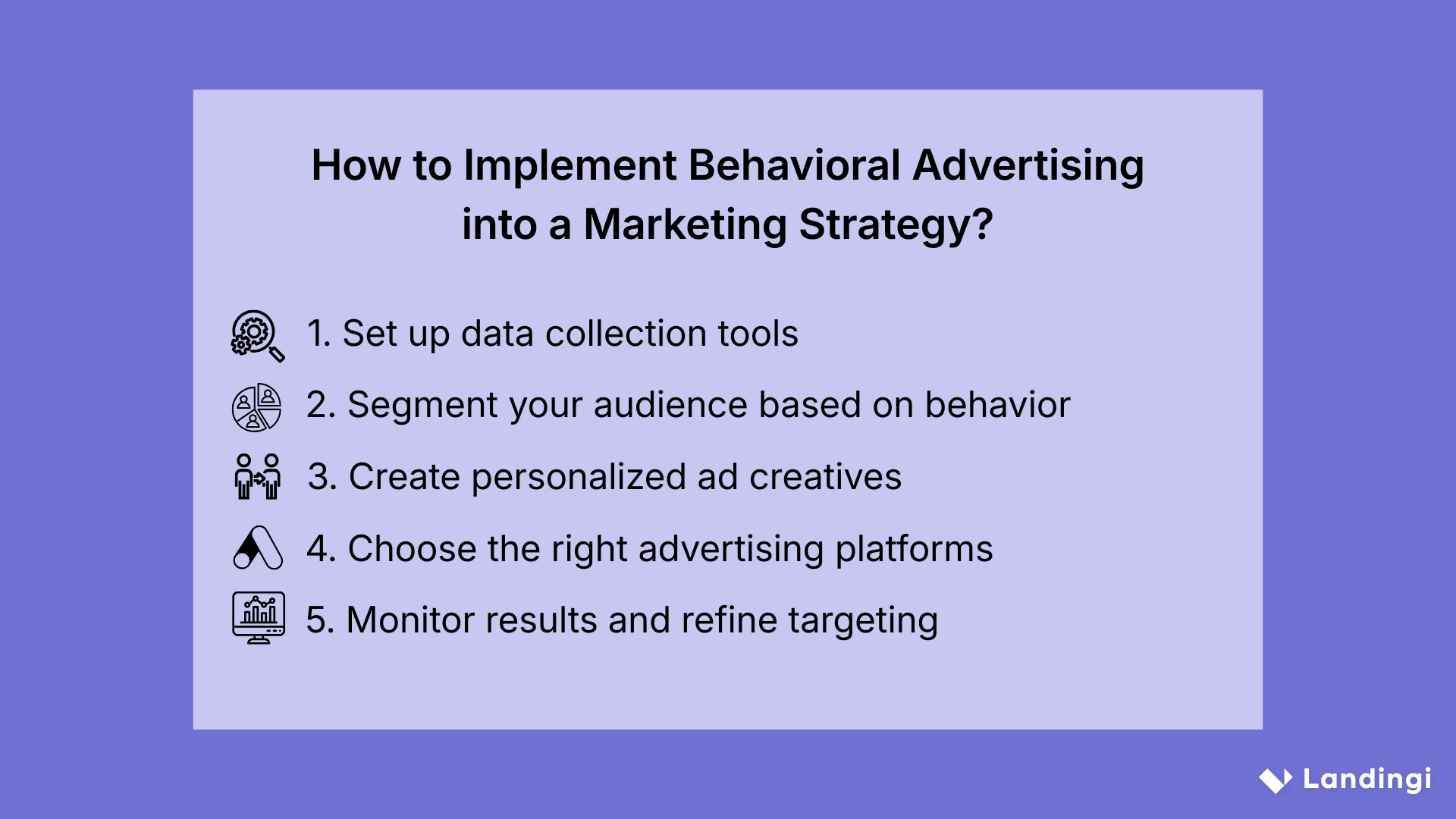
Here’s how to do it, step by step.
1. Set up data collection tools
Behavioral advertising begins with data, and that means tracking. Use analytics platforms, pixels, and cookies to monitor how users interact with your website, product pages, or app. Focus on actions like time on page, clicks, cart behavior, and search queries. The more signals you gather, the more accurate your targeting will be.
2. Segment your audience based on behavior
Once you have the data, divide users into segments. These can be based on past purchases, product views, content consumed, or browsing frequency. For example, frequent shoppers, cart abandoners, or people who visited a specific service page but didn’t convert. Behavioral targeting works best when each segment reflects a clear pattern.
3. Create personalized ad creatives
Use what you know about each segment to design ads that speak to their current interests or intent. Someone who browsed gift ideas for Mother’s Day should see different content than someone comparing software plans. The key is to match the message to the moment.
4. Choose the right advertising platforms
Behavioral advertising can run on various platforms, including Google Ads, Meta (Facebook and Instagram), and programmatic ad networks. Each platform has its own way of building audiences based on behavior, so match your setup with your goals and audience habits.
5. Monitor results and refine targeting
Track performance by looking at metrics like CTR, conversion rate, and bounce rate. Test new segments, adjust creative, and keep refining.
This approach ensures that your ads stay relevant, timely, and aligned with what your audience actually wants, not what you assume they want.
3 Successful Examples of Behavioral Advertising
Behavioral advertising utilizes real user actions to serve highly personalized ads. When done right, it consistently delivers better engagement, higher CTRs, and stronger conversions compared to broad or demographic-based targeting.
Below are real-world behavioral advertising examples showing how brands turn behavioral data into performance.
1. Neutrogena – Product Pairing Ads
Neutrogena noticed something interesting in their online shopping data: most customers were buying just one type of product, such as a cleanser, and then moving on. But what if those same people could be nudged gently into discovering something else they’d actually need?
The brand dug into past purchase behavior. It turns out that shoppers who bought cleanser often needed eye makeup remover as well. So Neutrogena built smart product pairings based on real buying patterns and turned them into banner ads and short videos. Each ad highlighted the perfect match, included helpful info, and a coupon to sweeten the deal.

These ads weren’t sprayed to everyone. They were shown only to users whose carts had told the same story in the past. The outcome: a £5.84 ROAS and a performance spike 289% above Neutrogena’s benchmarks. Proof that behavioral advertising works best when it’s built on real habits, not assumptions.
2. Netflix
Netflix doesn’t just serve content; it serves you content you didn’t know you were craving. Every time you binge, pause, or skip a show, that data becomes part of a quiet conversation between you and the platform.

Using behavioral advertising logic, Netflix analyzes viewing history to curate ultra-personalized show recommendations. Maybe you’re into slow-burn thrillers or comfort sitcoms – whatever your pattern, the homepage adjusts in real time to reflect it. By turning passive behavior into highly tailored content suggestions, Netflix increases engagement, strengthens retention, and keeps users coming back, episode after episode.
3. Timberland – Real-World Foot Traffic from Digital Behavior
Timberland had a clear goal: bring a younger crowd into their physical stores. But instead of blasting generic ads, they leaned into behavioral advertising to reach people who were not just interested in shoes, but actually ready to buy.

Using a mix of data, Timberland identified users who had recently visited similar retail locations or were physically near a Timberland store. With that info, they created precise digital boundaries (called geofences) around store locations and targeted ads to people likely in the footwear-buying mindset.
It paid off. The campaign drove a 6.2% lift in store visits, and impressively, 1 in 5 people who saw the ad showed up within 24 hours.
10 Proven Behavioral Advertising Strategies & Best Practices
Below are 10 practical and proven examples of online behavioral advertising in action. Each one shows how targeted advertising based on user data can drive better results across platforms.
1. Website retargeting with product-specific ads
Advertisers track users who visited specific product pages and show dynamic ads for those exact items across websites and apps.
Example: A user browses a home decor site, views a rug, then sees that same rug in an Instagram ad later that day.
This behavioral retargeting tactic often lifts conversions by over 70%, according to Divimode.
2. Email campaigns triggered by behavioral segmentation
Audience segmentation by actions like cart abandonment or repeat visits can trigger automated, personalized emails.
Example: A deal seeker adds an item to cart but leaves and gets an email 30 minutes later with a 10% discount.
3. Social media targeting based on engagement
Behavioral targeting works on platforms like Facebook and TikTok by building custom audiences based on user behavior: likes, comments, video views.
Example: A user watches 80% of a product demo video and later receives a targeted ad with a free trial CTA.
4. Personalized recommendations using purchase history
Retailers analyze purchase intent and past behaviors to recommend complementary products.
Example: A frequent shopper buys baby products, and next week sees relevant ads for new parent services.
5. Geo-behavioral targeting for localized offers
Combining app usage and location data allows advertisers to serve timely, location-based deals.
Example: A user near a competitor’s store sees a coupon for your product while browsing nearby.
6. Exit-intent popups based on mouse movement
Some websites track cursor behavior and display offers as users attempt to leave.
Example: A pop-up with a 15% discount appears just before a user closes the tab, creating a sense of urgency.
It’s a simple form of behavioral advertising that can reduce bounce rate and boost sales.
7. Real-time social proof to reinforce behavior
Showing user behavior publicly can influence purchase decisions through FOMO.
Example: “Emma in Austin just bought this item” notifications appear while users browse a product page.

8. Targeting based on content consumed
Behavioral segmentation can also be based on blog reads, video views, or visited categories.
Example: A user reads two articles about home workouts, then sees ads for fitness equipment.
9. Cart abandonment ad sequences
Advertisers run multi-step ad campaigns based on how far a user has gone in the purchase funnel.
Example: Day 1 – remind user about the cart. Day 3 – add a discount. Day 5 – use urgency (“only 2 left”).
10. Machine learning for predicted behavior
AI analyzes large-scale user data to predict which ads and formats will perform best, and automatically adjusts targeting accordingly.
Example: Google Ads Smart Bidding adjusts spend in real time based on conversion likelihood.
What are the Popular Platforms for Behavioral Advertising?
The most popular platforms for behavioral advertising include Google Ads (DV360), Meta Ads (Facebook/Instagram), LinkedIn Ads, Amazon Advertising, and The Trade Desk. Emerging players like Criteo and AdForm are also gaining traction, especially in e-commerce and privacy-first environments.
Each platform offers unique ways to serve relevant ads based on user behavior, purchase intent, or cross-channel activity. Google leads in search queries and browsing history across the web. Meta dominates social engagement, while LinkedIn is best for B2B audience segmentation. Amazon leverages real-time shopping behavior, and The Trade Desk enables targeted advertising based on shared behaviors and demographics. Tools like Criteo and AdForm extend capabilities with behavioral retargeting, AI-driven insights, and support for data security and cookie-less tracking, all crucial for consistently reaching potential customers.
Should I Use Behavioral Advertising as a Marketing Expert?
Yes, you should use behavioral advertising as a marketing expert if your goal is performance. It delivers significantly better ROI than broad targeting, often increasing conversions 3–10x by focusing on users’ real actions like page views, cart activity, or past purchases. As a marketing expert working with PPC and landing pages, you should adopt it strategically, following privacy-first principles aligned with GDPR, CCPA, and upcoming 2025 regulations.
| Use Behavioral Advertising If… | Avoid It If… | |
|---|---|---|
| Audience Type | You’re targeting high-intent users, frequent shoppers, or SaaS buyers based on browsing habits and search queries. | You’re in a low-traffic niche or handle sensitive data (e.g., health, finance). |
| Budget Level | You have $5K+ monthly for testing campaigns across Meta, Google, or TikTok. | Your ad spend is under $1K/month — contextual ads may offer better ROI. |
| Compliance Setup | You use consent tools, limit data collection, and review privacy settings regularly. | You don’t have clear data governance or attract mostly EU traffic. |
| Campaign Goals | You’re focused on performance marketing — CTRs, ROAS, and lead volume. | Your goal is pure brand awareness or reach-only campaigns. |
If you specialize in PPC, this approach ensures stronger connections, higher relevance, and better conversion rates, especially when paired with landing pages built for behavior-driven traffic. Start by testing behavioral segments on Google or Meta, then align your messaging with the exact user actions tracked.
What are the Popular Companies that Offer Behavioral Advertising Services?
Popular companies offering behavioral advertising services in 2025 include top tech platforms like Criteo, The Trade Desk, Google DV360, Adobe Advertising Cloud, and MediaMath, all leveraging user behavior, search queries, and browsing history to deliver relevant ads across channels. Leading performance agencies such as MuteSix, NoGood, Disruptive Advertising, Tinuiti, and inBeat specialize in behavioral targeting on platforms like Meta and Google, combining data-driven segmentation with landing page optimization and privacy-compliant practices.
For marketers focused on performance, Landingi plays a crucial role by helping create high-converting landing pages tailored to behavioral segments, ensuring that every click from targeted ads leads to a page built to convert.
Programmatic Landing Pages let you generate personalized pages at scale so every behavior‑driven segment feels uniquely addressed.
What is the Difference between Behavioral Advertising and Contextual Advertising?
Behavioral advertising targets users based on their past actions, such as browsing history, search queries, or purchases, while contextual advertising delivers ads based on the content of the page a user is currently viewing, without collecting personal data.
Behavioral advertising relies on cookies or tracking pixels to follow users across websites and show relevant ads based on behavior. Contextual ads use keywords or page topics to match ads in real time, making them a strong option for privacy-compliant campaigns in 2025.
| Aspect | Behavioral Advertising | Contextual Advertising |
|---|---|---|
| Data Used | User data like search queries, browsing history, purchases | Page content, keywords, and topics |
| Targeting Focus | Personalization based on past behaviors | Relevance based on current page context |
| Privacy Impact | Requires cookies/tracking; regulated under GDPR/CCPA | Cookie-free and compliant with privacy laws |
| Relevance Type | High personalization, but can lead to ad fatigue | Matches user mindset in real time; brand-safe |
| Performance | Up to 70% higher conversions in retargeting campaigns | Boosts purchase intent by 63% in studies |
Online behavioral advertising works best for e-commerce and SaaS campaigns where retargeting and lifecycle-based ads (like abandoned cart reminders) matter most, especially on platforms like Meta and Google Ads. Contextual advertising is ideal for privacy-first campaigns and pairs well with landing pages that convert without relying on personal data. The most effective marketers combine both methods to reach new audiences, deliver relevant offers, and maximize ROAS across the funnel.
What is the Use of Landing Pages in Behavioral Advertising?
Landing pages are essential in behavioral advertising because they convert targeted ad clicks into actions. They act as the destination for users who’ve already shown interest through specific behaviors and are designed to match that intent with a focused, relevant experience.
When done right, a landing page continues the conversation started by the ad. For example, if a user saw a targeted ad for a limited-time offer on a product they previously viewed, the landing page should highlight that exact offer, product, or solution. This approach ensures message match, improves trust, and boosts conversion rates across behavioral campaigns.
Create Effective Landing Pages for your Behavioral Advertisements
To get the most out of behavioral advertising, your landing page needs to be just as targeted as your ad. Whether you’re running online behavioral advertising campaigns through Google, Meta, or programmatic platforms, what happens after the click is just as important as the ad itself. A well-designed landing page bridges the gap between user intent and action and often determines whether a visit turns into a conversion.
The most effective behavioral advertising examples pair targeted ads with landing pages that reflect the user’s behavior, like viewed products or abandoned carts, and guide them toward a clear action. Without that alignment, even the best targeting loses impact.
Landing pages turn intent into results. With a platform like Landingi, you can quickly build conversion-focused pages that match behavioral segments and boost the performance of every campaign. Try out now!