
Google Ads and Microsoft Advertising (formerly Bing Ads) dominate search advertising, with Google holding approximately 82% of global search ad revenue share and Microsoft at 12% as of 2025 benchmarks. Choosing the right platform for your digital advertising strategy can boost ROI by up to 3x depending on your niche.
In this article, we compare Google Ads vs. Bing Ads based on market share, audience, features, and performance across industries. We’ll also break down advertising costs using current CPC data to help you decide which platform suits your business goals and budget.
What is Google Ads?
Google Ads is an online advertising platform developed by Google that allows businesses to display ads across its search engine and partner sites. Google defines the platform as a program enabling advertisers to create online ads to reach people exactly when they’re interested in the products and services that you offer.
The platform supports both search and display advertising with extensive reach. Ad placements appear in Google search results, on YouTube, in Gmail, and across over 2 million websites in the Google Display Network. This broad distribution allows businesses to connect with potential customers at multiple touchpoints throughout their online journey.
Google Advertising operates on a pay-per-click (PPC) model, where advertisers bid on keywords and pay only when users click their ads. Through Google Search, advertisers reach users actively searching for specific terms – capturing high-intent traffic at the moment of interest. Meanwhile, the Google Display Network enables broader audience reach through visual banners and video formats, ideal for building awareness and retargeting.
Google Ads typically serves a variety of goals – ranging from increasing website traffic and generating leads to promoting brand awareness and driving online sales. The platform includes tools for performance tracking, A/B testing, and campaign optimization, making it suitable for both small businesses and large enterprises.
Your ads drive traffic – Landingi turns it into leads and sales. Start building today!
What is Bing Ads?
Microsoft Advertising, formerly Bing Ads, is a digital advertising platform that enables businesses to display paid ads within the Bing search engine and across partner sites. Microsoft defines it as a pay-per-click (PPC) advertising platform used to display ads based on the keywords used in a user’s search query.
The platform allows advertisers to reach users through multiple channels. Microsoft ads appear in search engine results and across the display network, including MSN, Outlook.com, and other Microsoft-owned properties. Businesses can create various ad formats – text ads, shopping ads, or responsive ads – and target audiences by location, demographics, or device type.
Bing’s market share in global search engines was approximately 4.03% as of Q4 2025, according to StatCounter. While smaller than Google’s, it reaches a distinct audience segment, especially in the U.S., where its desktop market share exceeds 6%.
Microsoft Advertising enhances campaign management with advanced reporting, keyword planning tools, and unique integration with LinkedIn profile data for refined targeting.
Different platforms, same goal: conversions. Create ad-ready landing pages with Landingi.
6 Key Differences Between Google Ads and Bing Ads
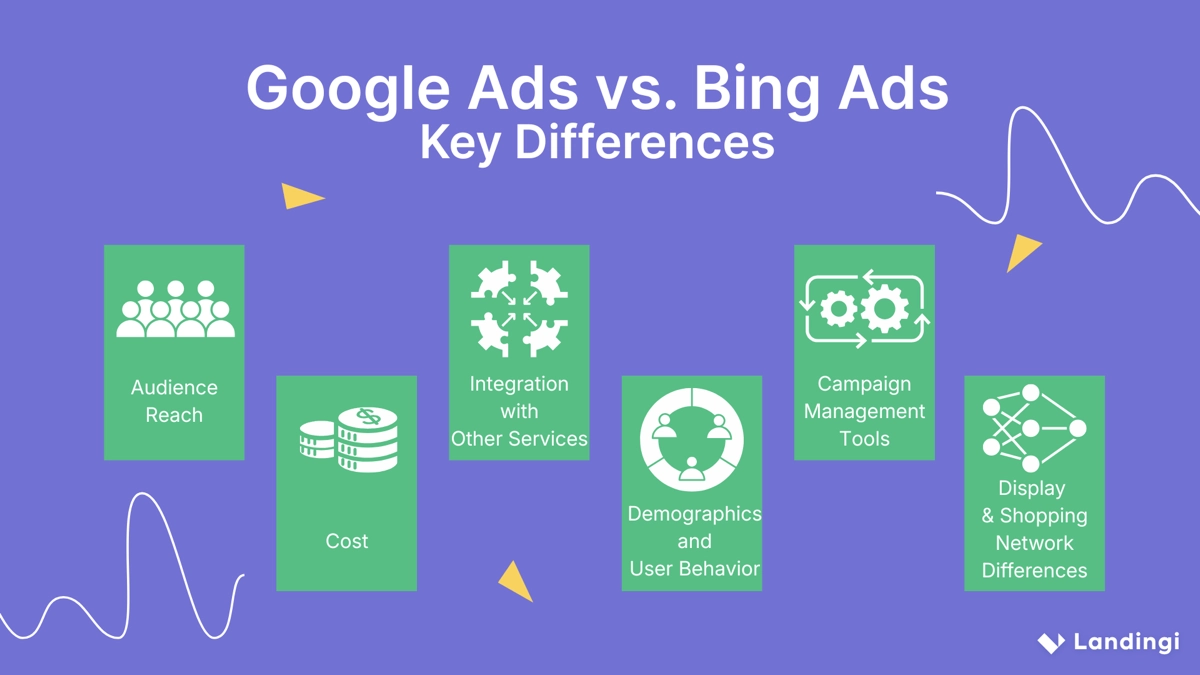
While Google Ads and Microsoft Advertising (formerly Bing Ads) operate on similar pay-per-click models, they differ significantly in reach, audience composition, cost structure, and platform capabilities. Understanding these distinctions helps you make informed decisions about where to allocate your advertising budgets.
1. Audience Reach and Market Share
Google Ads dominates the search advertising market. As of Q4 2025, Google controls 90.83% of the global search engine market according to StatCounter, while Bing holds approximately 4.03%. This substantial difference means ads on Google typically generate significantly higher impressions and clicks due to the platform’s broader user base and search volume.
2. Cost
The cost advantage often favors Microsoft Advertising. According to PPLE Labs, advertisers on the platform pay approximately 20-30% less per click, on average, than in Google Ads. For businesses with limited budgets or those seeking to maximize ROI through lower acquisition costs, this difference can be substantial and may justify testing Bing despite its smaller reach.
3. Demographics and User Behavior
Bing’s audience profile differs notably from Google’s in ways that benefit certain advertisers. According to Microsoft’s internal data, 73% of Bing users are under 45, and 41% of US users earn over $100,000 annually. The platform’s audience also skews toward desktop use, making it particularly effective for targeting more affluent, professional users in industries such as finance, B2B services, and luxury goods.
Set up ads. Drive traffic. Convert smarter. Start using Landingi today.
4. Integration with Other Services
Platform ecosystems create distinct targeting opportunities. Google Ads integrates seamlessly with Google Analytics, YouTube, and Google My Business, enabling comprehensive cross-platform campaign tracking and optimization. Microsoft Advertising, however, offers a unique advantage through its LinkedIn integration, enabling advertisers to target users based on professional attributes such as job title, company, and industry.
5. Campaign Management Tools
Both platforms provide robust campaign management capabilities, though Google Ads leads in automation sophistication. Google’s platform offers more advanced machine learning features, predictive analytics, and automated optimization suggestions. Microsoft Advertising supports similar core functionality but typically implements new tools and features more slowly, with fewer AI-driven optimization recommendations.
6. Display and Shopping Network Differences
Network reach varies considerably between platforms. Google’s Display Network spans over 2 million websites, apps, and video platforms, providing unmatched scale for display campaigns. Microsoft’s display network, while smaller, reaches users through high-quality properties including MSN, Outlook, and other platforms. For Shopping Ads, Google maintains wider adoption and traffic volume, though Microsoft supports product listing ads with comparable functionality that may deliver better ROI due to lower competition.
Google Ads vs. Bing Ads – Cost Comparison
Google Ads is typically 2× to over 5× more expensive than Microsoft Advertising, especially in competitive industries. This is confirmed by WordStream’s benchmark data, which shows that Google’s average CPCs are consistently higher across industries:
| Industry | CPC – Google Ads | CPC – Microsoft Advertising |
|---|---|---|
| Legal Services | $8.58 | $1.42 |
| Home Improvement | $7.85 | $1.50 |
| Education | $6.23 | $1.22 |
| Finance & Insurance | $3.46 | $1.82 |
| Health & Fitness | $5.00 | $1.24 |
| Travel | $2.12 | $1.17 |
While Google offers a larger reach, PPC advertising on Bing costs significantly less per click. For brands in cost-sensitive sectors, Microsoft Advertising can provide more efficient results across both ad platforms.
When Should I Use Google Ads Instead of Bing Ads?
Choose Google Ads when your primary objectives are maximum reach and rapid traffic acquisition. Google’s dominant market share makes it the natural choice for advertisers who need scale and velocity in their campaigns.
The platform excels in several specific scenarios. For large-scale PPC campaigns with substantial budgets, Google’s vast user base ensures sufficient search volume even in competitive niches. It’s particularly effective for product launches requiring immediate, high-volume visibility and for businesses operating in competitive industries where capturing market share demands presence on the leading search platform.
Google Ads also offers distinct advantages for mobile-first strategies. Google’s mobile advertising capabilities and app promotion tools are more mature and more widely adopted than alternatives. Additionally, businesses targeting international markets benefit from Google’s truly global reach – its dominance extends across most countries and languages, making it essential for campaigns spanning multiple regions.
When Should I Use Bing Ads Instead of Google Ads?
Use Bing Ads when your audience skews older and relies more on desktop devices. The platform reaches 44 million desktop users who don’t use Google, with nearly one-third of U.S. users having high incomes. This makes it particularly effective for insurance, legal services, real estate, and B2B offerings. Many advertisers in these sectors report stronger lead quality at lower costs.
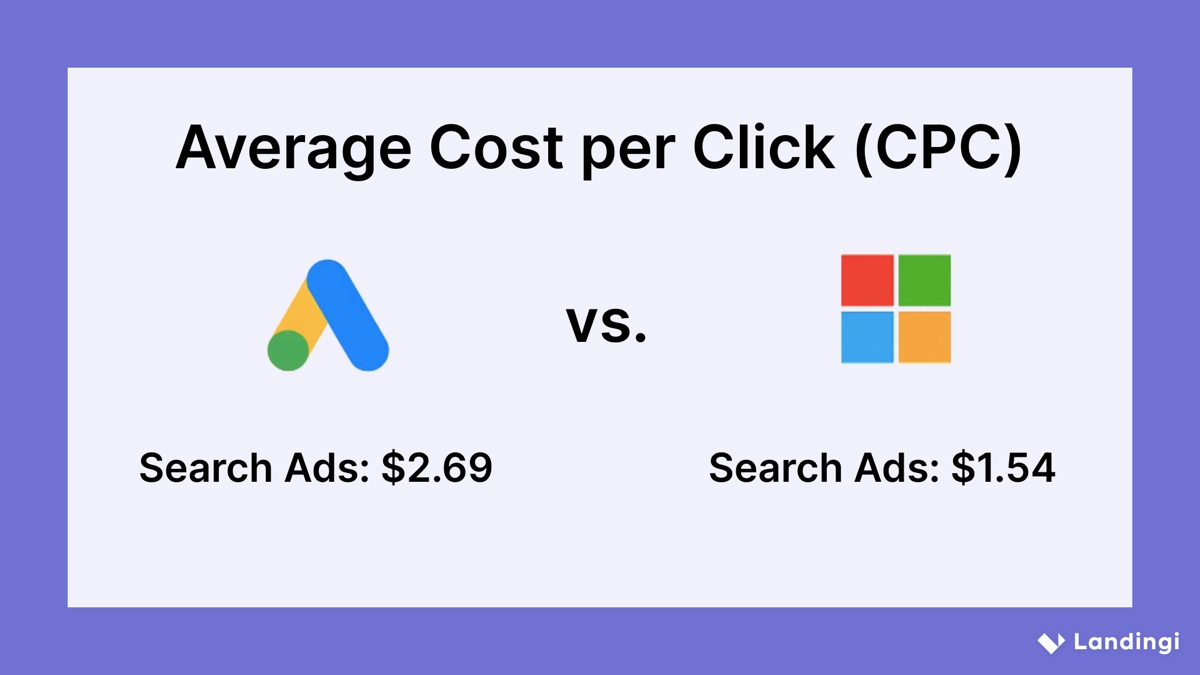
Bing Ads also excel when budget efficiency matters. WordStream reports an average CPC of $1.54 across industries – significantly lower than Google. Lower costs result from less competition, allowing a more sustainable PPC strategy for small and mid-sized businesses.
Comparing ad platforms? Make sure both convert with optimized landing pages.
Google Ads vs. Bing Ads – Which is Better for Real Estate?
Bing Ads is more cost-effective for real estate, but Google Ads delivers higher lead volume, so the answer depends on your campaign goals, budget size, and target market.
Choose Google Ads if your priority is generating large volumes of leads quickly. The platform excels for rental listings, competitive urban markets, and properties requiring immediate visibility. Google’s mobile reach and local intent features – particularly through Google Maps and Search – make it effective for capturing high-intent buyers actively searching in specific neighborhoods.
Choose Bing Ads if you’re targeting buyers aged 35+ or marketing premium listings in suburban areas. The platform’s audience aligns well with homebuyers who have greater purchasing power and longer decision-making timelines. Lower competition and precise demographic filters enable a more focused PPC strategy with less wasted budget, making it ideal for luxury properties and markets where cost per lead matters more than lead volume.
Google Ads vs. Bing Ads – Which is Better for eCommerce?
Google Ads is generally better for eCommerce brands focused on scale and mobile sales. The platform offers broader reach, advanced Shopping campaign features, and seamless integration with Google Merchant Center, making it ideal for large product catalogs, time-sensitive promotions, and volume-driven conversions.
However, Bing Ads can outperform Google for high-ticket products targeting older demographics or during off-peak seasons when lower acquisition costs matter most. Reduced competition allows eCommerce businesses with smaller budgets to maximize returns without the bidding pressure of Google’s marketplace.
Google Ads vs. Bing Ads – Which is Better for Dropshipping?
Google Ads is better for dropshipping due to its speed, traffic volume, and mobile dominance. The platform delivers high-intent traffic through Shopping campaigns and enables fast product testing – essential for impulse purchases, trend-based items, and time-sensitive promotions where most conversions occur on mobile devices.
Bing Ads works better as a secondary channel for long-term campaigns focused on consistent ROI rather than rapid scaling. While it offers cheaper CPCs for testing, the platform typically underperforms in volume for eCommerce, limiting its effectiveness as a primary dropshipping channel.
What is the Market Share for Google Ads vs. Bing Ads?
Google Ads holds a dominant 90%+ market share in global search, while Bing Ads (Microsoft Advertising) accounts for about 4%, according to StatCounter Global Stats data from Q4 2025.
| Platform | Search Engine Share | Search Ad Revenue Share |
|---|---|---|
| Google Ads | 90.83% | 82% |
| Microsoft Advertising | 4.03% | 12% |
| Others | 5.14% | 6% |
In desktop search within the United States, Bing performs better, reaching a market share of around 9.73%, driven by its integration with Windows and Microsoft Edge. However, on mobile – where most search traffic happens – Google maintains a share exceeding 95%.
This means Google offers volume for advertisers targeting broad audiences across all devices, while Bing serves as a lower-cost alternative with stable desktop reach and specific demographic advantages.
How to Combine Google Ads and Bing Ads in a Digital Advertising Strategy?
The most effective approach is to use Google Ads as your primary ground and Bing Ads as your expansion channel. Start by launching campaigns on Google to capture high-intent, high-volume traffic. This builds brand visibility quickly while generating performance data to identify your top-performing keywords, devices, and demographics.
Once you’ve established what works on Google, replicate those successful campaigns on Microsoft Advertising with strategic adjustments. Modify bids and targeting to align with Bing’s distinct audience profile: older, desktop-focused, and more affluent users. This allows you to extend your reach at lower CPCs while maintaining efficiency.
Track both platforms separately to compare cost per conversion, ROI, and audience behavior. Optimize your creatives and landing pages based on platform-specific performance, then scale spend proportionally to results. This dual-platform strategy balances maximum reach with cost efficiency, strengthening your overall PPC performance.
Maximize ROI on Google and Bing! Use Landingi to capture every click that counts.
Choose the Right Platform and Boost Your Google Ads and Bing Ads Performance with Landingi Landing Pages
You now understand the difference between Google Ads and Bing Ads – from audience demographics to platform features. You’ve compared platforms for reach and analyzed the costs of Google Ads vs. Bing Ads to determine where to invest. But choosing the right platform is only half the equation.
The other half? Where you send your traffic. Even the most targeted ad campaign fails without a landing page designed to convert. Landingi helps you create platform-specific landing pages that turn clicks into customers. With built-in A/B testing, paid campaigns optimization tools, and EventTracker for granular analytics, you can continuously improve performance and reduce cost per acquisition.
Try Landingi today and ensure your Google Ads and Bing Ads budget delivers maximum results.