Key Facts:
- A unique value proposition (UVP) explains what a business offers, who it serves, and why customers should choose it over competing solutions.
- A strong UVP combines customer needs, meaningful benefits, and a credible point of difference rather than simply listing product features.
- An effective value proposition statement should be clear, specific, relevant to its audience, and easy to understand.
- Landing page A/B testing helps businesses compare different UVP messages and identify which ones lead to more conversions.
Even a great product can struggle to convert if people can’t quickly understand what makes it worth choosing. That’s especially true on a landing page, where visitors need a good reason to stay before they consider taking action. A clear unique value proposition answers three questions: What do you offer? Who is it for? Why should customers choose it? Get those answers right, and your headline, supporting copy, and CTA can work together to communicate the value of your offer.

What Is a Unique Value Proposition (UVP)?
A unique value proposition (UVP) is a clear statement of the value your product or service delivers, who benefits from it, and what makes it a better choice than available alternatives. It gives potential customers a reason to consider your offer without having to figure out its advantages on their own.
A UVP is not the same as a catchy slogan or a list of impressive features. “Advanced automation tools” tells people what a product has, but “Automate repetitive tasks and give your team more time for customer work” explains what those tools actually do for them. The difference is simple: features describe the product, while a value proposition explains why those features matter.
A strong UVP also needs a believable point of difference. That might be a faster process, a more specialized solution, better flexibility, or a particular benefit competitors don’t offer in the same way. It doesn’t have to promise something revolutionary, but it should give customers a clear reason to choose you.
On a landing page, the UVP usually shapes the headline and supporting copy, with benefits and proof reinforcing the message further down the page. Visitors should be able to understand the offer and its main advantage before deciding whether to click the CTA.
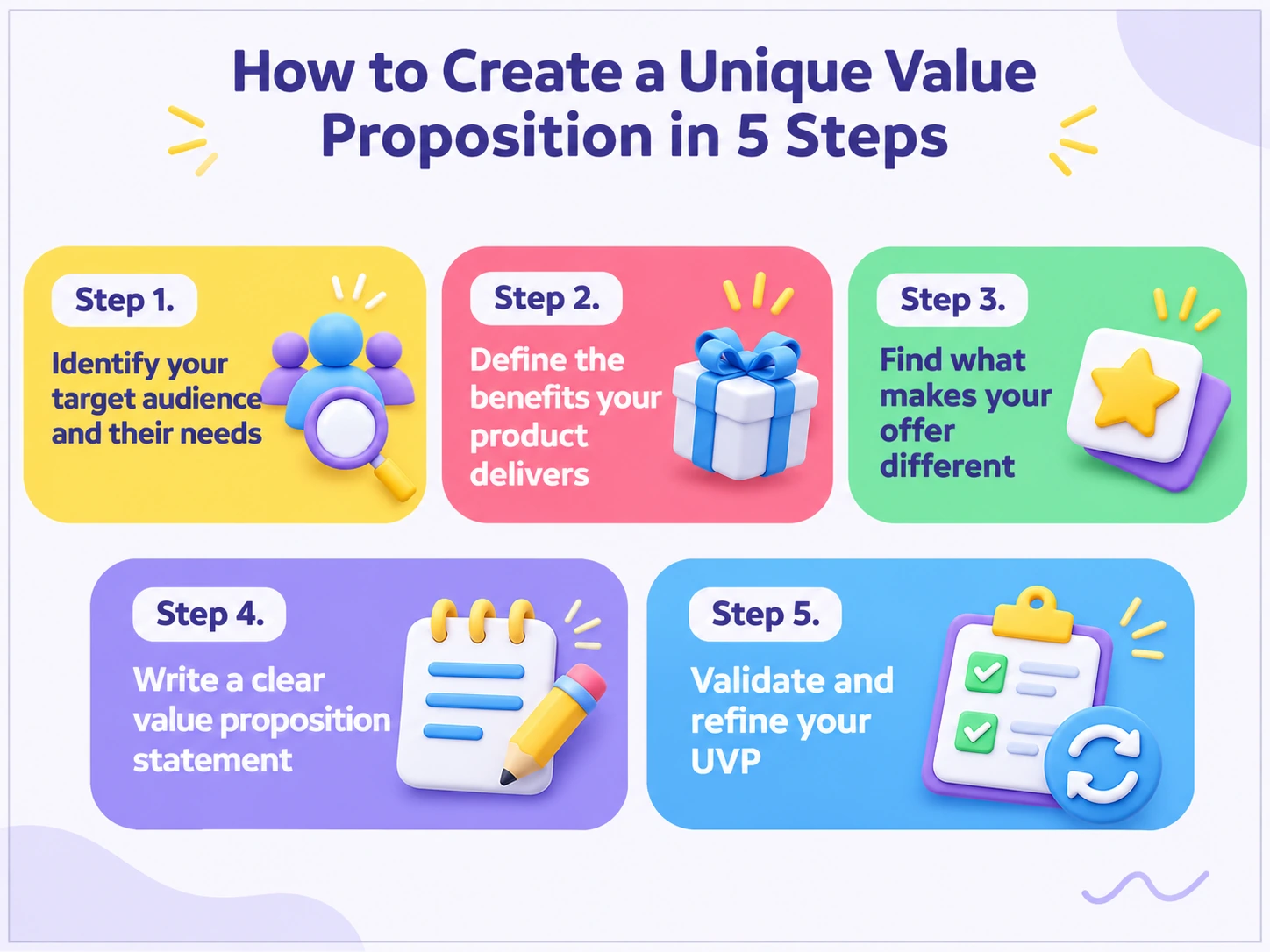
How to Create a Unique Value Proposition in 5 Steps
Creating a unique value proposition starts with understanding what customers need and where your offer fits into their choices. The goal is to turn that knowledge into a clear statement you can use in your marketing and test against real customer behavior.
Step 1. Identify your target audience and their needs
Start with the people most likely to benefit from your product, not everyone who could potentially buy it. Look at what they’re trying to achieve, what makes that difficult, and what alternatives they’re already considering.
Customer interviews, support conversations, reviews, and sales inquiries can reveal more than broad demographic profiles. Pay particular attention to the words customers use when describing their problems. Those expressions often make better marketing copy than the terminology your company uses internally.
For example, a project management tool might target small marketing teams that struggle to keep client feedback, deadlines, and approvals organized. That’s a much more useful starting point than simply defining the audience as “business professionals.”
Step 2. Define the benefits your product delivers
List your product’s main features, then ask what each one helps customers accomplish. A feature becomes meaningful when you connect it to an outcome.
For example:
- Feature: Automated approval reminders.
- Benefit: Fewer delayed projects because teams spend less time chasing feedback.
- Customer value: More predictable delivery without adding administrative work.
Focus on benefits that address the needs you identified in Step 1. You don’t need to mention everything your product does. Choose the advantages that matter most to your audience and that you can reasonably deliver.
Step 3. Find what makes your offer different
Look at how competing products solve the same problem. Compare their positioning, pricing, workflows, limitations, and customer feedback. Your strongest differentiator may be something customers regularly struggle to find elsewhere.
For a project management tool, that could be client approvals built directly into the workflow, rather than another set of features designed for large internal teams.
A difference only strengthens your UVP when customers have a reason to care about it. Being the first, biggest, or most advanced isn’t particularly persuasive unless that distinction translates into a meaningful advantage.
And if competitors make similar promises, look for something more specific you can demonstrate, such as a simpler setup process, a specialized use case, or a measurable result.
Step 4. Write a clear value proposition statement
Bring your audience, main benefit, and differentiator into one concise message. A simple unique value proposition template can help organize your thinking:
For [target audience] who need [desired outcome], [product] provides [main benefit], unlike [alternative], because [credible differentiator].
Using our project management example:
For small marketing teams managing client projects, FlowDesk keeps feedback and approvals in one place, unlike general task managers, because client review is built directly into the project workflow.
The formula is a starting point, not necessarily the final headline. For a landing page, you could make the message shorter and more direct:
Keep client feedback and approvals in one place.
Manage marketing projects without scattered email threads or delayed sign-offs.
The headline communicates the main benefit, while the supporting copy makes the advantage more concrete. Avoid forcing every detail into one sentence. If the message needs a long explanation to make sense, it probably needs another round of editing.
Step 5. Validate and refine your UVP
A value proposition can sound convincing internally and still leave potential customers wondering what you’re actually offering. Before launching it widely, show the statement to people who match your target audience and ask them to explain, in their own words, what the product does, who it’s for, and why they might choose it.
If their answers differ significantly from what you intended, revise the wording before moving on to performance testing.
A landing page is a practical place to compare different UVP messages under similar conditions. Create two versions with different headlines or supporting copy, while keeping the layout, offer, form, and CTA as consistent as possible.
With A/B testing, you can compare conversion rates between versions rather than choosing the message that sounds best in a meeting. Make sure each variant receives comparable traffic, and avoid drawing conclusions from a handful of visits.

The results can tell you which version performs better, but they won’t always explain why. In Landingi, EventTracker can show how visitors interact with the page, while Solis analyzes those signals in context and suggests opportunities for improvement.
The aim isn’t to find a clever phrase and keep it forever. It’s to develop a value proposition that customers understand, your product can support, and your landing page can communicate effectively.
Compare different headlines and supporting messages to see which version converts better.
What Makes a Strong Unique Value Proposition?
A strong unique value proposition makes the value of an offer immediately clear and gives customers a reason to choose it. It doesn’t need clever wordplay or ambitious promises. It needs four qualities:
- Clarity: People should understand what you offer and why it matters without having to decode industry jargon.
- Relevance: The message should address a problem or goal your target audience genuinely cares about.
- Differentiation: It should explain what makes your solution worth choosing over available alternatives, even if that advantage isn’t entirely unique to your business.
- Credibility: Every important claim should be realistic and supported by something tangible, such as customer results, product capabilities, or a clear explanation of how the benefit is delivered.
These qualities work together. A promise can be clear but unremarkable, distinctive but irrelevant, or impressive but difficult to believe. The strongest UVP gives customers enough information to understand the offer and enough confidence to consider the next step.
Unique Value Proposition Examples: What Works and Why
The best unique value proposition examples don’t rely on impressive adjectives. They explain a benefit that matters to a particular audience and give customers a reason to consider the offer. Here are six examples showing how different brands approach that challenge.
1. Landingi – from landing page creation to campaign optimization
Value proposition: Create, publish, manage, and optimize landing pages in one AI-powered platform.
Landingi offers an AI landing page operation platform for marketers, agencies, and businesses running digital campaigns. Instead of focusing only on page creation, the platform brings together AI-powered generation, publishing, visitor behavior tracking, and ongoing optimization.

The value proposition addresses a practical need: managing landing pages throughout their entire lifecycle without switching between disconnected tools. Lunar generates editable landing pages from prompts, while EventTracker collects behavioral data and Solis uses those signals to identify optimization opportunities.
What makes this proposition effective is its focus on the complete workflow rather than a single feature. The homepage headline, “Win more campaigns with AI landing page builder,” reinforces that positioning with an outcome-oriented promise, but the product capabilities explain the actual value behind it.
2. Nike – innovation that supports athletic performance
Value proposition: Performance-focused sportswear and footwear designed to help athletes pursue their goals.

Nike builds much of its product messaging around athletic performance and innovation. Its running footwear, for example, combines specialized materials and technologies with benefits such as cushioning, responsiveness, and running efficiency.
The audience is broad, but the value becomes more specific at the product level. A runner choosing racing shoes has different priorities from someone buying everyday sneakers. Nike’s approach works best when it connects a particular technology to the benefit an athlete can expect from using it.
It’s also a useful reminder that “Just Do It” is a brand slogan, not a complete UVP. The slogan creates an emotional connection, while product-specific messaging explains what customers are actually buying and why.
3. Amazon – selection, convenience, and delivery
Value proposition: A wide product selection, competitive prices, and convenient shopping with delivery options.

Amazon addresses a familiar customer need: finding and purchasing products without visiting multiple stores. Its marketplace combines a broad selection with product comparisons, customer reviews, and delivery options that help shoppers make purchases in one place.
The proposition is practical rather than particularly creative. Customers can understand the benefit immediately, and features such as delivery estimates and product availability make it easier to evaluate the offer.
The message is strongest when Amazon supports its general promise of convenience with specific information. Fast delivery, for instance, depends on the item, location, and available shipping options, so those details matter when communicating value.
4. Google – finding relevant information quickly
Value proposition: Fast access to relevant information from across the web.

Google Search addresses a straightforward need: helping people find information. Its search systems organize results from a large index of web pages and assess factors such as relevance, usability, and the nature of the query.
For someone looking for a quick answer, directions, or information about a product, the benefit is clear. Google’s value proposition is built around reducing the effort required to find useful information, rather than asking users to understand the technology behind its search engine.
The strength of this example is its simplicity. The promised outcome is easy to recognize and closely connected to what people use the product for. However, speed and relevance are broad advantages, so demonstrating the quality of actual results remains essential.
5. Apple – an integrated product experience
Value proposition: Devices and software designed to work together through a consistent, connected experience.

Apple frequently emphasizes how its products work together. Features such as Handoff and Continuity allow people to move between compatible Apple devices while continuing tasks, sharing content, or accessing information.
This proposition speaks particularly to customers who use, or are considering using, several Apple products. The value isn’t simply owning an iPhone, Mac, or Apple Watch, but being able to use them together with less friction.
What makes the approach effective is that Apple can demonstrate the benefit through familiar activities. Starting a task on one device and continuing it on another is easier to understand than a general claim about innovation. Still, this is a broad ecosystem proposition; individual Apple products need more specific benefits to explain why a customer should choose them.
6. Netflix – on-demand entertainment across devices
Value proposition: Access to a broad selection of movies and series, with the flexibility to watch on different devices.

Netflix appeals to viewers who want entertainment without being tied to a traditional television schedule. Its offering combines on-demand access to movies and series with viewing across supported devices and personalized recommendations.
The main benefit is convenience. Subscribers can choose what to watch and when, while recommendations help them discover content suited to their interests.
This is a clear proposition, but not an entirely unique one. Other streaming services offer similar flexibility, so Netflix also relies on its content catalog, original productions, and viewing experience to give customers reasons to subscribe. Its example shows why a strong UVP needs more than a relevant benefit when competitors promise much the same thing.
How to Communicate Your UVP on a Landing Page
A landing page should communicate your unique value proposition from the first screen. Visitors need to understand what you’re offering, why it matters to them, and what they can do next without searching for answers further down the page.
Start with a headline that communicates the main benefit, then use supporting copy to explain who the offer is for and what makes it different. Keep the CTA close to that message and make sure the action matches the promise. If your UVP emphasizes saving time, for example, the CTA should lead directly toward that benefit rather than a vague next step.
The rest of the page should support the promise, not repeat it. Product visuals can show how the solution works, while testimonials, specific results, and other relevant landing page components give visitors reasons to believe it.
You can use Lunar to generate an editable landing page around your UVP, then refine the headline, supporting copy, and proof to match your audience. Once the page is live, compare different messages to see which one communicates the value most effectively.
Turn your value proposition into a complete, editable landing page in minutes.
Common Unique Value Proposition Mistakes to Avoid
Even a well-researched UVP can lose its impact when the message is too broad, makes promises it cannot support, or leaves customers guessing about the actual benefit. Watch out for these common mistakes:
- Using generic claims. Phrases like “Innovative solutions for modern businesses” could describe almost any company. A more useful alternative is: “Automate invoice processing and spend less time entering financial data manually.”
- Promising results you cannot prove. “Double your sales in 30 days” sounds attractive, but without reliable evidence, it can damage credibility. Instead, describe a capability you can demonstrate: “Track customer activity and identify opportunities to improve your sales process.”
- Trying to communicate every benefit at once. A UVP packed with features, audiences, and promises makes it difficult to identify the main advantage. Lead with the strongest benefit and leave secondary details for the supporting copy.
- Creating a disconnect between the ad and the landing page. If an ad promises a free consultation but the landing page leads with a general company introduction, visitors may struggle to find what they came for. A clearer headline would be: “Book a free consultation to discuss your marketing strategy.”
- Using the same message for every audience. A product may serve freelancers and enterprise teams, but each group can value different capabilities. Tailor the UVP to the offer and audience rather than forcing one statement into every campaign.
A useful final check is to read your UVP without the company name or logo. If it could describe five competitors just as easily, the message probably needs more specificity.
FAQ About Unique Value Propositions
Here are answers to common questions about developing, using, and measuring a unique value proposition.
What is the difference between a UVP and a USP?
A unique value proposition (UVP) explains the overall value customers receive and why they should choose your offer. A unique selling proposition (USP) focuses more narrowly on a specific feature or advantage that distinguishes your product from competitors. The two can overlap, but a UVP connects differentiation with customer benefits.
Can a business have more than one value proposition?
Yes. A business can have different value propositions for individual products, services, or customer segments. For example, the same software might emphasize time savings for small teams and workflow control for larger organizations. Each message should reflect the needs of its intended audience.
Where should you place your value proposition on a website?
Place your main value proposition prominently in the homepage or landing page hero section, usually through the headline and supporting copy. Reinforce it with relevant benefits, visuals, and proof throughout the page. Visitors should understand the offer without having to scroll to find its main advantage.
How do you know if your UVP is effective?
Start by checking whether potential customers can explain your offer and its benefits in their own words. Then compare different messages through landing page A/B testing, using conversion rates and visitor behavior to evaluate performance. A strong UVP should be easy to understand and encourage the action your page is designed to generate.
Bring your value proposition to life, track visitor behavior, and improve your landing page as you learn what works.
Turn Your Value Proposition Into a Landing Page With Landingi
A strong value proposition gives people a reason to consider your offer. A well-designed landing page turns that message into a clear path toward conversion, with the right supporting information, proof, and CTA.
With Landingi, an AI landing page operation platform, you can put your UVP into practice without building every page from scratch. Lunar generates complete, editable landing pages from a campaign brief, helping you turn your main benefit, target audience, and offer into a structured page in minutes.
Once the page is live, you can test different headlines and supporting messages to see which version performs better. EventTracker shows how visitors interact with the page, while Solis analyzes that behavior alongside the page and campaign context to identify opportunities for improvement.
Your first UVP doesn’t have to be your final one. With Landingi, you can create, test, and refine the message as you learn what matters most to your audience. Try Landingi and give your value proposition a place to prove itself.