If you’re looking for a funnel builder that holds the ClickFunnels advantages, such as ease of creation and the power of customization, while addressing its most common pain points (high cost, server bugs, and support problems), you’re in the right place.
Below, we compare and review 5 of the best ClickFunnels alternatives in 2026, based on our own testing and verified feedback from platforms such as G2, Capterra, and Trustpilot. These tools give you powerful customization, strong performance, and features tailored to various business needs without the common drawbacks of ClickFunnels. Read on and discover which platform best fits your business needs.

Why Should I Consider ClickFunnels Alternatives?
You may want to explore alternatives to ClickFunnels if you’re facing high pricing, performance issues, or limited design freedom. More importantly, different platforms prioritize different features that may better match your business needs. And if your growth depends on stronger landing pages, deeper testing, or more flexible integrations, switching to a specialized tool can deliver better long-term results.
ClickFunnels is an all-in-one marketing automation and funnel-building platform created for entrepreneurs and online sellers. Its mission is to make building funnels simple for non-technical users.
It combines a funnel builder, landing pages, email marketing, payments, analytics, and course-delivery tools in one system, serving over 150,000 customers globally.
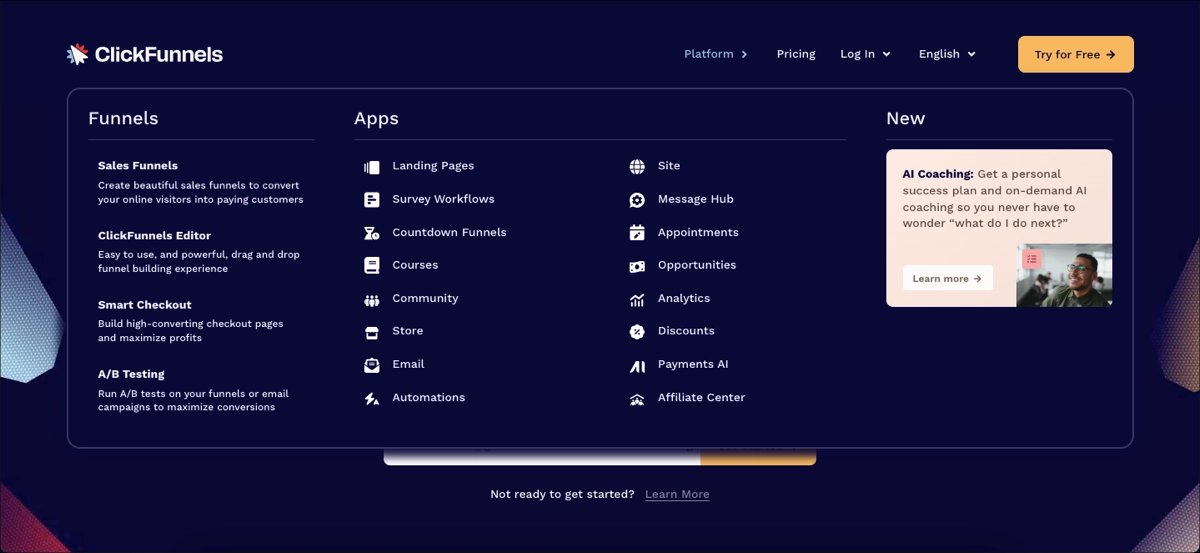
This broad feature set makes ClickFunnels appealing for quick, all-in-one setups, yet it also comes with trade-offs that push many users to explore other tools:
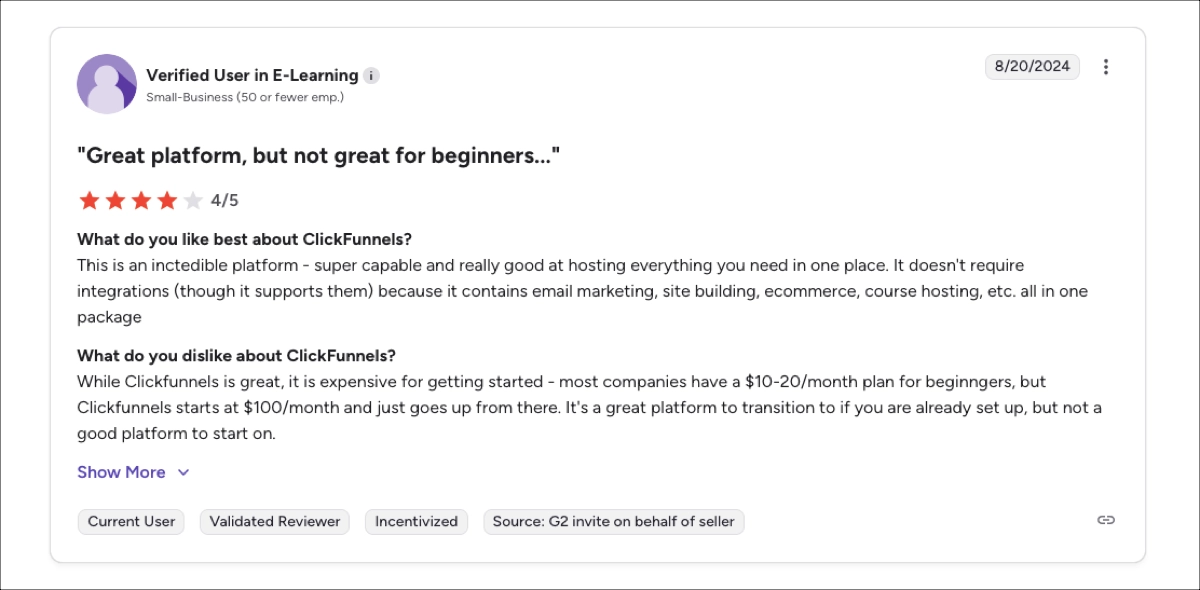
High cost
ClickFunnels starts at around $81/month with no free plan. Stating price is relatively high, and costs increase quickly when you add users, contacts, or exceed the email limits.
Limited Design Freedom Despite an Easy Editor
ClickFunnels offers an intuitive drag-and-drop interface, making it simple for beginners to build funnels without technical skills. However, the same simplicity creates limits – the grid-based editor restricts placement and layout control, which can be challenging for teams aiming for precise branding or CRO-focused designs.
Funnel Templates That Don’t Scale With Advanced Needs
The platform supports a range of funnel types, including sales and lead capture flows. However, many users find the templates rigid once they attempt to expand, customize, or optimize them. This lack of flexibility often pushes teams to explore tools that offer stronger personalization and more modern design capabilities.
Built-In Tools That Fall Behind Specialized Platforms
ClickFunnels includes essential marketing tools – landing pages, email features, forms, checkout pages, and A/B testing. Yet each of these components is relatively basic compared with dedicated landing page, email, or analytics platforms. As businesses scale, these limitations can impact performance and become a clear reason to consider alternatives.
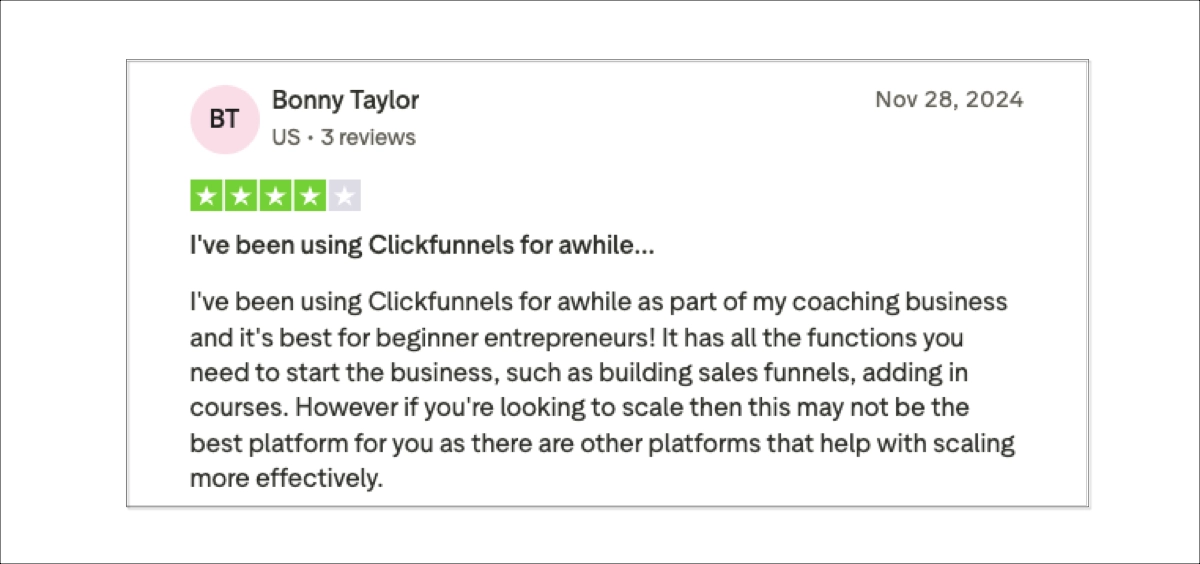
Because of these limitations, many marketing teams and agencies seek faster, more flexible, or more affordable alternatives – especially when the primary goal is building high-converting landing pages, which is not ClickFunnels’ core strength.
Choosing a platform that aligns with your business goals can be more effective than trying to fit your strategy within ClickFunnels’ constraints.
Take your landing pages with you! We’ll transfer up to 3 landing pages at no cost to help you get started.
What Are the Best ClickFunnels Alternatives?
The best ClickFunnels alternatives in 2026 are Systeme.io, Landingi, GetResponse, HubSpot, and Unbounce. Each offers strong funnel or landing-page capabilities, but at varying price and complexity levels.
Here’s a quick comparison:
| Alternative | Stand-Out Feature | Cost | Free Plan |
|---|---|---|---|
| Systeme.io | Affordable all-in-one funnel builder | From $17/mo | Yes |
| Landingi | Pixel-perfect landing page builder, automation | From $24/mo | Yes |
| GetResponse | All-in-one marketing automation | From $13/mo | No (trial only) |
| HubSpot | Enterprise-grade CRM, marketing automation | €20–€890/mo | Yes |
| Unbounce | Advanced landing page editor, Smart Traffic feature | From $74/mo | No (trial only) |
5 Top ClickFunnels Alternatives in 2026
While ClickFunnels’ all-in-one approach appeals to many marketers and business owners, some users may find it limiting in terms of flexibility, pricing, or integration capabilities, leading them to explore more specialized or affordable alternatives.
Here are five strong ClickFunnels alternatives, each offering a unique strength:
- Systeme.io – best for budget-conscious creators who need all-in-one funnel building,
- Landingi – best for teams that live on landing pages and care about design control, testing, and scalability,
- GetResponse – best for marketers whose main channel is email with landing pages on top,
- HubSpot – best for B2B and SaaS companies that want CRM, marketing, and sales in one ecosystem,
- Unbounce – best for PPC and CRO teams needing deep optimization and full creative control.
Below you’ll find detailed breakdowns and direct comparisons with ClickFunnels.
1. Systeme.io – Simple All-in-One Marketing Platform
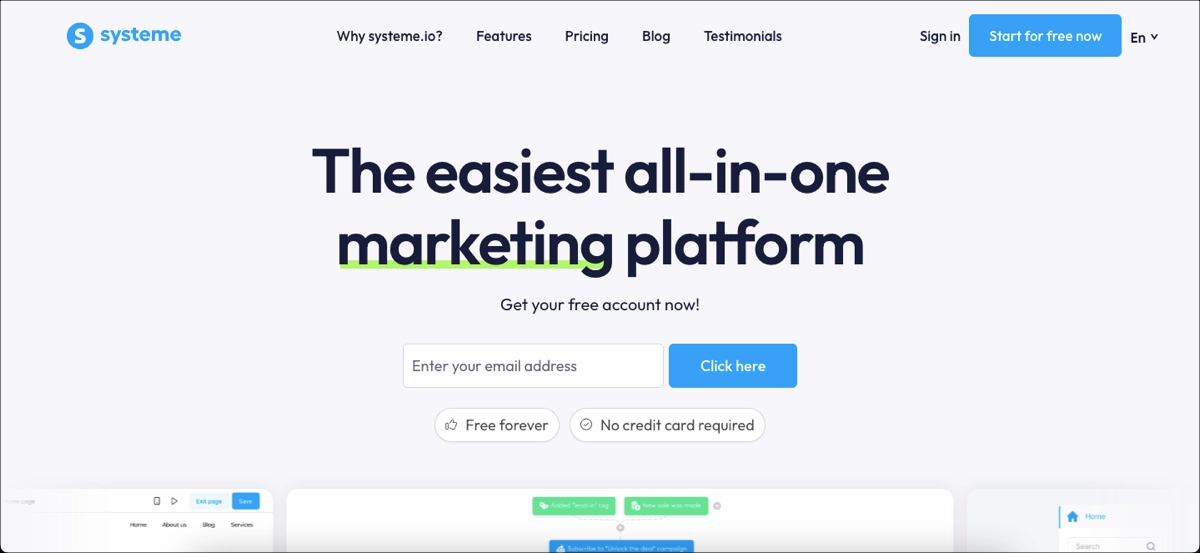
Systeme.io is an all-in-one marketing platform that bundles funnels, a website builder, email marketing, course hosting, and simple automation into one low-cost tool. The platform is designed to help entrepreneurs and small teams manage their online business without juggling multiple tools.
Pricing
Systeme.io offers four main plans, all with unlimited email sends and file storage:
- Freemium – $0/mo (generous limits for funnels and basic automation).
- Startup – from $17/mo.
- Webinar – from $47/mo.
- Unlimited – from $97/mo (unlimited funnels, emails, automation).
You can start without a credit card, which is a big contrast to ClickFunnels’ paid-only pricing. Compared to ClickFunnels, Systeme.io offers much more flexibility for users just getting started or growing on a tight budget.
Key features
The platform stands out as a cost-effective and scalable ClickFunnels alternative because it not only builds funnels with multi-step flows, but also integrates email marketing, affiliate management, booking calendars, and community features, all at a price point that’s accessible for most businesses.
Key features in systeme.io include:
- Funnel builder with multi-step flows (opt-in, sales, upsell, thank-you pages)
- Landing pages, websites, simple blogs
- Email marketing with automation workflows and tagging
- Course hosting and membership areas
- Affiliate management
- Built-in payments (Stripe, PayPal, Apple Pay)
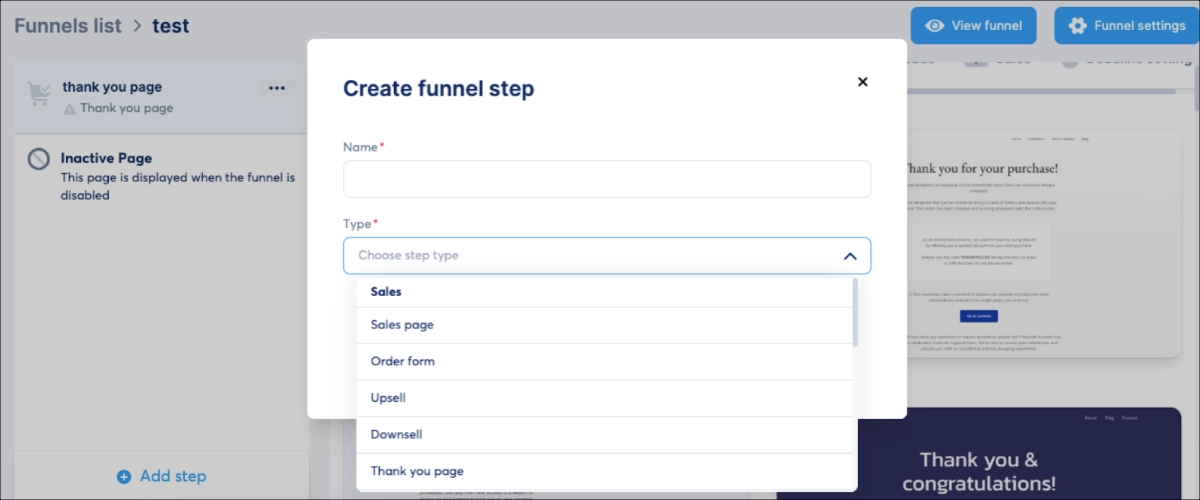
For a low price, you get almost everything you need to run a lean online business. This makes it especially valuable for solo founders and small teams that want a low-cost funnel stack and are willing to settle for a simpler design and analytics.
User Rating, Pros & Cons
- G2: 4.8/5
- Capterra 4.8/5
- Trustpilot: 4.8/5
Reviewers consistently praise systeme.io for offering great value compared to tools like ClickFunnels. They appreciate that it provides an all-in-one stack with funnels, email, courses, and payments. Users highlight fast setup and easy-to-use templates, as well as a migration service that makes switching from other tools simple.
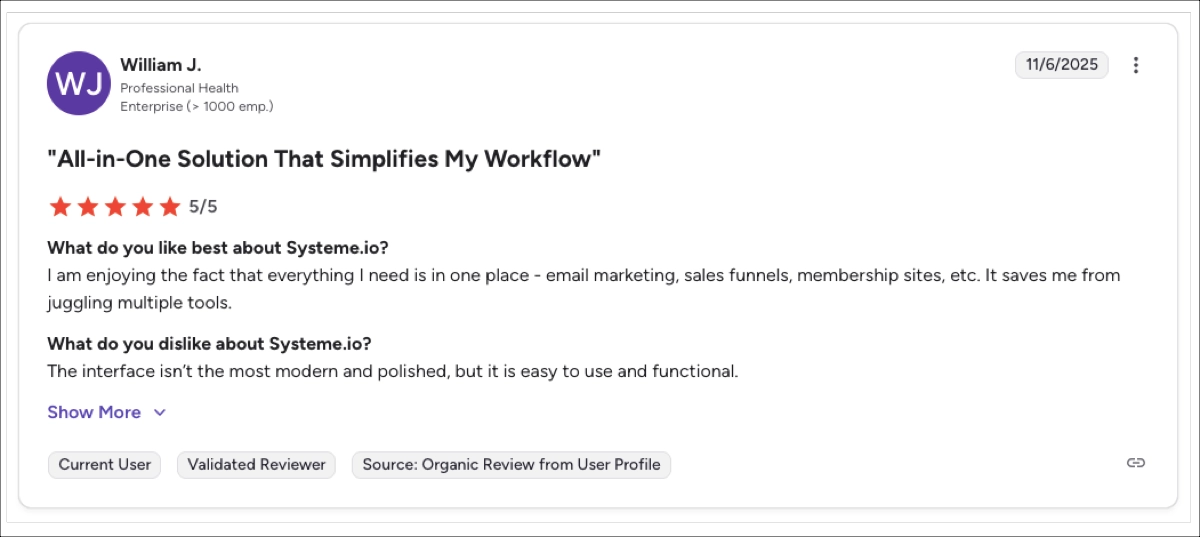
In my opinion, the real value of Systeme.io lies in its free plan and flat pricing. You can replace ClickFunnels for a fraction of the cost and still run funnels, email, and courses. For smaller businesses focused on speed and cost, this is very hard to beat.
However, not every part of Systeme.io is flawless. Users report challenges with the initial setup of domains, DNS settings, and email sender verification – areas that can be frustrating if you’re not technically inclined. They also find the drag-and-drop builder a bit clunky compared to more polished editors. The comments also concern fewer native integrations and analytics – external tools are often needed to gain deeper insight.
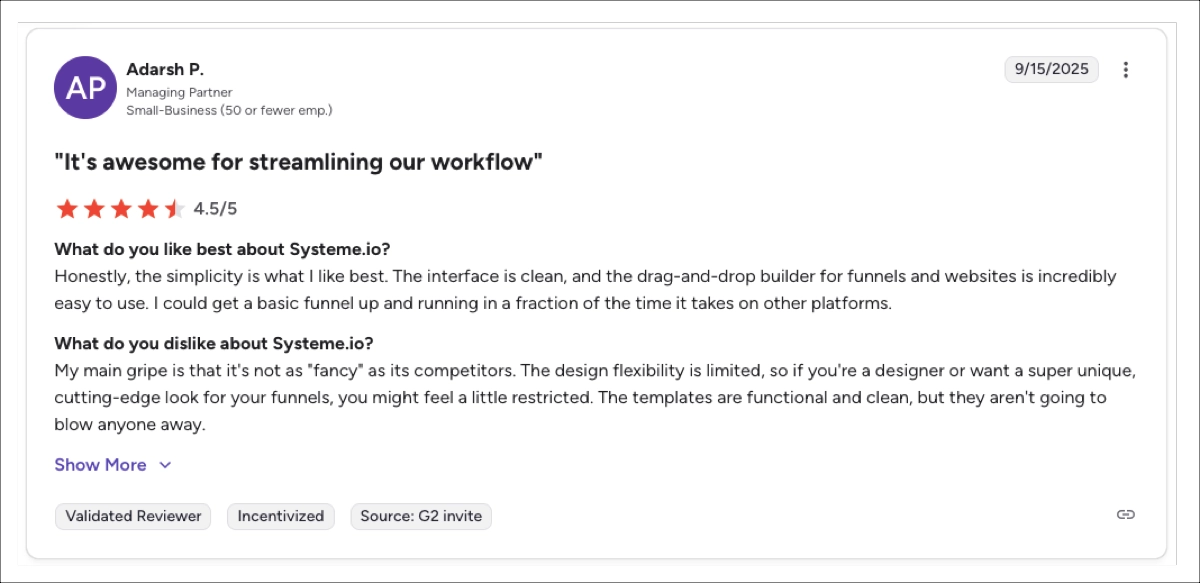
The biggest minus, in my opinion, is the landing page builder ceiling. You can launch quickly, but if your team runs heavy A/B testing, advanced personalization, or strict brand design, you will likely hit limitations faster than with a dedicated builder like Landingi.
Systeme.io vs. ClickFunnels: Which One’s for You?
Here’s a quick look at how the features and pricing compare:
| Feature | Systeme.io | ClickFunnels |
|---|---|---|
| Starting Price | $0/mo (Free), paid from $17/mo | From $81/mo (Launch) |
| Funnels & Pages | Funnels + pages; simpler editor | Strong funnel focus, decent pages |
| Landing Page Design | Basic drag-and-drop, no mobile editor | Template-driven, limited – custom code at higher tier |
| Email Marketing | Built-in with automation | Basic; limited automation |
| Webinars | Native webinar support | Not built-in (requires 3rd-party tools) |
| Course Hosting | Yes | Yes (on higher-tier plans) |
| Ease of Use | Beginner-friendly | More complex, especially at scale |
Systeme.io is best for creators, solo entrepreneurs, and small businesses that want everything in one place – without a complicated setup or high price tag. ClickFunnels might suit larger teams or marketers who need advanced funnel control and don’t mind the extra cost or learning curve.
2. Landingi – Landing Page Builder for Performance-Driven Teams
Landingi is a landing-page automation platform featuring a pixel-perfect editor, advanced testing capabilities, and enterprise-level options. It’s built first and foremost for landing pages and funnels, not as a general CRM tool. Its features are focused on conversion-driven page creation, campaign performance, and scalability.

Pricing
Landingi offers a 14-day free trial for those who want to test its capabilities, and a Free plan with a generous bundle of features. Paid plans answer larger needs:
- Lite – $24/mo (10 pages, unlimited conversions, 5,000 visits, 5 users).
- Professional – $57/mo (unlimited pages, 50,000 visits, 10 domains, 20 users, advanced features).
- Enterprise – $1,150/mo (unlimited everything, 100 domains, SSO, audit logs, custom SLA).
Compared with ClickFunnels’ Launch at $81/mo and Scale at $164/mo, Landingi’s Lite and Professional plans are much more affordable as a pure landing page stack.
Key features
Landingi is built to streamline the creation and optimization of landing pages at scale. With its core features:
- Drag-and-drop, no-code landing page builder,
- Vast library of conversion-optimized landing page templates,
- Composer for AI-driven page layout generation and AI Assistant for content creation, SEO, and images,
- Built-in A/B testing,
- EventTracker for detailed user interaction tracking,
- Pop-ups, lightboxes, and Form Builder,
- Programmatic Landing Pages and automatic translation tools,
- Over 170 integrations with major marketing tools,
the platform offers a comprehensive toolkit for conversion-focused campaigns.
What makes Landingi stand out as a ClickFunnels alternative is its depth in landing page design and conversion optimization. While ClickFunnels focuses on funnel building, Landingi concentrates on optimizing landing page performance – providing marketers with data-backed tools, scalable page management, and design flexibility.

It’s especially appealing to teams and enterprises that need advanced collaboration features, secure infrastructure, and customization at scale. Landingi’s enterprise offering includes all the essential features: SSO, audit logs, domain whitelisting, team workspaces, advanced user permission controls, custom development options, GDPR and WCAG compliance, as well as access to a dedicated account manager – making it a reliable choice for larger organizations with complex workflows and security requirements.
Explore all enterprise-level features Landingi offers. Make your platform decision with full clarity.
User Rating, Pros & Cons
- G2: 4.5/5
- Capterra: 4.8/5
- Trustpilot: 4.4/5
Users appreciate Landingi’s ease of use, true design freedom, and easy A/B testing compared to funnel-first tools. They highlight the value of EventTracker, the variety of templates, and the ease of publication options, as well as the impressive performance of landing pages.

Many value the holistic feel of the platform, combining creation, testing, and optimization tools in one place. And in my opinion, that’s what makes Landingi a standout: it delivers the precision and power modern marketers need, without bloated tools or steep learning curves.
While Landingi is intuitive, some users mention a slight learning curve with the interface – especially when exploring advanced features. A few reviewers also note that some deep customization may require light coding or workarounds, though for most use cases, the builder handles everything visually. Some users feel advanced automation and add-ons can be pricey versus “all-in-one” tools.

The only minus in my opinion is that Landingi is “landing-pages first”, which can be problematic if you do not want to run everything via integrations. For teams that want one monolithic platform, this can feel like extra setup.
Landingi vs. ClickFunnels: Which One’s for You?
The table below highlights what each platform offers:
| Feature | Landingi | ClickFunnels |
|---|---|---|
| Starting Price | $0/mo (Free), paid from $24/mo (Lite) | From $81/mo (Launch) |
| Landing Page Builder | Advanced pixel-perfect WYSIWYG, deep styling control, template-rich, AI-supported | Less customizable, custom code in the higher plan only |
| A/B Testing | Server-side A/B and EventTracker for deep insights | Simple split tests; limited LP analytics |
| Conversion Tools | Pop-ups, lightboxes, behavior tracking | Limited without integrations |
| Automation | Landing page-centric automation, integrations to CRM/email | Funnels, email, and courses in one |
| Enterprise Features | SSO, audit logs, permissions | Limited; focused on funnels |
Landingi is ideal for marketers, teams, and enterprises focused on high-performance landing pages, testing, and conversion analytics. Its AI features, customization options, and enterprise scalability give it a clear edge over ClickFunnels in design precision and data-backed decision-making. ClickFunnels, on the other hand, may be better suited for those who want to build full marketing funnels and websites within one tool – but with trade-offs in flexibility and cost.
3. GetResponse – Smart Automation for Email-Focused Funnels
GetResponse is a long-standing email marketing and automation platform that has expanded into the sales funnel space with its Automated Conversion Funnel – a toolset designed to help users build landing pages, capture leads, sell products, and automate the customer journey. It’s a natural upgrade path for teams that start with email and later need simple landing pages and funnels.
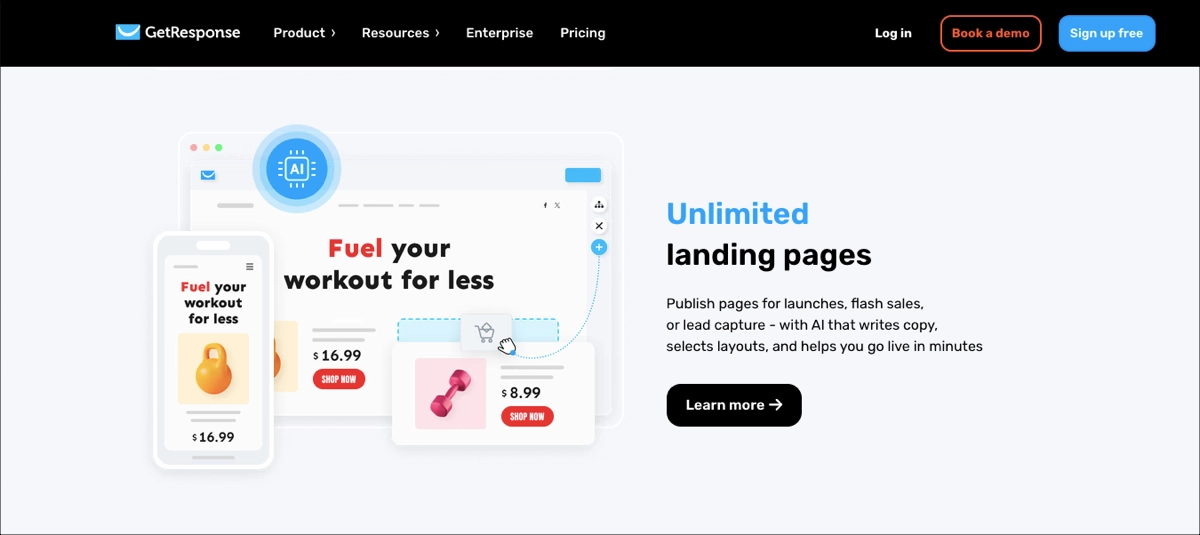
In comparison to ClickFunnels, GetResponse offers a stronger focus on email marketing campaigns and e-commerce automation. While both platforms let you build sales funnels, GetResponse combines that with its powerful email engine, robust autoresponders, and behavior-based workflows, making it especially effective for e-commerce brands and lead-nurturing campaigns.
Pricing
GetResponse offers a 14-day free trial and paid plans starting at ~ $13/month. However, access to the conversion funnels is only available on higher-tier plans, starting at $41/month. That makes it affordable for basic email marketing, but potentially more expensive if you’re looking to utilize its full funnel-building capabilities.
ClickFunnels starts around $81–$97/month, so GetResponse undercuts it on entry price but focuses more on email than page design.
Key features
The platform focuses on email automation as its core strength, and landing pages support that workflow rather than lead it. Its AI tools help speed up simple builds, but they tend to create structures that require additional optimization.
Key GetResponse features include:
- Email marketing with a strong automation library,
- Landing page builder with AI layout suggestions,
- Conversion funnels that combine landing pages, emails, and sales flows,
- Built-in webinars and scheduling,
- Basic analytics with Google Analytics integration,
- 200+ integrations.
GetResponse is best for teams whose core channel is email, and who see landing pages as part of that email engine rather than a separate optimization layer.
User Rating, Pros & Cons
- G2: 4.3/5
- Capterra: 4.2/5
- Trustpilot: 3.9/5
Users consistently praise GetResponse for its comprehensive feature set and how it simplifies marketing tasks, particularly in areas such as email automation and lead generation. Users also praise its 24/7 chat support, helpful onboarding, and the large library of automation templates that make campaign setup fast and predictable.
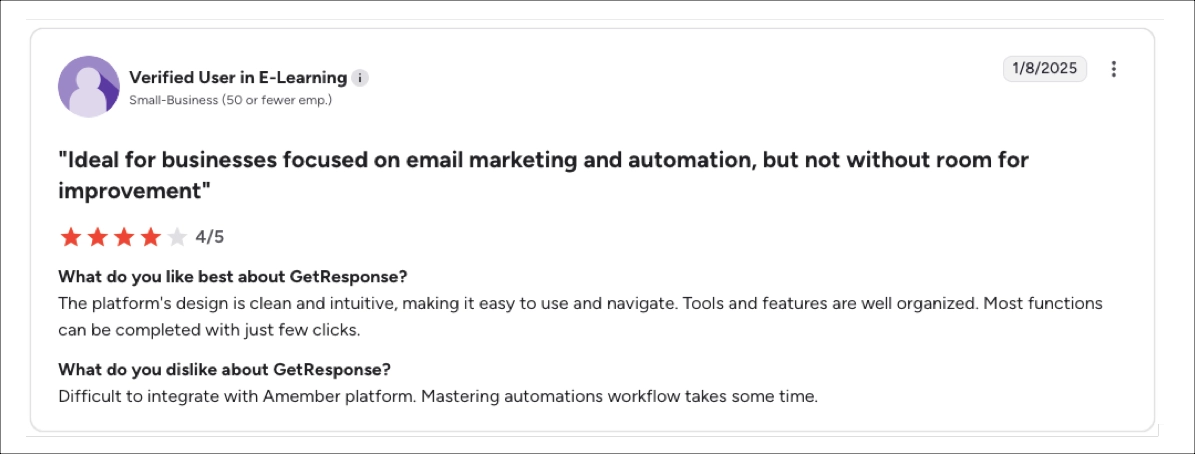
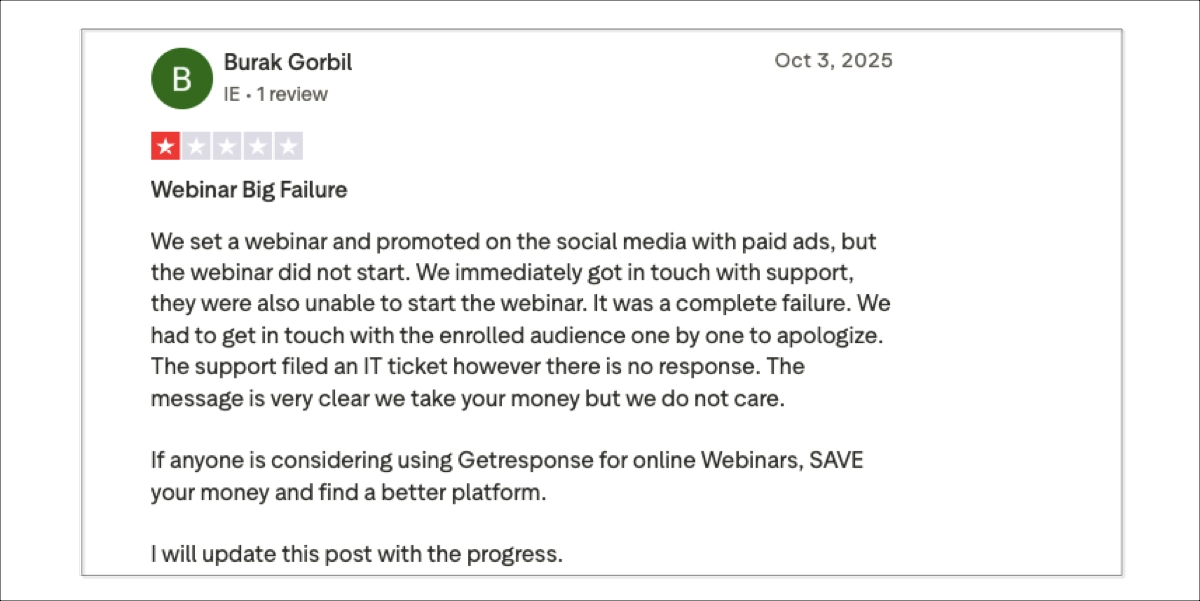
However, there are also cons of GetResponse. Billing complaints dominate user feedback, with automatic renewals and a strict no-refund policy creating significant frustration among users. These payment issues compound technical problems like account blocks, buggy webinars, and an outdated landing-page editor with limited layout control, leaving teams unable to trust the platform for consistent campaign delivery.
In my opinion, the biggest issue is that landing pages feel like an afterthought rather than a priority. The AI builder works for straightforward pages, but it lacks the depth needed for advanced optimization – making dedicated builders like Landingi a better choice for landing page-dependent businesses.
GetResponse vs. ClickFunnels: Which One’s for You?
Below is a brief overview of each platform’s key strengths and differences:
| Feature | GetResponse | ClickFunnels |
|---|---|---|
| Starting Price | From ~$13/mo | From $81/mo (Launch) |
| Email Marketing | Industry-leading automation tools | Basic functionality |
| Landing Page Builder | Simple builder, AI layouts, weaker analytics | Template-driven, limited – custom code at higher tier |
| Funnel Builder | Automated Conversion Funnel (Pro+) | Full-featured across all plans |
| Automation | Email-centric, many templates and flows | Funnel-centric, with email |
| E-commerce Tools | Abandoned cart, product sales | Available, but less ecommerce-focused |
GetResponse is ideal for businesses that want a marketing automation-first funnel builder, especially ecommerce brands or lead-gen marketers. If email is your core channel and you want deep automations and sales workflows, it’s a strong ClickFunnels alternative. On the other hand, ClickFunnels may be more suitable for those who need dedicated funnel templates and web pages from the start – with fewer moving parts.
4. HubSpot – Marketing Platform for Growing B2B Teams
HubSpot is a comprehensive CRM and marketing automation platform that integrates landing pages into a broader revenue ecosystem. It’s designed for companies that need unified data, advanced workflows, and integrated sales and service tools. Its features focus on lead management, personalization, and long-term scalability across the customer lifecycle.
In comparison to ClickFunnels, HubSpot replaces far more of the sales and CRM stack but offers less flexibility in landing-page design.
Pricing
HubSpot offers a free CRM and basic tools (also landing page builder – up to 30 pages for free) for those who need simple solutions or want to test the platform’s capabilities. Its pricing depends on the Hub and tier:
- Marketing Hub Starter: from ~€20/mo.
- Marketing Hub Professional: ~€890/mo.
- Content Hub Starter: from ~€9/mo (per seat).
- Content Hub Professional: ~€440/mo.
Compared to ClickFunnels, HubSpot can be more expensive as you grow, but it replaces several tools at once.
Key Features
HubSpot’s landing-page features sit inside its broader marketing and CRM ecosystem, giving teams tools that connect page creation with data, automation, and personalization. Below are the core capabilities that shape how HubSpot handles landing page-based campaigns:
- Drag-and-drop page builder,
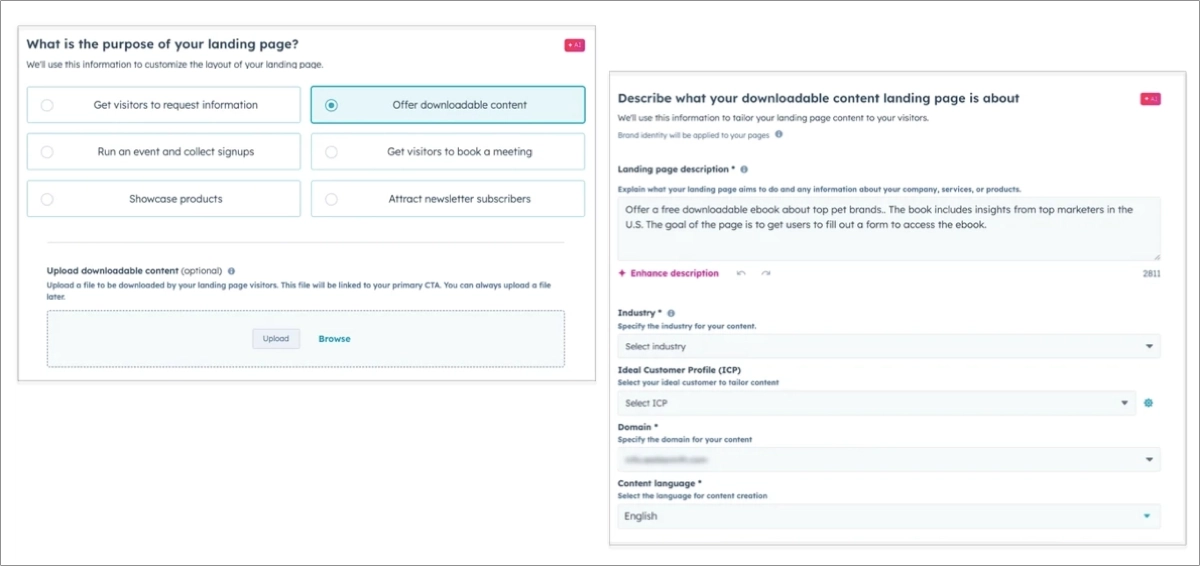
- AI-driven landing page generation
- Integrated CRM and lead management,
- Advanced workflows, lead scoring, and AI-based automation,
- Dynamic content and personalization using CRM data,
- A/B and multivariate testing for pages, emails, and CTAs,
- Deep analytics and reporting, plus 1,500+ integrations.
HubSpot is best suited for growing B2B and SaaS teams that require marketing, sales, and service in a single system and can justify the higher costs based on pipeline impact.
User Rating, Pros & Cons
- G2: 4.5/5
- Capterra: 4.5/5
- Trustpilot: 1.9/5
Reviewers are highly positive about HubSpot’s strong automation and lead scoring across the full journey, integrated reporting and analytics across channels, reliable infrastructure, and enterprise-grade security. They also appreciate a huge education ecosystem (HubSpot Academy, docs, community).
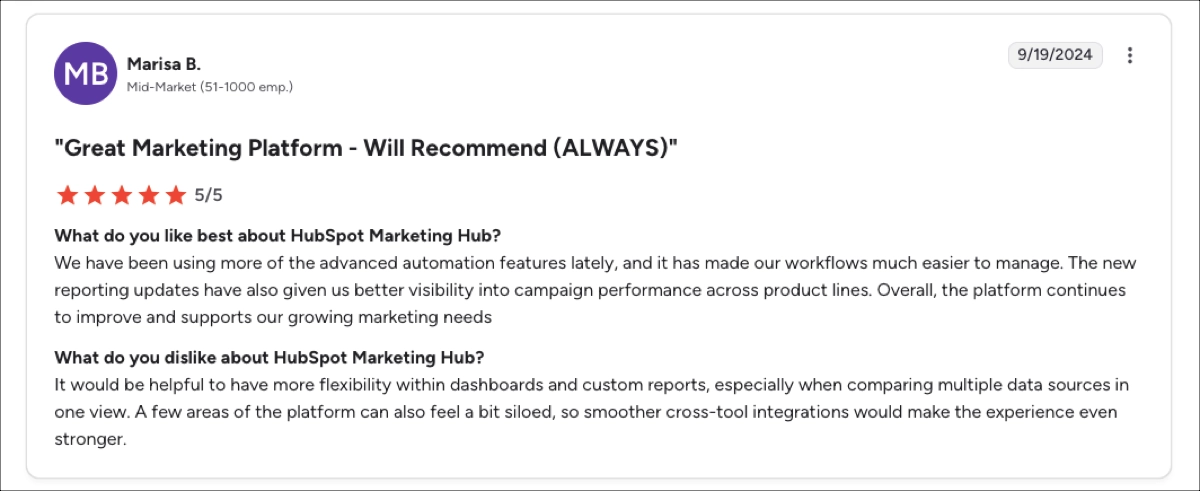
The biggest drawback is the high and rising cost, especially as the number of contacts grows or more Hubs are added. There are also complaints about billing, contracts, and upsells (locked-in terms, auto-upgrades). Some users find the editor less flexible for pixel-perfect design. For small teams, the tool can feel “too big” for their actual needs.
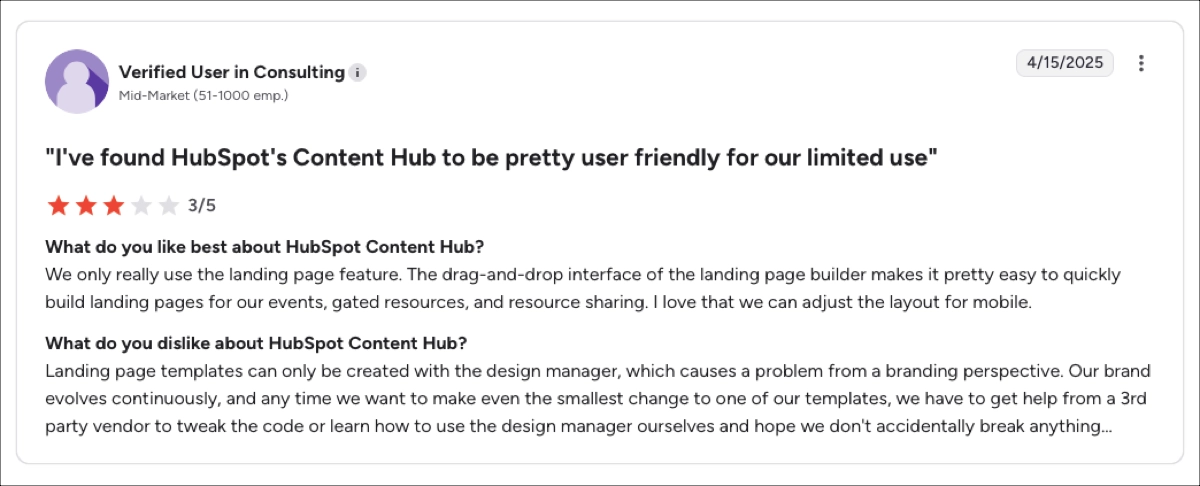
In my opinion, the plus is the long-term view. If you plan to standardize CRM, email, automation, content, and landing pages in one stack, HubSpot can centralize everything. But there are two sides of the coin: if your main problem is “we need better landing pages and tests”, HubSpot is often like buying a full ERP to fix your invoicing.
HubSpot vs. ClickFunnels: Which One’s for You?
Here’s how they compare at a glance:
| Feature | HubSpot | ClickFunnels |
|---|---|---|
| Starting Price | Free CRM + tools; Marketing Hub from €20/mo; Content Hub from €9/mo | From $81/mo (Launch) |
| Main focus | Full CRM + marketing + sales ecosystem | Funnels and sales pages |
| Landing Pages | CMS-backed landing pages with personalization | Funnel-embedded pages |
| A/B Testing | A/B/MVT for pages, emails, CTAs | Simple page split tests |
| Best for | B2B teams building full revenue ops stack | Digital products, simple funnels |
HubSpot is the strongest alternative for teams that want CRM, marketing, and sales in one system, not just a funnel builder. It outperforms ClickFunnels in automation, personalization, and data management, but offers less design freedom and becomes significantly more expensive as contact lists grow.
5. Unbounce – Landing Page Builder for High-Performance Campaigns
Unbounce is a landing-page platform built for marketers and agencies that optimize campaigns at scale. It combines a fully flexible pixel-perfect editor with AI-driven features such as Smart Traffic and Smart Copy. Its focus is on creating, testing, and personalizing landing pages, rather than managing full funnels or CRM workflows.
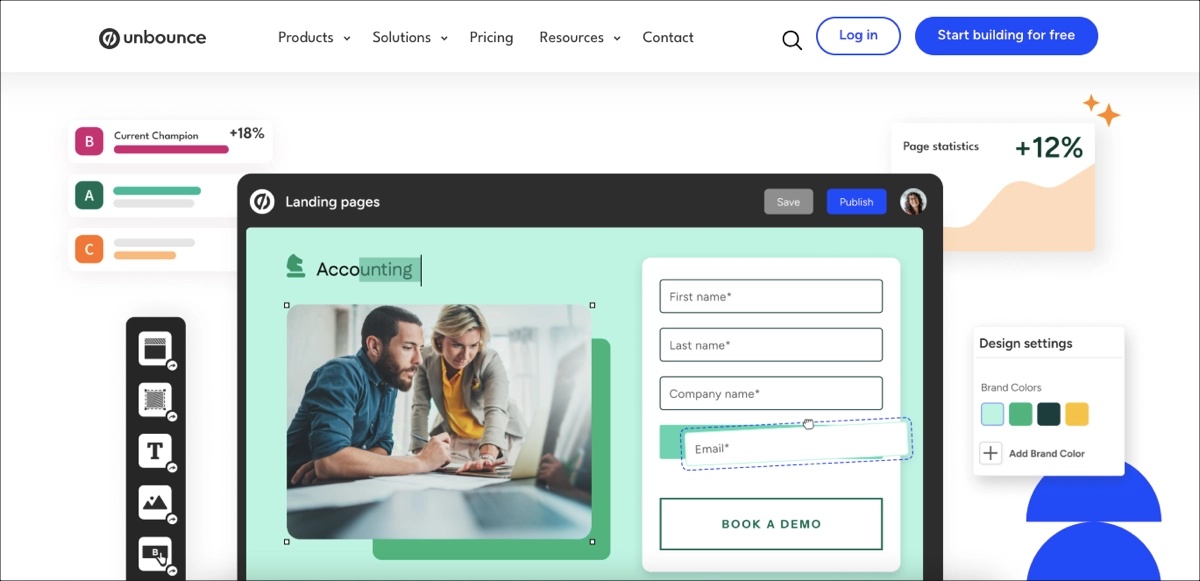
In comparison to ClickFunnels, Unbounce offers far stronger landing-page control and testing capabilities but lacks built-in automation and funnels, requiring external tools for end-to-end journeys.
Pricing
Unbounce offers four paid plans and a 14-day free trial (credit card required):
- Build – $74/mo (20,000 visits, 1 user, 1 domain)
- Experiment – $112/mo (30,000 visits, A/B tests, more domains/users)
- Optimize – $187/mo (50,000 visits, Smart Traffic AI, advanced targeting)
- Agency – custom (100k+ visits, numerous domains, all features)
Unbounce is priced for performance-driven teams, but the entry cost is significantly higher than that of many competitors.
Key Features
Unbounce’s feature set is built around conversion optimization, giving teams tools to design, test, and personalize landing pages with full creative control. Below are the core capabilities that shape how Unbounce supports high-performance campaigns:
- Pixel-level drag-and-drop landing page builder
- 100+ templates for pages, pop-ups, and sticky bars
- Smart Traffic (AI) that routes visitors to the highest-converting variant
- Dynamic Text Replacement for PPC personalization
- Unlimited A/B testing (from Experiment plan)
- AI-assisted copywriting (Smart Copy)
- Basic analytics + deeper insights in higher plans
The platform is best for marketers, PPC teams, and agencies that run high-traffic campaigns and need advanced experimentation, personalization, and design flexibility.
User Rating, Pros & Cons
- G2: 4.3/5
- Capterra: 4.5/5
- Trustpilot: 1.9/5
Users highlight Unbounce’s strengths in design control, testing capabilities, and conversion-focused features. They praise the platform for supporting experimentation and allowing them to refine campaigns with precision. Many also appreciate the reliability, fast hosting, and smooth integrations that simplify daily work.
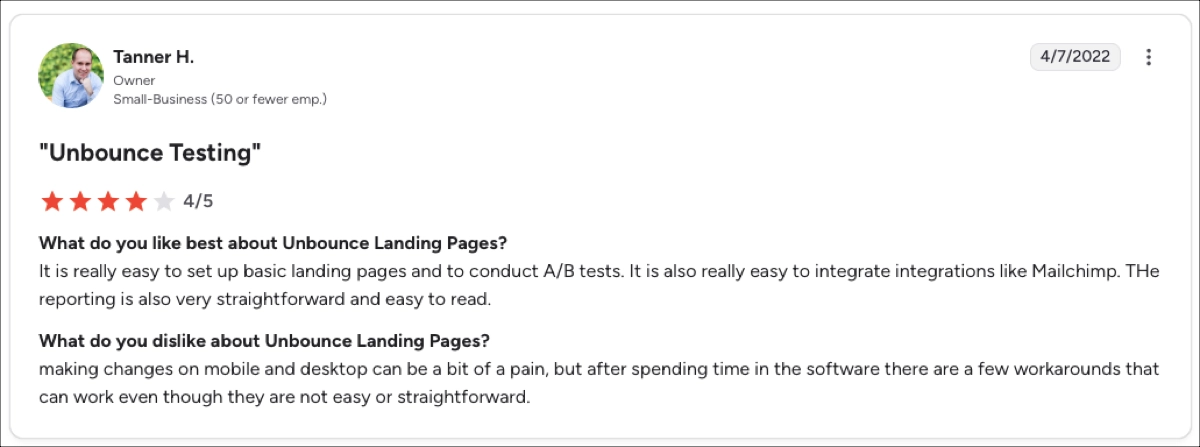
Many users report that the platform becomes sluggish when working with large, complex pages, resulting in the editor slowing down during intensive design or testing tasks. This makes daily production harder for teams that build multiple variants or manage high-volume campaigns.
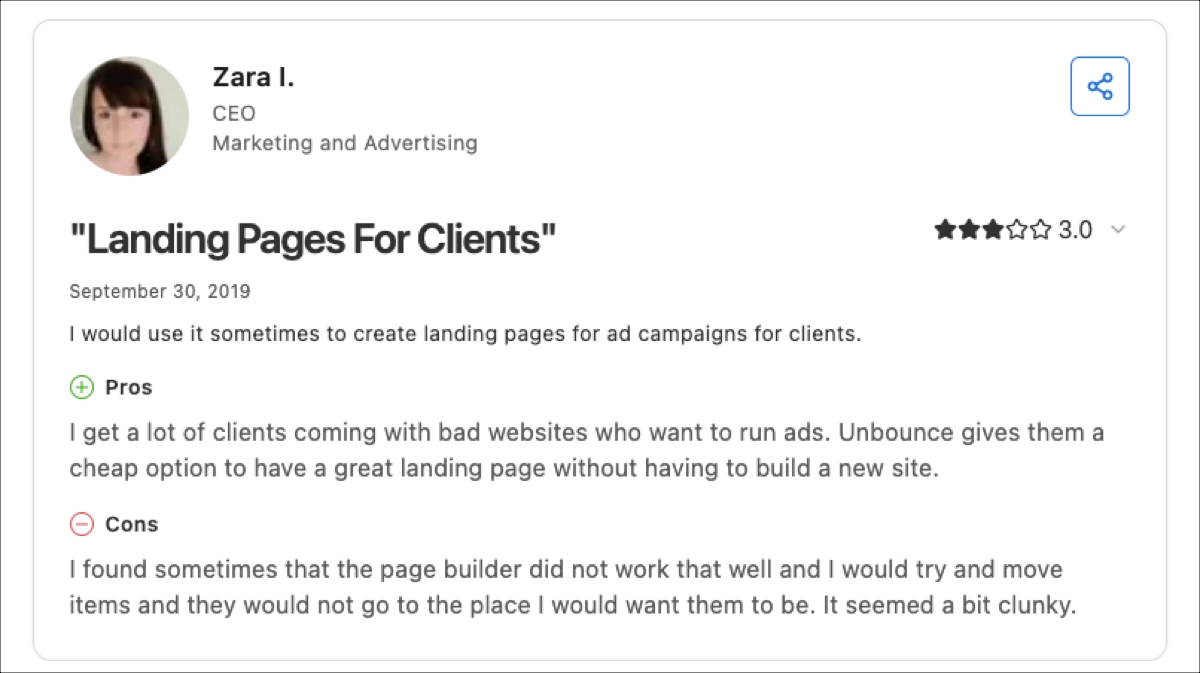
Unbounce delivers exceptional conversion optimization capabilities that few platforms match. Where it falters, in my opinion, is pricing – the traffic-based model means scaling campaigns directly inflates costs (levels three times higher than Landingi), making growth expensive rather than rewarding.
Unbounce vs. ClickFunnels: Which One’s for You?
Here’s how these tools measure up in core areas:
| Feature | Unbounce | ClickFunnels |
|---|---|---|
| Starting Price | From $74/mo (Build) | From $81/mo (Launch) |
| Landing Page Editor | Pixel-perfect drag-and-drop | Limited grid-based builder |
| Funnel Builder | None (requires external tools) | Built-in |
| Traffic limits | Strict traffic caps by plan | Not unlimited, plan-based |
| A/B testing | Unlimited variants + Smart Traffic AI | Basic A/B only |
Unbounce is a strong ClickFunnels alternative for teams entirely focused on landing-page performance and testing. It offers advanced optimization features, but its pricing and reliance on external tools make it significantly more expensive to scale. In practice, many teams find that Landingi delivers similar conversion capabilities with greater design control and significantly lower long-term costs.
Choose the Best ClickFunnels Alternative
The right ClickFunnels alternative depends on what your team needs most:
- Systeme.io is the most budget-friendly for all-in-one funnels.
- GetResponse works best for email-first marketing.
- HubSpot is a long-term solution for companies building their CRM and automation stack.
- Unbounce is well-suited for PPC and CRO teams that rely heavily on A/B tests and variants.
However, if your primary challenge is landing-page performance, design freedom, and scalability, Landingi is the ideal landing page builder to consider first.
Landingi provides teams with pixel-perfect editing, reliable testing, EventTracker insights, programmatic landing pages, and robust automation workflows – all at a more predictable price than Unbounce and ClickFunnels. For most performance-driven teams and agencies, Landingi becomes the more scalable and cost-effective long-term choice. Start a free Landingi trial and see how easily your team can scale landing page creation and testing.