B2C conversion rate optimization (B2C CRO) is the process of turning website visitors into paying customers through data-driven changes that remove friction and guide users to take action – such as making a purchase, signing up, or subscribing. B2C CRO focuses on creating dedicated landing pages tailored to specific campaigns, products, promotions, or audience segments instead of relying only on optimizing an entire store or CMS. It begins by identifying what blocks conversions, whether that’s poor layout, slow loading speeds, or unclear messaging.
With average e-commerce conversion rates typically ranging from around 2% to 3.5%, even small improvements can lead to significant revenue growth. High-performing landing pages can exceed 5%, especially when optimized for specific campaigns and audiences. Landing pages play a key role by focusing user attention, aligning with intent, and removing distractions – making them one of the most effective tools in B2C CRO. With an AI landing page operation system like Landingi, teams can generate, test, and optimize B2C landing pages faster using AI-powered workflows, A/B testing, integrations, and rapid campaign publishing.
This guide explains the main factors that influence conversion rates, how to improve critical elements, and why landing pages are essential for turning traffic into customers.
Key facts
- Average B2C conversion rates typically range from 2.5% to 5%, depending on industry and traffic quality (BigCommerce, VWO)
- Dedicated B2C landing pages convert higher than general product or category pages due to focused intent and reduced friction
- Even small CRO improvements (e.g., +0.5%) can significantly increase revenue at scale
- Landing page optimization enables faster testing cycles than full-site or CMS optimization
- AI-powered workflows accelerate building, testing, and optimizing high-converting landing pages in 2026

How to Calculate B2C Conversion Rate?
To calculate B2C conversion rate, divide the number of conversions by the total number of visitors and multiply by 100:
For example, if you generate 50 conversions from 1,000 visitors, your conversion rate is 5%.
Tracking this metric over time shows how effectively your B2C CRO efforts turn shoppers into buyers. It also helps you evaluate specific campaigns – especially when you use dedicated B2C landing pages instead of general store pages, where results are harder to isolate.
It’s more effective to track conversion rates per landing page, campaign, or traffic source rather than across your entire website. This gives you clearer insights into what drives performance and what needs improvement.
What is a Good B2C Conversion Rate?
A good B2C conversion rate typically starts above 3% and can exceed 5% for well-optimized experiences. High-performing brands achieve these results by combining strong messaging, clear offers, and optimized user journeys – often through dedicated, high-converting landing pages rather than general store pages.
Key factors that influence conversion rates include:
- Clear value propositions that match user intent
- Intuitive navigation and fast load times
- Trust signals (e.g., reviews, guarantees, secure checkout)
- Strong product presentation and clear, action-driven CTAs
Improving B2C CRO results often involves A/B testing, streamlining the user journey, and using personalization – such as dynamic content or targeted offers – to increase engagement and drive action. The biggest gains come from optimizing dedicated ecommerce landing pages rather than making broad changes across an entire store, because each page can be tailored to a specific audience and conversion goal.
What is an Average B2C Conversion Rate?
The average B2C conversion rate typically ranges from around 2% to 3.5%, with approximately 2.9% often cited as a realistic benchmark across industries. This reflects baseline performance and includes both optimized and non-optimized experiences.
Industries with lower-cost, high-demand products tend to convert better, while high-ticket or complex purchases typically result in lower conversion rates due to longer decision cycles.
At this level, performance is most often limited by foundational issues such as:
- Poor mobile experience
- Slow page load speed
- Friction in the checkout or conversion flow
Even small technical or usability issues – like delays or unclear navigation – can significantly reduce conversions. Fixing these basics is usually the first step before moving into more advanced landing page optimization.
2% isn’t enough? Make it higher! Landingi helps you fine-tune your landing pages for better results.
What Is The Average B2C Conversion Rate By Industry?
B2C conversion rates vary by industry, typically ranging from around 1% to over 6%, depending on product type, purchase intent, and user behavior. Differences between desktop and mobile performance also play a significant role in overall results.
| Industry | Overall Rate | Desktop | Mobile | Key Factors |
| Food & Beverage | 6.0% | 6.8% | 5.4% | High frequency purchases, subscriptions |
| Health & Beauty | 4.55% | 5.2% | 3.9% | Repeat purchases, personalization |
| Fashion & Apparel | 3.01% | 3.7% | 2.8% | Visual appeal, seasonal demand |
| Electronics | 2.3% | 2.9% | 1.8% | Price comparison, higher consideration |
| Home & Furniture | 1.24% | 1.6% | 0.9% | High-ticket items, delivery concerns |
| Overall Average | 2.9% | 3.2% | 2.8% | Baseline across B2C ecommerce |
Industries with frequent, low-risk purchases tend to achieve higher conversion rates, while high-ticket or complex products convert less often due to longer decision cycles.
Device differences also matter. Desktop conversion rates typically outperform mobile by a noticeable margin, even though mobile generates the majority of traffic. This gap highlights how important it is to optimize mobile experiences, especially for ecommerce landing pages.
Seasonality is another key factor. Conversion rates often increase during high-demand periods, such as November and December, when promotions and urgency drive faster purchase decisions.
Understanding these patterns helps set realistic benchmarks and build more effective B2C CRO strategies. This is why many brands use dedicated landing pages for specific campaigns or segments – to better match intent, reduce friction, and improve conversion performance.
5 Steps to Improving B2C Conversion Rates
Improving B2C conversion rate optimization (B2C CRO) involves analyzing user behavior, optimizing landing pages, reducing friction in the conversion flow, testing variations, and applying personalization. Together, these steps create a continuous optimization loop that helps turn shoppers into buyers more effectively over time.

Step 1. Analyze visitor behavior
Use analytics tools and behavioral data – such as scroll depth, clicks, and session patterns – to identify where users drop off. Focus on key friction points like unclear navigation, weak messaging, or slow load times.
In 2026, this process increasingly relies on tools that combine tracking with interpretation. For example, insights from behavior tracking can highlight not just where users leave, but why – making it easier to prioritize what to fix first.
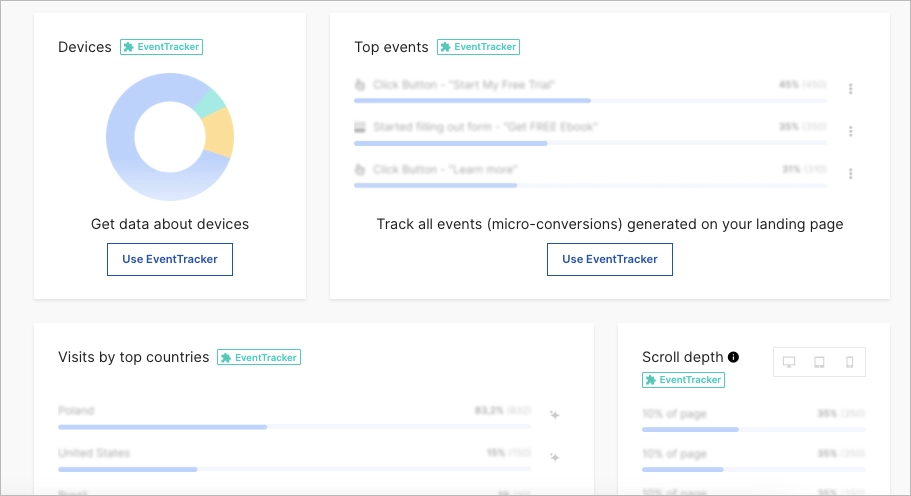
With EventTracker in Landingi, you can automatically track all user interactions – including clicks, scroll depth, form activity, and micro-conversions – without any setup. Built-in heatmaps and event tracking show exactly how users engage with your landing page, giving you clear, actionable data to improve conversion paths faster.
Spot what truly works on your landing page and improve conversions!
Step 2. Optimize landing pages
Focus on building high-converting landing pages with a clear structure and a single goal. Your B2C landing page should include a strong headline, a clear value proposition, persuasive visuals, and a visible, action-driven CTA.
What drives conversions on ecommerce landing pages:
- Clear message match between the ad and the landing page
- One primary action (no competing CTAs)
- Strong visual hierarchy (headline → product → CTA)
- Trust elements such as reviews, guarantees, and secure payment signals
Optimizing landing pages at this level allows you to test and improve specific campaigns, offers, or audience segments without affecting your entire store. With Solis, Landingi’s AI landing page optimization tool, you can go beyond manual analysis.
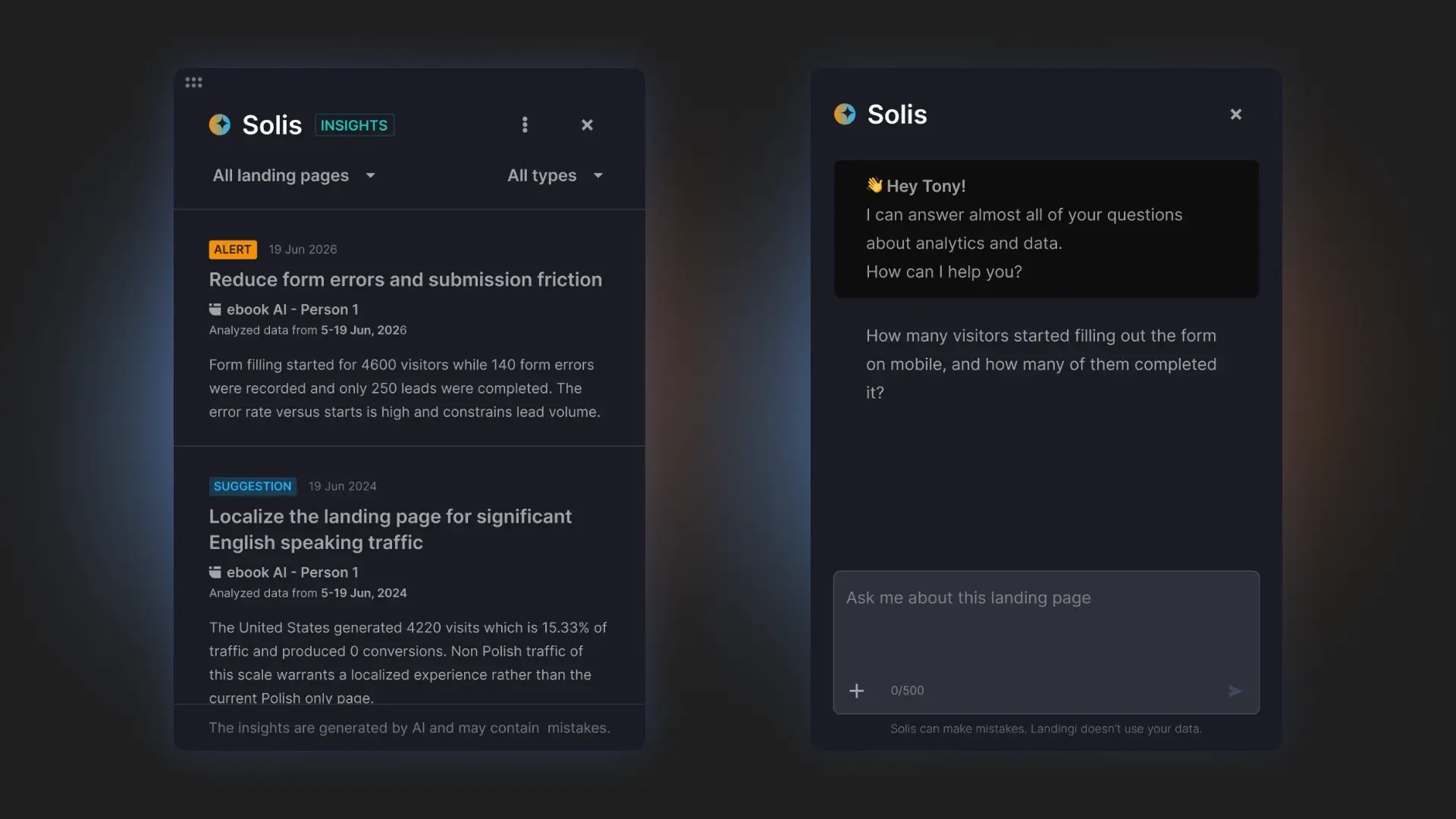
Solis continuously analyzes behavioral data from EventTracker – including scroll depth, clicks, form interactions, and conversions – and highlights what actually impacts performance. It surfaces issues like drop-offs or underperforming elements and delivers clear optimization suggestions, so you can quickly identify bottlenecks and improve results without guesswork.
Turn behavioral data into clear optimization insights and faster conversion wins.
Step 3. Simplify the checkout process
Reduce friction by minimizing form fields, enabling guest checkout, and offering flexible payment options. Remove unnecessary steps and make the process predictable and fast.
Features like autofill, progress indicators, and transparent pricing help reduce abandonment and improve completion rates. The easier it is to finish the action, the more users will convert.
Step 4. Leverage A/B testing
Use A/B testing to refine key elements such as headlines, layouts, product visuals, and CTAs. Instead of guessing, test variations and measure what actually improves performance. Modern landing page optimization focuses on continuous experimentation rather than isolated tests. Even small changes can have a measurable impact when applied consistently across campaigns.
Step 5. Use personalized marketing tactics
Apply personalization to re-engage users and increase relevance. This includes dynamic content, retargeting campaigns, and tailored offers based on user behavior.
Personalized product recommendations, cart abandonment flows, and time-sensitive incentives – such as limited discounts or free shipping – help reduce hesitation and move users toward conversion. The more relevant the experience, the higher the likelihood of turning visitors into buyers.
Why Are Landing Pages Important For B2C CRO?
Landing pages are central to B2C conversion rate optimization because they allow you to control the entire user journey around a single goal. A B2C landing page is designed for one specific campaign, offer, or audience – making it easier to match intent and reduce friction.
This level of focus is what enables faster testing, clearer insights, and better performance. Each ecommerce landing page can be optimized independently, without affecting the rest of your site, which makes landing page optimization more precise and scalable.
How B2C landing pages drive CRO success?
B2C landing pages drive conversion rate optimization by removing distractions and guiding users toward one high-intent action – such as making a purchase, claiming an offer, or signing up.
What makes high-converting landing pages effective:
- Clear message match between traffic source and page content
- One primary conversion goal with no competing actions
- Strong visual hierarchy that directs attention (headline → product → CTA)
- Trust signals such as reviews, ratings, and secure payment indicators
- Urgency and motivation triggers, like limited-time offers or free shipping
These elements work together to simplify decision-making and keep users focused on completing the action. By reducing friction and aligning the experience with user intent, B2C landing pages consistently outperform generic product or category pages – helping brands turn shoppers into buyers more efficiently.
Build your B2C landing page in Landingi – no code, no delays, just results.
8 Key B2C Conversion Rate Optimization Metrics
B2C conversion rate optimization (B2C CRO) relies on a set of metrics that show how users interact with your pages and where conversions are gained or lost. These metrics are most valuable when tracked at the landing page or campaign level – where you can clearly connect performance to a specific offer, audience, or traffic source.
| Metric | What it shows | Why it matters for CRO |
| Conversion Rate | % of users who complete a desired action | Measures how effectively you turn shoppers into buyers |
| Bounce Rate | % of users who leave after one interaction | Signals mismatch between intent and page |
| Average Order Value (AOV) | Average revenue per transaction | Indicates profitability of each conversion |
| Cart Abandonment Rate | % of users who don’t complete checkout | Highlights friction in the buying process |
| Click-Through Rate (CTR) | % of users who click a CTA or link | Shows how engaging your messaging is |
| Customer Lifetime Value | Total value of a customer over time | Reflects long-term impact of conversions |
| Time On Site | How long users stay and engage | Indicates content relevance and engagement |
| Cost Per Acquisition (CPA) | Cost to acquire a customer | Measures efficiency of your campaigns |
These metrics work best when analyzed together, not in isolation. For example, a high CTR with a low conversion rate often signals issues on the landing page, while a high cart abandonment rate points to friction in the checkout process.
In 2026, effective landing page optimization goes beyond tracking surface-level metrics. It includes monitoring micro-conversions – such as button clicks, scroll depth, or form interactions – to understand how users move through the page before converting. This is where combining behavioral data with interpretation becomes critical.
With tools like EventTracker and AI-powered analysis from Solis, you can connect these signals into a single view – identifying what drives conversions, what blocks them, and where to optimize next.
FAQ About B2C CRO
Here are the most common questions about B2C conversion rate optimization, covering tools, strategies, and best practices for building high-converting landing pages and improving campaign performance.
What is the best B2C CRO tool?
The best B2C CRO tool is one that lets you build, test, track, and optimize landing pages in a single workflow, without relying on multiple disconnected platforms. In 2026, effective B2C conversion rate optimization is less about individual tools and more about connected systems that combine fast page creation, behavioral tracking, testing, and optimization in one environment.
Traditional tools like Optimizely, Hotjar, or VWO still support key activities such as A/B testing, heatmaps, and user behavior analysis. However, they often require combining multiple platforms to manage the full process.
A more effective approach is using an AI-powered landing page operation system like Landingi, where you can build, test, and optimize high-converting landing pages within one environment. This includes generating pages faster, tracking user behavior, and improving performance based on real data – without switching between tools.
For ecommerce, platforms like Shopify can support CRO through analytics and apps focused on upselling or cart recovery. Still, the biggest gains often come from optimizing dedicated ecommerce landing pages tied to specific campaigns, rather than relying only on store-level improvements.
What are the limitations of B2C conversion rate optimization?
The main limitations of B2C conversion rate optimization include external factors (such as seasonality, economic shifts, and competition), incremental impact of testing, risk of over-optimization, and the need for continuous adaptation.
External conditions – including changing consumer behavior, market trends, and competitor actions – can influence conversion rates regardless of how well your landing page optimization is executed. This makes it difficult to predict consistent growth based on CRO alone.
Even with continuous testing, results are often gradual. A/B tests require time and sufficient traffic, and optimizing individual elements may not deliver significant improvements if underlying issues – such as weak messaging or poor offer fit – are not addressed.
Over-optimization is another common risk. Excessive pop-ups, aggressive upselling, or constant interruptions can frustrate users and reduce trust. High-converting landing pages focus on clarity and relevance, not just maximizing pressure.
Finally, B2C CRO is an ongoing process. User expectations evolve quickly, which means strategies must be continuously tested and updated. Without regular analysis and iteration, even well-optimized pages can lose performance over time.
What are the common B2C CRO mistakes?
The most common B2C CRO mistakes include ignoring mobile optimization, relying on assumptions instead of data, skipping A/B testing, overcomplicating user journeys, and failing to build trust.
Ignoring mobile performance remains one of the biggest issues, especially as mobile traffic dominates in ecommerce. Poor responsiveness, slow load times, or poor layouts can quickly drive users away.
Another frequent mistake is making decisions without real user behavior data. Without analyzing how users interact with your landing page – through clicks, scroll depth, or form behavior – it’s difficult to identify what actually blocks conversions.
Overcomplicating the user journey also reduces performance. Too many choices, unclear navigation, or multiple competing CTAs create decision fatigue and distract users from the primary goal.
Finally, weak product presentation and missing trust signals – such as reviews, guarantees, or secure payment indicators – can lower confidence and lead to abandoned purchases.
More clicks, more conversions, less effort! Landingi makes it easy to build pages that convert.
What is the difference between B2C and B2B CRO?
The key differences between B2C and B2B CRO include conversion speed, decision-making complexity, user intent, and the role of content in the buying process.
B2C conversion rate optimization focuses on fast decisions, simplified user flows, and clear, action-driven experiences designed to turn shoppers into buyers. It typically relies on high-converting landing pages, emotional triggers, and frictionless paths to purchase.
B2B CRO is built around longer decision cycles, multiple stakeholders, and lead generation rather than immediate purchases. It requires more detailed content, such as case studies, whitepapers, and product demos, to build trust and support evaluation over time.
These differences directly impact how landing pages are designed and optimized. B2C landing pages prioritize speed, clarity, and conversion, while B2B pages focus more on information depth and nurturing. Understanding this distinction is essential for applying the right conversion rate optimization strategy.
What is the best course for B2C CRO?
The best B2C CRO courses include programs from CXL, MarketMotive, and platforms like Coursera, Udemy, and HubSpot Academy, depending on your experience level and learning goals.
Advanced courses such as the Conversion Optimization Minidegree by CXL or certifications from MarketMotive focus on data-driven strategies, experimentation, and real-world case studies. These are best suited for marketers looking to deepen their expertise in conversion rate optimization.
For beginners, platforms like Udemy and Coursera offer accessible courses on A/B testing, landing page optimization, and user behavior. HubSpot Academy provides free training that covers the fundamentals of conversion-focused marketing.
Improve B2C CRO With High-Converting Landing Pages
High-converting landing pages are one of the most effective ways to improve B2C conversion rate optimization because they keep the user focused on one clear goal and remove unnecessary friction. Visitors arrive on a page built for a specific action, which makes the path to conversion simpler and more intuitive.
To improve performance, focus on fast loading speeds, clear and benefit-driven messaging, a strong and visible call to action, and a layout that naturally guides users toward the next step. Persuasive visuals and trust signals, such as reviews or guarantees, help reduce hesitation and make decisions easier.
Testing these elements – from messaging to layout – helps you understand what works best for your audience and refine your approach over time. This leads to a smoother user experience and more consistent results.
The biggest gains come from combining landing page optimization with real user behavior data and continuous experimentation. A landing page operation system like Landingi supports this process by letting you build, test, and optimize B2C landing pages in one workflow, using data and AI-driven insights to improve performance step by step.
Start building landing pages tailored to your campaigns and audiences, and improve your results based on what truly drives conversions. Try it now!