B2B digital marketing promotes products and services to other businesses through channels like SEO, paid advertising, content marketing, email, LinkedIn, and dedicated landing pages. In 2026, successful digital marketing for B2B also relies on AI and continuous optimization to generate qualified leads and shorten complex sales cycles.
Jay Baer writes in Time to Win: “There are nearly infinite ways a business COULD alter their behaviors to enchant customers and prospects, but it turns out there is just ONE that matters most: SPEED.” Today, 64% of customers consider speed as important as price, making fast execution a competitive advantage for B2B companies.
B2B focuses on expertise, trust, and measurable business outcomes. B2B landing pages turn traffic from search, paid campaigns, email, and social media into qualified leads while supporting personalized messaging for different buyer personas.
This guide explains what B2B digital marketing is, how to build an effective B2B digital marketing strategy, which B2B marketing channels deliver the best results, and what you can learn from successful B2B marketing examples.

What is B2B (Business to Business) Digital Marketing?
B2B (Business-to-Business) digital marketing is the practice of promoting products or services to other businesses through digital channels. It focuses on longer buying cycles, multiple decision-makers, and purchasing decisions based on ROI, business value, and trust.
An effective B2B digital marketing strategy combines several B2B marketing channels. LinkedIn remains one of the most effective platforms for reaching professionals by job title, company size, and industry, while search, paid advertising, email, webinars, and industry publications support buyers throughout the decision-making process.
What are the types of B2B digital marketing?
The main types of B2B digital marketing include SEO, content marketing, PPC advertising, email marketing, social media marketing, webinars, account-based marketing (ABM), and partner marketing. Most companies combine several of these channels to support different stages of the buying journey.
Create B2B landing pages built to generate qualified leads.
Content remains the foundation of B2B lead generation, but execution has changed. Marketing teams now use AI to generate pages faster, personalize campaigns, and optimize performance continuously. Dedicated B2B landing pages give every campaign a focused destination where visitors can take one clear action.
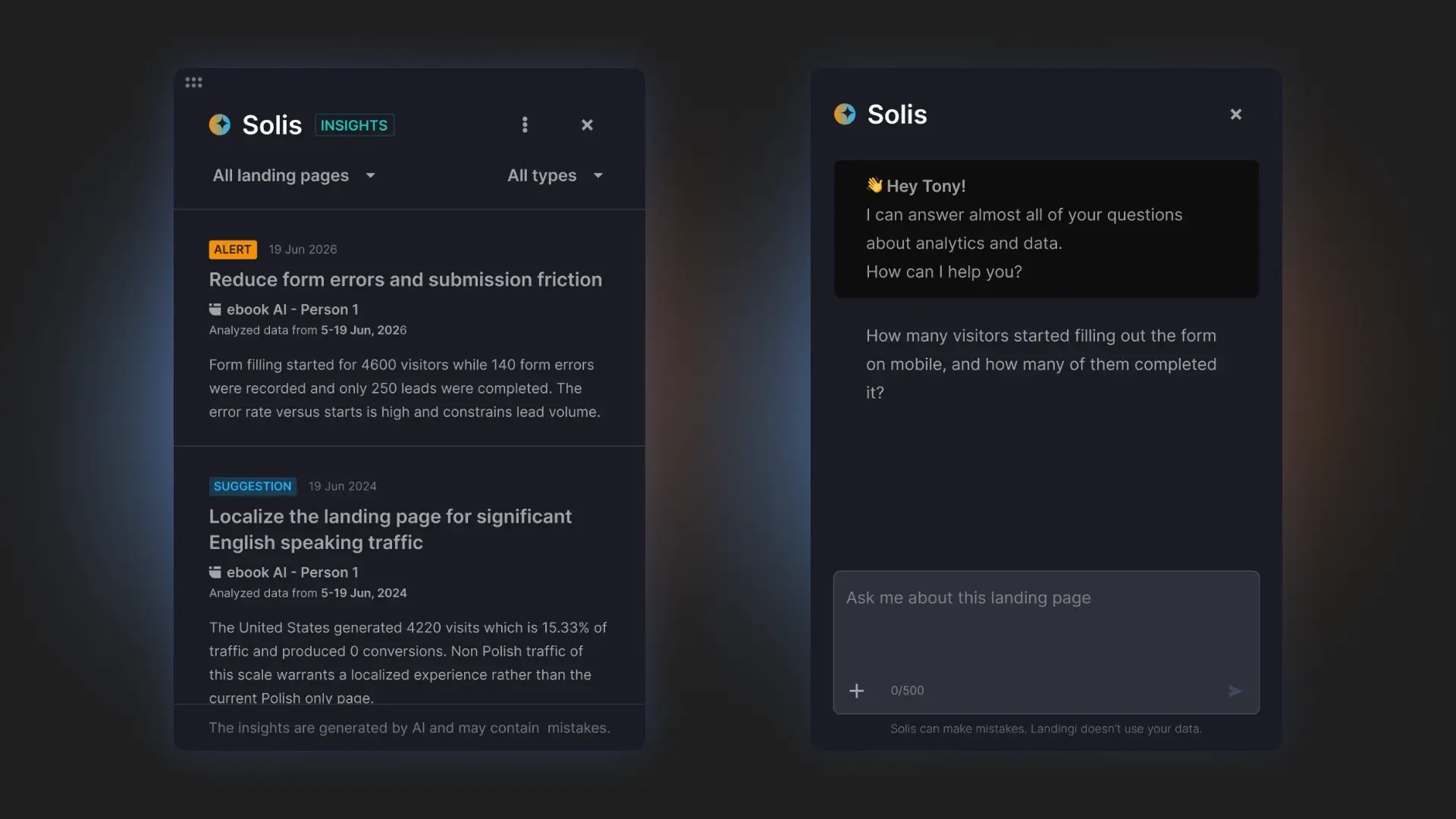
Optimization is equally important. AI landing page operation systems such as Landingi combine page creation, publishing, testing, and optimization in one workflow. Solis analyzes behavioral data collected by EventTracker, identifies friction points, and recommends improvements based on how visitors actually use your landing pages.
Success is measured by business outcomes, including qualified leads, pipeline velocity, customer acquisition cost, lifetime value, and conversion rate. These metrics show which channels, campaigns, and landing pages contribute most to growth.
How to Create B2B Digital Marketing Strategy?
To create a successful B2B digital marketing strategy, define clear business goals, understand your audience, choose the right channels, create relevant content, optimize for conversions, and continuously improve performance using data. Follow these six steps.
Step 1. Define business goals and KPIs
Start with measurable objectives, such as increasing qualified leads by 30%, shortening the sales cycle, or improving pipeline conversion. Then choose KPIs that reflect business impact, including lead quality, customer acquisition cost (CAC), conversion rate, and customer lifetime value (CLV).
Step 2. Understand your audience and buying journey
Define your ideal customer profile and buyer personas, including job roles, company size, industry, and challenges. Then map the buying journey from awareness to decision so every campaign delivers the right message at the right stage.
Create personalized B2B landing pages for every audience segment in minutes.
Step 3. Choose the right B2B marketing channels
Select channels based on where your buyers look for information. LinkedIn, Google Search, email, webinars, industry communities, and account-based marketing (ABM) often work together to support long B2B buying cycles instead of competing with one another.
Step 4. Create content that supports every decision stage
Produce educational content that answers real business questions. Blog articles, whitepapers, comparison pages, case studies, webinars, and ROI calculators help prospects evaluate solutions while establishing your expertise.
Step 5. Build landing pages and optimize lead generation
Direct every campaign to dedicated B2B landing pages instead of generic website pages. Match each page to a specific audience, offer, or buying stage, then use clear forms, proof points, and CTAs to turn traffic into qualified leads.
Modern AI landing page operation systems shorten the path from campaign idea to launch. Lunar, Landingi’s AI-native landing page generator, turns a campaign brief into a complete, editable landing page – including copy, structure, and sections. Generated pages stay inside the Landingi workspace, so teams can publish them on their own domain, manage them from one dashboard, and continue improving them without switching tools
Step 6. Measure, optimize, and scale
Monitor metrics such as qualified leads, lead-to-opportunity rate, pipeline velocity, and ROI. Use these insights to refine campaigns, improve landing pages, and allocate budget to the channels that generate the strongest business results.
Generate complete B2B landing pages from a single campaign brief.
3 Successful B2B Digital Marketing Examples
Successful B2B marketing examples show how different companies combine content, personalization, and digital channels to reach decision-makers. While every business has unique goals, the examples below highlight strategies that consistently support B2B lead generation, brand authority, and long-term customer relationships.
1. Slack Example
Slack built its growth by showing how its platform solves everyday workplace challenges instead of simply promoting features. Product demos, customer stories, video explainers, and industry-specific use cases help prospects understand the value before speaking with sales.
Slack also supports its content with free product access, making it easier for teams to experience the platform and recommend it internally. This combination of educational content and product-led growth has made Slack one of the strongest examples of modern B2B digital marketing.

2. HubSpot Example
HubSpot remains a benchmark for inbound marketing. Its strategy focuses on answering customer questions through blogs, reports, certification courses, templates, and free tools that attract prospects long before they’re ready to buy.
By combining educational resources with CRM, marketing automation, and customer success stories, HubSpot nurtures leads throughout the buying journey and establishes credibility before the first sales conversation.

3. Adobe Example
Adobe combines personalized campaigns with high-value educational content to engage both creative professionals and enterprise buyers. Webinars, customer success stories, product tutorials, and industry reports help different audiences understand how Adobe’s solutions fit their business needs.
The company also tailors messaging across products, industries, and job roles, creating highly relevant experiences that support complex B2B buying journeys and long sales cycles.

FAQ about B2B Digital Marketing
Whether you’re building your first B2B digital marketing strategy or refining an existing one, these answers cover some of the most common questions about B2B digital marketing, lead generation, channels, costs, and tools.
Which B2B tactic should I test next on my landing page to drive qualified leads?
Start by testing role-specific messaging, customer case studies, and stronger calls to action. Decision-makers respond to proof, so showcase measurable outcomes, recognizable client logos, and testimonials relevant to their industry or role. You can also test lead magnets such as ROI calculators, implementation guides, or strategy consultations.
Run A/B tests to compare headlines, page layouts, CTAs, and form lengths. To move beyond assumptions, use behavioral data to understand how visitors interact with your page. AI landing page optimization tools like Solis analyze EventTracker data, identify friction points, and recommend improvements based on actual user behavior, helping teams prioritize changes that are most likely to increase conversions.
Turn data into better-performing landing pages with Landingi!
Where to find the best B2B digital marketing strategy templates?
You can find B2B digital marketing strategy templates on platforms like HubSpot, SlideTeam, and SaaS Hackers. They can help you define goals, document buyer personas, map customer journeys, and plan campaigns across different B2B marketing channels. Choose templates that are flexible enough to adapt to your sales process, target audience, and business objectives.
What is the average cost of B2B digital marketing?
The cost of B2B digital marketing depends on your goals, industry, and campaign scope. Small and mid-sized businesses often invest between $3,000 and $10,000 per month, while enterprise organizations may spend $100,000 or more on multi-channel campaigns. The largest costs typically include paid advertising, content production, marketing technology, and campaign optimization.
What are the most common B2B digital marketing channels?
The most effective B2B marketing channels include LinkedIn, Google Search, email marketing, content marketing, webinars, PPC advertising, and account-based marketing (ABM). Rather than relying on a single channel, successful companies combine multiple touchpoints to engage decision-makers throughout the buying journey and support long-term B2B lead generation.
Where can I find the best B2B digital marketing courses?
Some of the best B2B digital marketing courses are available on HubSpot Academy, LinkedIn Learning, Coursera, and Google Skillshop. They cover topics such as content marketing, SEO, paid advertising, analytics, lead generation, and account-based marketing, making them valuable for both beginners and experienced marketers.
What is the best B2B digital marketing tool?
For B2B lead generation through landing pages, Landingi stands out as an AI landing page operation system that helps marketing teams create, manage, optimize, and scale campaigns from one platform.
Landingi combines AI-powered page creation, analytics, testing, and optimization in one workflow. Lunar, its AI-native landing page generator, turns a campaign brief into a complete, editable landing page, while Solis continuously analyzes behavioral data collected by EventTracker to identify optimization opportunities and recommend improvements based on real visitor interactions. This enables marketing teams to launch campaigns faster and continuously improve conversion performance without disrupting their workflow.
For organizations managing multiple campaigns, this integrated approach simplifies landing page operations while helping maintain consistent performance across different audiences and channels.
Generate, publish, and optimize B2B landing pages from one AI-powered workflow.
How do I choose the best B2B digital marketing agency?
Choose an agency with proven experience in your industry, measurable case studies, and transparent reporting. Look for expertise across multiple B2B marketing channels, including SEO, paid advertising, content marketing, and B2B lead generation, and make sure the agency can align its strategy with your business goals rather than offering one-size-fits-all solutions.
Is digital marketing effective for B2B?
Yes. B2B digital marketing enables companies to reach the right decision-makers, measure campaign performance in real time, and continuously optimize results. Combined with AI, automation, and dedicated B2B landing pages, it helps businesses generate higher-quality leads, shorten sales cycles, and improve marketing ROI.
Convert More B2B Buyers with Smarter Landing Page Operations
Today’s B2B digital marketing is no longer just about choosing the right channels. Success comes from launching campaigns faster, delivering personalized experiences, and continuously optimizing performance based on real user behavior. Dedicated B2B landing pages remain one of the most effective tools for turning campaign traffic into qualified leads.
Landingi helps marketing teams manage this entire process in one AI-powered workflow. Generate landing pages with Lunar, optimize them with insights from Solis, and monitor visitor behavior with EventTracker – all within one AI landing page operation system. Instead of juggling multiple tools, you can create, publish, analyze, and improve landing pages faster while keeping every campaign focused on measurable business results. Try Landingi now!