
An insurance landing page is where a visitor stops comparing providers and starts requesting a quote. Its job is simple: remove distractions, answer key questions, build trust, and make taking the next step feel easy.
Insurance customers rarely make decisions on the first click. They compare providers, coverage options, reviews, and prices before choosing who to trust. A well-designed insurance landing page helps move them from “I’m still researching” to “Show me my quote” by making the decision process clearer and more straightforward.
In 2026, insurance companies are also speeding up how these pages are created and optimized. AI-powered tools can generate complete insurance quote landing pages, while behavioral analytics reveal where potential customers hesitate or abandon forms. Platforms like Landingi bring these workflows together, helping teams launch, analyze, and improve insurance landing pages faster.
Let’s look at some of the best insurance landing page examples and see what makes them convert.

20 Insurance Landing Page Examples
The best insurance landing pages make complex decisions feel simpler. They build trust, explain value clearly, and guide visitors toward requesting a quote or speaking with an advisor.
Below, you’ll find insurance landing page examples from providers across auto, health, life, travel, and business insurance. Each one uses a different approach, but all offer valuable lessons in insurance landing page design and lead generation.
#1 Credit Karma
Credit Karma’s landing page is clear in what it wants visitors to do. This auto insurance landing page is simple, both in design and content.

Simplicity is admirable, but this example might just be a victim of a “too much of a good thing” mentality.
- The form only requires a ZIP code and answering two yes/no questions. From the UX standpoint, it’s a solid choice.
- The landing page is bland in terms of colors. An all-white background with a header, a form, and nothing else except for the footer.
- Speaking of the footer, it takes up too much space. It shouldn’t be on a landing page in the first place, but if it has to be there, it would be wise to make it smaller.
#2 Progressive
Progressive’s landing page has a clear goal of getting a quote for auto insurance.
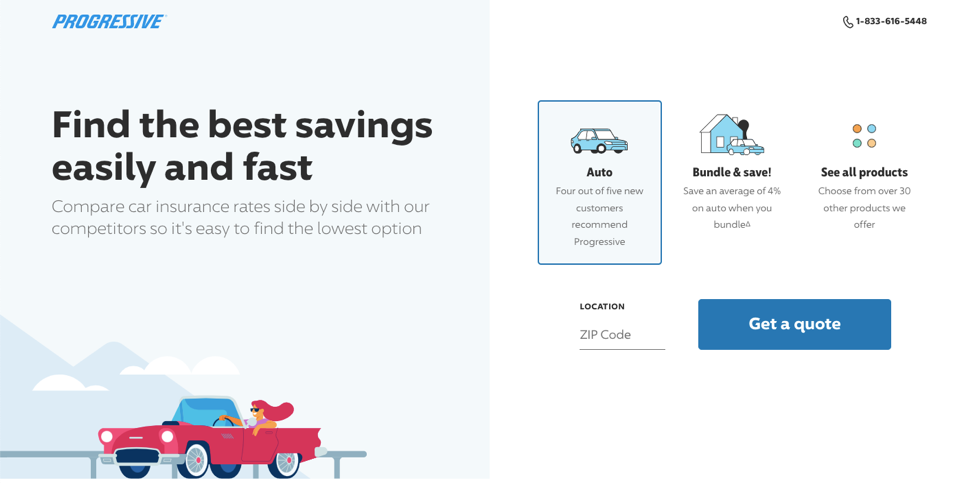
The form is the clear star here, and the rest of the page plays a supporting role.
- The form asks for a ZIP code and a type of insurance, with optional additional buttons.
- The use of tabs that correspond to different parts of the copy is a good solution for saving space.
- The copy is related to auto insurance, so there will be no confusion here.
- The background is mostly white and boring. However, the colors work well together. There is enough contrast to make the copy legible.
- The “#1 Insurance Website” section takes too much space and offers little helpful information.
#3 Liberty Mutual
The page promoting Liberty Mutual’s car insurance starts like a landing page:

but the more you scroll, the more of a typical product page it becomes:
- The hero section of this landing page example is well done. A short and enticing header, a fitting image, and a quick form to fill out.
- Subsequent sections contain lots of links that redirect to other pages in the same domain.
- The sections themselves are informative and written succinctly, but some could be removed to save space.
- The addition of recent testimonials is a solid choice, but they lack real names, which reduces their credibility.
#4 Bupa Private Client
This particular healthcare landing page made by Bupa Private Services has a well-defined target group and messaging.

It targets people who expect a full suite of health-related services and the copy has a luxurious angle to it.
- Design-wise, it attempts to evoke feelings of luxury and exclusivity. The colors of gold and brown, the images, the animations – all of that create an opulent composition.
- The template isn’t too complicated, making it easy to follow.
- The entire page focuses on its goal, with a handful of links taking visitors elsewhere.
- The contact form is too long for the goal of getting a callback. If someone is interested in the service, they can discuss all the required information over the phone. Asking for it upfront might discourage visitors from filling it out.
#5 Axa
The health insurance landing page made by Axa Global Healthcare is comprehensive, and it contains sections that help visitors get the full picture of the offer.

Some of the notable elements include:
- A detailed table with a comparison of cover levels
- An explainer of the steps from the landing page to getting coverage
- A drop-down FAQ section
- Additional, tailor-made options are presented neatly
- Customer rating
A few parts of the page might be distracting, and some links should be removed for that very reason. Overall, though, it’s a solid landing page.
#6 Allianz Care
Just like the example above, the Allianz landing page features a lot of useful information.

In fact, there are a few similarities between Axa and Allianz, but the latter is more in-depth.
- There are links in the top bar that improve navigation on the page by scrolling down to the chosen section.
- A list of costs of common occurrences in various countries shows how much visitors can save by choosing an international insurance plan.
- The “Why Allianz Care” section showcases the unique benefits of the business.
- A great example of social proof: recent testimonials with names and star ratings.
- The landing page design includes a few images; the focus is on the copy instead.
The great aspect of this landing page is it allows visitors to learn about the offer and get a quote quickly. The informational approach can help increase the conversion rate.
#7 Global Rescue
This is a landing page through and through, but it does have one problem that can negatively impact the conversion rate.

Here is what Global Rescue’s page does right:
- The Unique Selling Points are explained clearly.
- The page itself is short but has enough information to convince visitors to get an estimate.
- The personal memberships section shows a variety of benefits.
However, the CTA is the elephant in the room. The “Get a Price Estimate” box does not stand out enough, especially if you consider the red “Visit Our Blog” CTA on the bottom of the page. Focusing on one CTA and making it more visible is a great start for the optimization process.
#8 Insubuy
The landing page Insubuy uses in paid campaigns is a product page.

While the insurance company does a lot to show a value proposition and help the visitors stay on the page and fill out a form, there are a few things to work on.
- The form has multiple fields and requires various personal information, which might not be comfortable for first-time visitors.
- The section called “What does travel insurance include?” has all of the main elements, but some of them have a link to another page.
- The “Insurance Guide” is a list of links for popular inquiries. It can be replaced with an FAQ section.
- Design-wise, it looks a bit dated. A nice, modern travel-focused template would do a much better job here.
#9 Travelinsured
Travelinsured went for minimalism in the design along with structure simplicity, and indeed, in most cases, it does the job smoothly.

What makes it work?
- A clever trick to replace copy with an outstanding background picture carrying a promise of dream travel.
- A form with a CTA button is centered to catch the eyes in a flash.
- The absence of distracting elements enables a clear focus on the target action.
Nevertheless, such an attitude has two weak spots:
- It may be hard to convince hesitant to this offer without a piece of copy underlying its strengths.
- Some fields in the form might be moved to the second step to avoid discouraging the impatient.
#10 Amplify
This is an excellent example of an insurance landing page that does more with less.

Amplify’s page is short, but all the main elements are contained inside.
- The hero section has a persuasive copy.
- The testimonial is presented up top to make sure it’s visible quickly.
- Adding an animation of the process of getting a quote next to benefits saves space.
- The design is simple without being too dull.
Of course, no landing page is perfect. Here are some ways it could improve:
- Adding more testimonials would make a better impression.
- Linking to Trustpilot takes visitors away from the landing page, which poses a risk of them not coming back.
Other than that, this is a good example of a life insurance landing page.
#11 Geico
The insurance company with a gecko as its mascot has a landing page dedicated to its life insurance offers.

Here are some things Geico did right:
- There is a CTA button and a short form in every section.
- Multiple parts of the landing page offer general tips without being too sales-oriented.
- The page layout is clear, making it easy to read and digest all the information.
As for the optimization, this caught my attention:
- External links might ruin visitors’ concentration.
- The FAQ boxes have one-sentence answers with links, so their potential is unfulfilled.
All in all, it’s more of a product page than a landing page, but with a few simple tweaks, the page can become more focused, making it easier to convert.
#12 SoFI
SoFI and Ladder use their landing page as a click-through page to take visitors through multiple conversion funnel steps.

The page has a clear layout, with each section easily distinguishable thanks to different background colors. What else is there to know about this page?
- The use of the “Get my quote” CTA button is consistent across the page.
- It’s not adjusted to larger screens, but it works great on smaller-resolution devices.
- Showing the steps on the landing page is a solid choice.
- The main benefits are presented right below the hero section, so people will see them while scrolling through the page.
- One part of the page (the estate plan) speaks to a different target audience, so it might be a good idea to remove it.
#13 Guardianlife
Guardianlife landing page is sparing with colors and easy-readable.

What is worth noting:
- Dark and deep blue fonts standing out from the background look clear, inviting visitors to read through and be persuaded.
- Copy bearing well-explained “why’s” (Why does a customer need the product? Why should he choose this offer specifically?).
- Intuitive and thoughtful navigation with a primary CTA button in the hero section and the more complex form hidden below (as well as a more detailed offer presentation and FAQ).
- It looks like nothing here is redundant – every element plays its designated role.
While the first impression that comes to mind is “well done!”, this landing page may be too simple and found unattractive by visitors. It is important to the extent that some of them tend to transfer their ratings from one object to another. In this case: from the landing page to the product quality, what may cause they will jump ship to GL competitors.
#14 Zensurance
Zensurance’s business liability insurance landing page lets trust, transparency, and a clear value proposition do the heavy lifting instead of pushing a hard sell.

Winning points:
- Trust signals front and center – Right at the top, Zensurance highlights key achievements with sharp, icon-based stats. These numbers instantly establish credibility before visitors even scroll.
- Reviews that back up the claims – Further down, the page doubles down on trust with testimonials. Instead of just saying they’re the best, they show real people who believe it.
- A compelling savings hook – “Save up to 35% on insurance products” is a simple but powerful incentive. It’s clear, specific, and gives visitors a reason to stick around and explore their options.
Zensurance nails the balance between information and persuasion, making this landing page a perfect example of how to convert visitors without overwhelming them.
#15 Blue Cross Health
Blue Cross Health’s landing page does a great job of making insurance feel approachable. Instead of overwhelming visitors with dense information, it uses smart visuals and a clean layout to naturally lead them to the next step.

What works?
- Clever visual cues – The hero image isn’t just to set a warm, family-friendly tone. The father’s eyelines naturally lead visitors straight to the “Find a plan” button, subtly reinforcing the call to action without being pushy.
- Clear, to-the-point copy – No fluff, no confusion. The page lays out the essentials in a way that’s easy to scan, so visitors know exactly what’s being offered and why it’s worth their time.

With a mix of smart design choices and a friction-free experience, this landing page makes taking the next step feel easy and natural.
#16 Unum Insurance
Unum Insurance delivers a stress-free browsing experience with a clean design and plenty of helpful tools to guide visitors.

Smart moves:
- Clear, easy-to-follow design – The blue and white content blocks create a natural flow, making it easy to explore different insurance options.
- A learning-first approach – Instead of pushing a sale, Unum encourages visitors to explore, learn, and even join a webinar before making a decision.
- Helpful resources – Coverage calculators and FAQs are right where you need them, answering common questions without the hassle.
- Trust-building numbers – Unum highlights key stats, like the number of customers they serve, reinforcing their credibility.

With a welcoming design, useful tools, and a focus on clarity, Unum Insurance makes finding the right coverage feel refreshingly easy.
#17 Allstate
Allstate’s landing page gets straight to business, making it easy for visitors to request a quote without unnecessary steps or distractions. It’s clean, minimal, and focused on usability.

Smart moves:
- Quick insurance selection – Visitors can easily choose multiple insurance types in one go, streamlining the process and saving time.
- Straightforward copy – The messaging is clear, making it easy to understand the next steps.
By keeping things simple and action-oriented, Allstate ensures visitors can get what they need, fast.
#18 Ladder Insurance
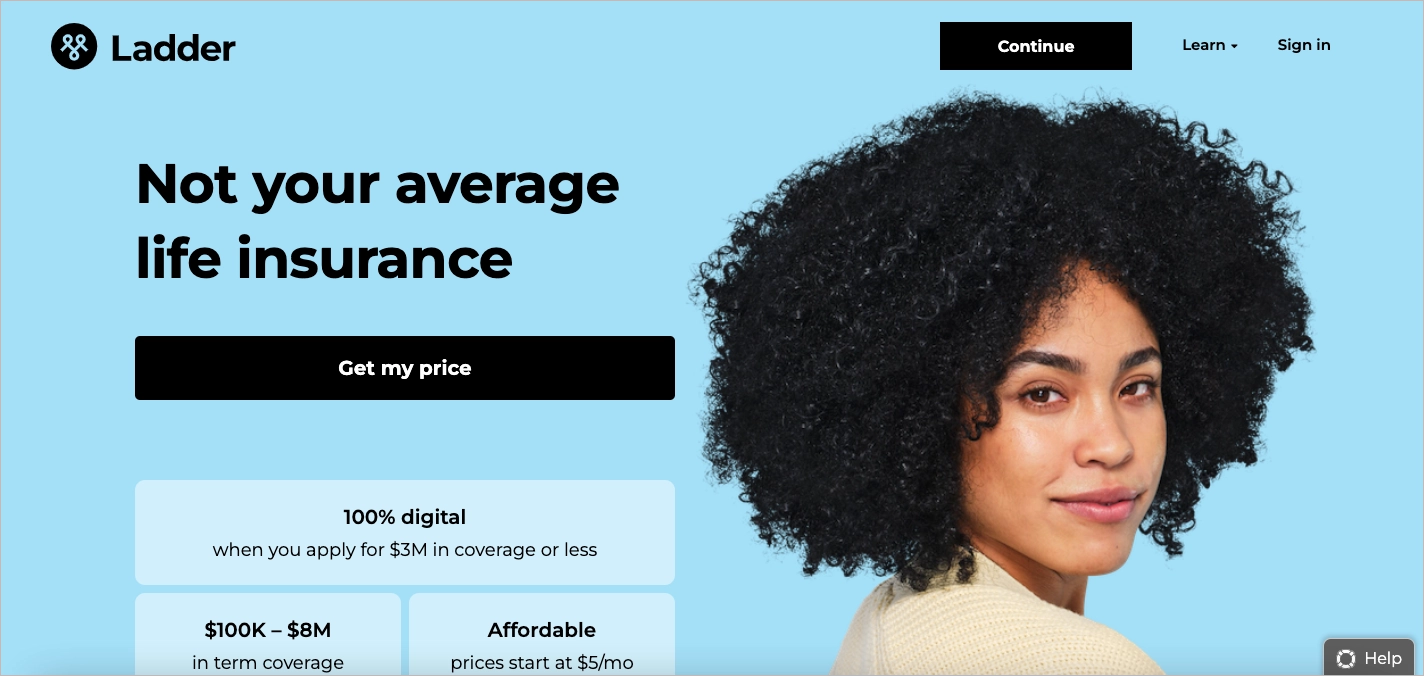
Ladder Insurance nails the first impression with a strong, no-fuss headline that instantly tells visitors what they offer. Their modern, intuitive website makes exploring life insurance options feel effortless, with a layout designed for clarity and ease.
What works?
- Bold, catchy headline – Visitors know exactly what Ladder Insurance specializes in from the moment they land on the page.
- Sticky header for easy action – The “Get My Price” button stays visible as users scroll, keeping the call to action within reach at all times.
- Minimalist, well-balanced design – Just the right mix of text and visuals makes the page clean, engaging, and easy to navigate.
- Helpful tools & support – Coverage calculators, FAQs, and a live chat option ensure visitors get the answers they need without frustration.
With its sharp design and seamless experience, Ladder Insurance makes life insurance feel like a simple, straightforward decision.
#19 Loop Insurance
The Loop Insurance landing page keeps things simple, fair, and easy to navigate.

Worth to appreciate:
- Clean, easy-to-read layout – The horizontal sections of text and images create a natural reading flow, making information easy to absorb.
- Soft, eye-friendly color scheme – The warm yellow background and brown text keep the site visually appealing.
- Strong customer support options – A chatbot, FAQs, and a blog provide multiple ways for visitors to get answers, whether they prefer self-service or direct assistance.
Loop Insurance blends style, clarity, and customer-first features to create a website that feels as welcoming as it is functional.
#20 Omaha Insurance
Omaha Insurance makes the process effortless with clear navigation and an intuitive layout that gets visitors where they need to go – fast. From the moment you land on the page, everything feels designed for convenience.

Smart elements:
- Simple, clear navigation – Well-labeled menu options make it easy to find the right coverage without unnecessary clicks.
- Helpful resources – Coverage calculators and FAQs provide quick answers, keeping potential customers informed and confident in their choices.
Omaha Insurance keeps things simple and stress-free, making it easy to get a quote or find the right coverage without any hassle.
Generate a custom insurance landing page based on your product, audience, and quote process.
How To Create Insurance Landing Page That Generates Quotes?
Creating an insurance landing page no longer has to start with a blank canvas. With AI-powered workflows, insurance teams can turn a campaign brief into a complete insurance quote landing page much faster – especially when they need separate pages for auto, health, life, travel, or business insurance campaigns.
The key is to give AI the same information you would normally prepare for a strategist, copywriter, and designer: the insurance product, target audience, campaign source, conversion goal, trust signals, quote form logic, and tone of communication. In Lunar, Landingi’s AI-native landing page generator, this brief becomes the foundation for the page structure, copy, CTAs, and lead generation flow.
A good AI prompt should explain who the page is for, what the visitor needs to understand before requesting a quote, and what action the page should drive. For insurance, that usually means reducing uncertainty, making coverage easy to compare, and making the quote request feel safe and quick.
Example prompt:
Create an insurance landing page for a regional auto insurance provider offering affordable car insurance quotes for drivers aged 25–55 in Texas. Build the page for a paid search campaign targeting users who compare car insurance prices and want a fast quote.
Use a clean, trustworthy insurance landing page design with a strong hero section, simple headline, short subheadline, and primary CTA: ‘Get My Quote’. Include a multi-step quote form that starts with ZIP code and vehicle type, then moves to driver details and contact information. Keep the form mobile-friendly and easy to complete.

Highlight key benefits: fast quote delivery, flexible coverage options, transparent pricing, local support, safe-driver discounts, bundle discounts, and simple online policy management. Add trust signals such as customer ratings, security badges, licensed agent support, testimonial section, FAQ, and a short explanation of how the quote process works.

Create sections for: hero, benefits, quote form, coverage options, social proof, how it works, why choose us, FAQ, and final CTA. Use clear, human, conversion-focused copy. Avoid jargon, pressure-based language, and overly corporate tone. Make the page feel reliable, simple, and built for people comparing insurance providers.
Within minutes, Lunar can generate a complete insurance lead generation landing page with ready-to-edit copy, trust-building sections, CTAs, and a quote request flow tailored to the campaign.
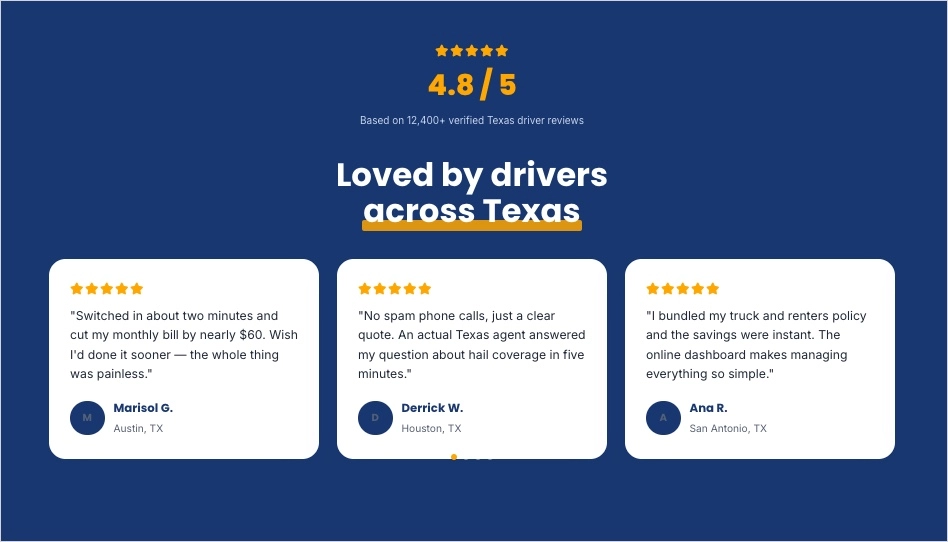
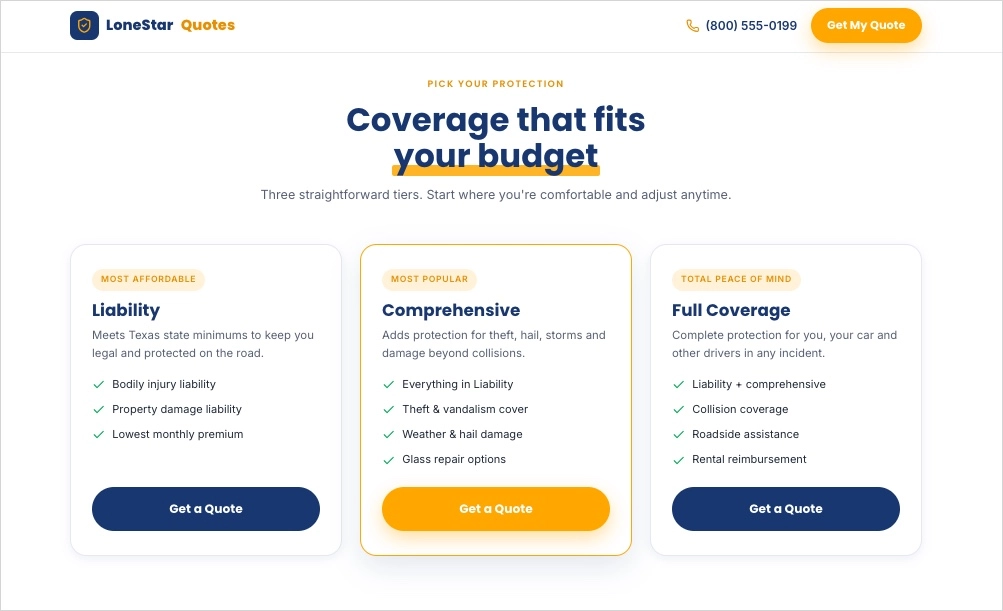
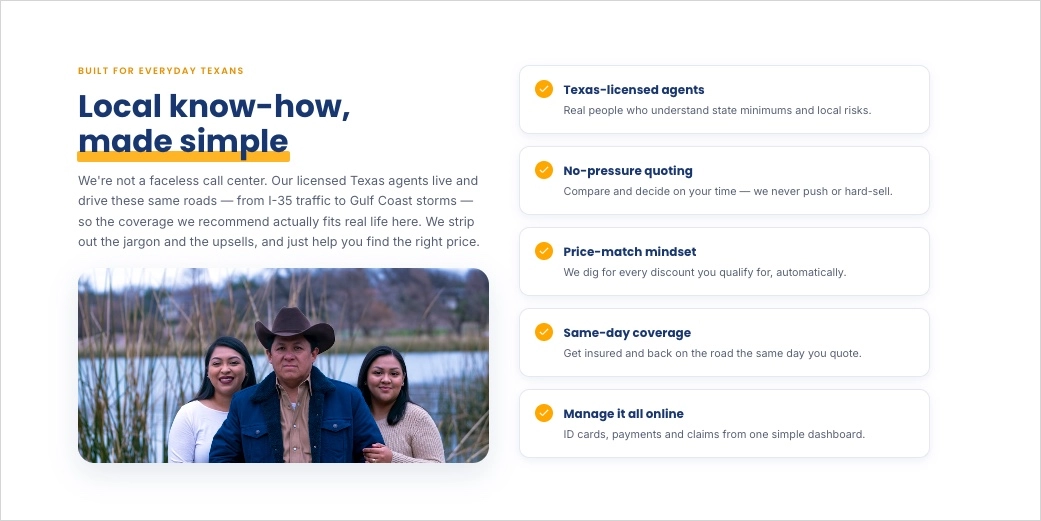
Your team can then refine the page, add brand visuals, adjust legal or compliance-related details, and publish it as a dedicated landing page for insurance ads, email campaigns, or local lead generation.
AI helps most at the first production stage, but optimization still depends on user behavior. After the page goes live, EventTracker can show how visitors interact with the page: where they click, how far they scroll, which CTA they use, and where they abandon the quote form. Solis can analyze that data in the context of the campaign and suggest practical improvements, such as shortening a form step, moving the CTA higher, clarifying coverage benefits, or making trust signals more visible.
This gives insurance teams a repeatable workflow: generate the first version with AI, publish the page, collect behavioral data, and improve the quote flow based on real visitor actions.
Create insurance landing pages, quote forms, and trust-building sections from a single prompt.
7 Best Practices for Insurance Landing Pages
Not every insurance landing page converts equally well. The highest-performing pages don’t simply collect leads – they reduce uncertainty, build trust, and make requesting a quote feel like a natural next step. Here are seven best practices that consistently improve quote generation and conversion rates.
#1 Create Dedicated Pages for Each Insurance Product
A landing page for auto insurance should not look or sound like a landing page for health, life, or business insurance. Different audiences have different concerns, buying triggers, and questions. Dedicated pages allow you to match messaging, benefits, and keywords to each insurance product and campaign.
#2 Use Multi-Step Quote Forms
Insurance quotes often require more information than other lead generation campaigns. Instead of presenting a long form upfront, break the process into smaller steps. Starting with simple questions helps reduce friction and increases the likelihood that visitors will complete the quote request.
#3 Build Trust Before Asking for Information
Insurance is a trust-based purchase. Before asking visitors for personal details, show customer reviews, ratings, testimonials, certifications, security badges, or industry accreditations. Trust signals often have a direct impact on quote request rates.
#4 Keep Coverage Information Simple
Visitors should quickly understand what is covered, what makes the policy valuable, and why they should choose your company. Clear explanations, comparison tables, FAQs, and concise benefit-focused copy usually outperform technical insurance jargon.
#5 Match the Page to the Traffic Source
A visitor clicking an ad for “cheap auto insurance quotes” should land on a page that immediately addresses that promise. Consistent messaging between ads, emails, and landing pages improves trust and often leads to higher conversion rates.
#6 Personalize the Experience
The best insurance landing pages feel relevant to the visitor. Dynamic content based on location, insurance type, campaign source, or audience segment can significantly improve engagement and quote requests.
#7 Optimize with Behavioral Data
Modern insurance landing pages are never truly finished. Tools like EventTracker help identify where visitors click, scroll, and abandon quote forms, while Solis can analyze that behavior and recommend improvements. The most successful insurance companies continuously refine their pages based on real user data rather than assumptions.
Use behavioral insights and AI-powered optimization to identify friction points and increase insurance quote requests.
FAQ About Insurance Landing Pages
Below are answers to some of the most common questions about insurance landing pages, quote generation, conversion optimization, and insurance lead generation campaigns.
What is an insurance landing page?
An insurance landing page is a dedicated page designed to generate quote requests, consultations, or policy inquiries for a specific insurance product. Unlike a traditional website page, it focuses on a single conversion goal and removes distractions that could prevent visitors from taking action.
The best insurance landing pages combine clear coverage information, trust signals, and a simple quote request process. Whether the offer concerns auto, health, life, travel, or business insurance, the goal remains the same: help visitors understand the offer and move them toward requesting a quote.
How can I improve insurance landing page conversion rates?
Improving insurance landing page conversion rates starts with reducing friction and building trust. Multi-step quote forms, clear coverage explanations, customer reviews, trust badges, and visible CTAs can all help increase quote requests.
Modern insurance companies also rely on behavioral analytics to identify drop-off points and optimize the user journey. Tools like EventTracker help reveal how visitors interact with quote forms, while AI optimization tools such as Solis can suggest improvements based on real user behavior.
Use behavioral insights and AI recommendations to reduce friction and increase quote requests.
What is the best insurance landing page builder?
Landingi is one of the best platforms for creating insurance landing pages, because it combines page creation, optimization, and performance analysis in a single AI-powered workflow.
Insurance teams can use Lunar, Landingi’s AI-native landing page generator, to create complete insurance quote landing pages from a prompt. After launch, EventTracker helps analyze visitor behavior through event tracking, scroll maps, and heatmaps, while Solis uses that data to identify optimization opportunities and improve conversion rates. This makes it easier to generate, test, and scale insurance lead generation landing pages without relying heavily on developers or multiple disconnected tools.
Do I need separate landing pages for different insurance products?
Yes. Dedicated landing pages generally perform better because each insurance product addresses different customer needs, concerns, and search intent. Someone looking for life insurance expects different information than someone comparing auto insurance quotes.
Creating separate landing pages for auto, health, life, travel, or business insurance also allows you to align messaging with specific advertising campaigns, keywords, and audiences. This typically leads to more relevant user experiences and higher conversion rates.
Build and optimize insurance landing pages with AI-powered workflows designed for lead generation.
Build Successful Landing Pages for Your Insurance Company with Landingi
The best insurance landing pages do more than collect leads. They help insurance companies turn traffic into quote requests by combining clear messaging, trust signals, and conversion-focused user journeys.
Landingi helps insurance teams generate, launch, and optimize landing pages faster through an AI-powered workflow. With Lunar, teams can create complete insurance quote landing pages from a prompt. EventTracker provides behavioral insights through event tracking, scroll maps, and heatmaps, while Solis analyzes that data and recommends improvements designed to increase conversion rates.
Whether you’re creating a landing page for auto insurance, health insurance, life insurance, or business coverage, Landingi helps you manage the entire process – from page generation and publishing to testing and ongoing optimization.As competition for insurance leads continues to increase, the most successful teams aren’t simply building landing pages. They’re continuously improving them based on real visitor behavior, campaign performance, and AI-driven insights. Try Landingi now!