Enterprise lead generation is less about collecting as many contacts as possible and more about reaching the right accounts, engaging multiple decision-makers, and turning long buying journeys into qualified pipeline. For large organizations, that means coordinating channels, content, targeting, lead qualification, and sales follow-up while keeping campaigns relevant across different audiences and markets.
Dedicated B2B landing pages are an important part of that system. Enterprise teams can use them for lead generation, ABM, webinars, content syndication, and paid campaigns, giving each audience a focused path to conversion. With Landingi, teams can create and launch these pages faster than through a traditional CMS, without waiting on developers for every campaign, then personalize, test, analyze, and scale them within one AI landing page operation system.
Key Facts
- Enterprise lead generation prioritizes qualified and sales-ready leads over raw lead volume.
- Buying decisions often involve multiple stakeholders, longer sales cycles, and more touchpoints than SMB sales.
- ABM, content syndication, webinars, paid acquisition, and targeted content are key enterprise lead generation tactics.
- Dedicated lead generation landing pages connect campaigns with measurable conversion actions and make testing and personalization easier.
- AI can support targeting, personalization, campaign creation, landing page production, and optimization at enterprise scale.
The strongest enterprise lead generation strategy connects these pieces into one system, so marketing isn’t simply generating more leads – it’s creating better opportunities for sales to turn into revenue.

What is Lead Generation Strategy in Enterprise Company?
An enterprise lead generation strategy is a structured way to attract the right accounts, turn their interest into qualified leads, and move them toward sales. The goal isn’t to fill the CRM with as many contacts as possible, but to create opportunities with companies that have real buying potential.

Enterprise lead gen has more moving parts: longer sales cycles, larger buying committees, higher deal values, and multiple touchpoints. That usually means combining content and SEO with ABM, paid campaigns, webinars, and other targeted tactics, while keeping marketing and sales closely aligned.
CRM, automation, analytics, and lead generation landing pages connect those efforts and show which prospects are actually moving forward. At enterprise scale, success is ultimately measured by lead quality and pipeline impact, not lead volume alone.
Uncover smarter ways to fill your pipeline! Discover enterprise-ready lead gen that scales.
How to Build an Enterprise Lead Generation Strategy?
To build an enterprise lead generation strategy, start with the revenue goal and work backward: define which accounts matter, who is involved in the buying decision, what signals indicate real intent, and what needs to happen before a lead is ready for sales. At enterprise scale, generating more contacts is rarely the hard part. The challenge is consistently finding the right ones and moving them forward.

Start by defining your ideal customer profile (ICP) using firmographic criteria such as industry, company size, revenue, geography, and technology stack. Then segment target accounts by priority. High-value accounts may justify one-to-one or one-to-few ABM campaigns, while broader segments can be reached through scalable paid campaigns, webinars, content syndication, SEO, and targeted content.
Next, map the buying committee, not just a single persona. Enterprise purchases can involve end users, department heads, technical evaluators, procurement, finance, and executives, each with different questions and objections. Your messaging and content should reflect those roles and the stage of the buying journey they’re in.
Capture leads on autopilot with purpose-built landing pages! Your funnel’s secret weapon is one great page away.
Build conversion paths for each major campaign and audience. Dedicated lead generation landing pages can connect an ad, webinar, report, ABM campaign, or other offer with one clear next step. Instead of sending different audiences to the same generic website page, you can match the message and offer to the account segment, campaign, or buying stage.
Then define what makes a lead genuinely qualified. Combine fit data with behavioral and intent signals, establish lead or account scoring criteria, and agree with sales on when a prospect becomes an MQL, SQL, or sales-ready lead. Routing rules and response times should be explicit too – a high-intent prospect loses value quickly if nobody knows who should follow up.
Finally, measure the strategy against pipeline, not just lead volume. Track landing page conversion rates, cost per qualified lead, MQL-to-SQL progression, opportunities created, pipeline generated, and ultimately revenue. Use those results to refine targeting, offers, channels, and conversion paths over time.
Use EventTracker to analyze how prospects interact with your lead generation landing pages and find where engagement turns into conversion.
4 Tips in Lead Generation for Enterprise Companies
Four enterprise lead generation tactics are especially useful when scale and lead quality need to work together: account-based marketing, personalized automation, content syndication, and data-driven paid campaign optimization. Each addresses a different part of the journey from target account to qualified pipeline.

1. Target high-value accounts with scalable ABM
ABM concentrates marketing and sales resources on accounts with the strongest revenue potential. Start with a shared ICP, then use CRM data, firmographics, technographics, and intent signals to identify and prioritize target companies.
From there, tailor campaigns to both the account and the people involved in the decision. Platforms such as 6sense and Demandbase can support account identification and targeting, while dedicated B2B landing pages give each segment or priority account a more relevant post-click experience.
Create dedicated landing pages for your highest-value accounts with Landingi.
Automation helps scale the strategy without making it generic. High-intent actions, such as repeated product-page visits or engagement with gated content, can trigger appropriate nurture flows or alerts for sales.

2. Automate personalized journeys across channels
Enterprise buyers rarely convert after one interaction. Connect CRM and marketing automation data so email, ads, content, and landing pages can respond to what prospects have already viewed, downloaded, or requested.
Personalization can vary by industry, account tier, buying role, funnel stage, or behavior. A prospect returning after a webinar, for example, shouldn’t necessarily receive the same message as someone arriving from a first-touch LinkedIn ad.
The goal is not automation everywhere. It’s using automation to keep a complex buyer journey relevant without requiring teams to manage every interaction manually.

3. Use content syndication to reach new buying audiences
Content syndication extends high-value assets such as research reports, whitepapers, webinars, and industry guides beyond your owned channels. Networks such as NetLine and TechTarget can put that content in front of relevant professional audiences and capture leads showing interest in the topic.
But syndicated leads shouldn’t automatically be treated as sales-ready leads. Connect them with qualification and nurturing workflows, and use campaign-specific lead generation landing pages when prospects move from content consumption toward a stronger conversion action.
One strong asset can support multiple campaigns, audiences, and funnel stages. The value comes from what happens after the download, not simply how many downloads it generates.

4. Optimize paid campaigns with behavioral data and CRO
For enterprise teams managing significant paid media budgets, improving conversion efficiency can create meaningful gains without buying more traffic. Start with precise audience segmentation, then make sure the post-click experience continues the promise made in the ad.
Dedicated landing pages make that experience easier to measure and improve. Test meaningful differences in headlines, offers, messaging, and page structure rather than making changes based on preference alone.
In Landingi, EventTracker can show how visitors click, scroll, and interact with a page, while A/B testing validates alternative versions. Solis takes optimization further by analyzing behavioral data in the context of the landing page and campaign and surfacing recommendations about what may be worth improving next.
Even tiny tweaks can skyrocket your results. A/B test your way to higher ROI – it starts with one variation!
That creates a more useful CRO loop: target → convert → observe → test → optimize. For high-volume enterprise campaigns, even modest improvements at the conversion stage can translate into more qualified leads from the same media spend.
5 Examples of Lead Generation in Enterprise Companies
The strongest enterprise lead generation campaigns rarely depend on one channel. They combine precise account targeting, useful content, dedicated conversion paths, behavioral or intent data, and coordinated sales follow-up. These five examples show different ways large B2B organizations have put those principles into practice.
1. Account-based marketing (ABM) – Snowflake
Snowflake provides a strong example of using ABM to make enterprise outreach more relevant at scale. Rather than treating every prospect the same, its team built personalized content experiences for target accounts and combined them with account-level advertising through Terminus.
A key part of the strategy was coordinating marketing with BDR and field sales teams. Personalized content could support outreach to different stakeholders within an account, while engagement data showed which companies were actually consuming content and deserved more attention.
The lesson for B2B enterprise lead generation is bigger than personalization itself: ABM works when targeting, content, account engagement data, and sales follow-up operate as one system.
Use Landingi to test and improve the landing pages behind your paid campaigns.
2. Intent data targeting – IBM
IBM’s Watson Analytics campaign is an older example, but it remains a useful illustration of how intent data can sharpen enterprise targeting. IBM combined Bombora’s Company Surge data with LinkedIn Account Targeting to identify businesses actively researching topics related to analytics and reach relevant marketing and technology professionals inside those organizations.
Bombora identified around 12,000 companies showing strong interest across multiple relevant topics, plus another 40,000 showing interest in at least one. IBM then focused LinkedIn Sponsored Content on those accounts rather than relying only on broader professional targeting.
The principle remains highly relevant in 2026: intent signals help enterprise teams prioritize accounts that are already demonstrating interest instead of treating every ICP-fit company as equally ready to buy.
Create dedicated B2B landing pages for priority accounts and campaigns instead of sending every prospect to the same generic destination.
3. Multi-channel demand generation – Cornerstone OnDemand
Cornerstone OnDemand shows how multiple acquisition channels can support the same enterprise conversion strategy. Its campaign combined Google, LinkedIn, Demandbase, Drift, content marketing, and improvements to its web experience rather than expecting one channel to generate the entire pipeline.
The team also tested different offers, including webinar registrations, demo requests, podcasts, downloadable assets, and an ebook. The ebook generated the strongest response, suggesting that prospects wanted useful information before moving toward a more sales-focused interaction
This is a useful reminder that multi-channel lead generation strategies need a shared conversion point. Ads can come from several channels, but the landing page and offer should make the next step obvious and measurable.

4. Webinar demand generation – Splunk
Splunk turned webinars into a structured demand generation program rather than treating them as isolated online events. Working with ON24 and its marketing automation system, the company used attendee behavior, poll responses, questions, and other engagement signals to identify stronger prospects and trigger appropriate follow-up.
The webinar experience was also connected to more targeted promotion and customized landing pages and emails. That matters in enterprise campaigns because registering for a webinar is only the beginning – engagement during and after the event provides additional signals about who may be moving closer to a buying decision.
Splunk’s example shows why webinars remain useful for enterprise lead generation: they combine education with measurable engagement, giving marketing and sales more information than a simple content download.
Build dedicated webinar landing pages and track what prospects do before moving them into the next stage of your funnel.
5. Thought leadership and research – Salesforce
Salesforce demonstrates a broader enterprise content strategy built around research, educational resources, webinars, articles, and other content for different stages of the buying journey. Its recurring State of Sales research is a good example of content designed around questions sales leaders are already trying to answer.
For enterprise marketers, the useful lesson isn’t simply “publish more content.” High-value research gives paid, organic, email, social, and sales campaigns something substantive to distribute. Dedicated lead generation landing pages can then connect individual assets and audiences with measurable next steps, rather than expecting content consumption alone to produce pipeline.
The stronger takeaway is that thought leadership can create demand and support lead nurturing across a long enterprise buying cycle – especially when content, distribution, conversion points, and sales follow-up are planned together.
Why Is Lead Generation Important for Enterprise Companies?
Lead generation is important for enterprise companies because it creates a predictable flow of qualified leads for sales to develop into opportunities. With long sales cycles and large buying committees, enterprise teams can’t rely on demand appearing at exactly the right moment – they need a consistent way to identify and engage potential buyers earlier.
A strong enterprise lead generation strategy also helps marketing and sales focus their resources. Intent signals, engagement data, and lead qualification reveal which accounts deserve attention, while campaign performance shows which channels and offers actually contribute to pipeline.
That makes lead generation more than a way to fill the CRM. Done well, it connects marketing activity with sales opportunities, supports expansion into new segments, and gives enterprise teams a clearer path from interest to pipeline to revenue.
What’s the Use of Landing Pages in Lead Generation for Enterprise Companies?
Landing pages give enterprise lead generation campaigns a dedicated place to turn interest into measurable action. Instead of sending prospects from an ad, ABM message, webinar invitation, or content campaign to a generic website, teams can match the page to the specific audience, offer, and next step.

That becomes especially important at enterprise scale. One company may need separate B2B landing pages for industries, account tiers, buyer roles, regions, products, and campaign stages. The challenge is no longer creating one good page – it’s managing dozens or hundreds of relevant pages without turning every campaign launch into a development project.
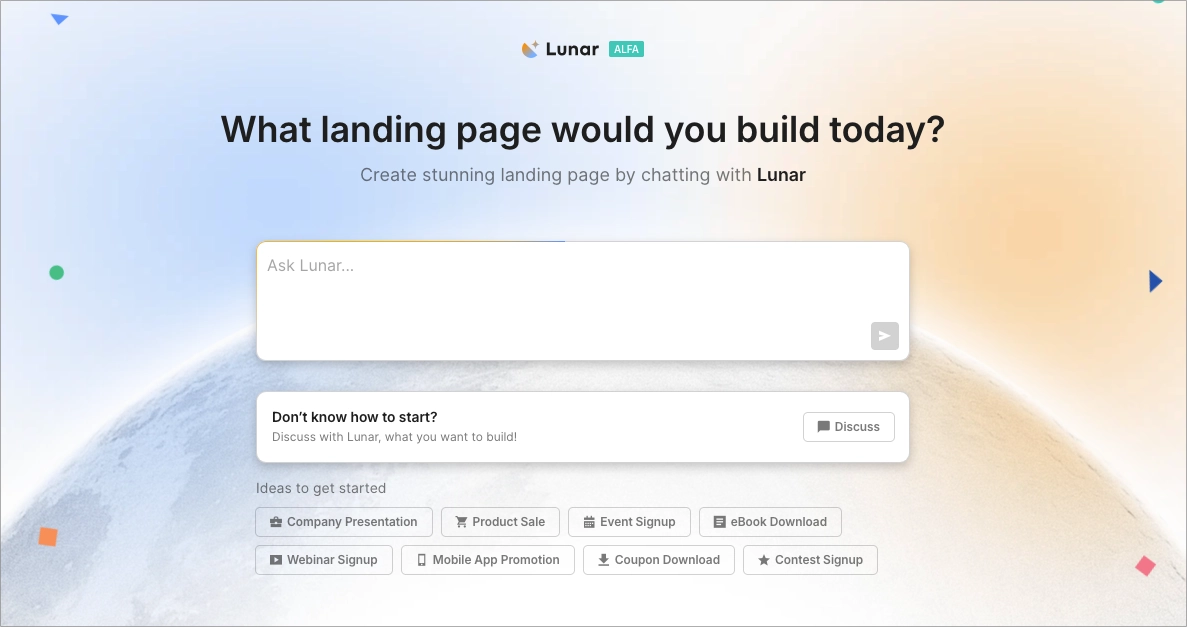
This is where Landingi becomes part of the enterprise lead generation workflow. As an AI landing page operation system, it lets teams create, personalize, test, and manage campaign pages without relying on developers for every change. Lunar, its AI-native landing page generator, can generate complete, editable pages from prompts, helping teams move faster from campaign brief to launch across paid campaigns, ABM, webinars, and content syndication.
Once those pages are live, the same workflow moves into optimization. EventTracker captures clicks, events, and scroll behavior, A/B testing validates different messages and page variants, and Solis analyzes behavioral data in the context of the page and campaign to surface optimization recommendations. CRM and marketing automation integrations can then connect captured leads with qualification, nurturing, and sales follow-up.
For enterprise teams, landing pages become the measurable layer between acquisition and pipeline – where campaigns can be launched faster, personalized at scale, and continuously improved based on how prospects actually behave.
Create, manage, test, and optimize enterprise landing pages with Landingi – without making every campaign dependent on developers.
How AI Supports Lead Generation for Enterprise Companies?
AI supports enterprise lead generation by helping teams decide who to target, personalize outreach, create campaign assets faster, and identify what needs optimization. At enterprise scale, its biggest advantage is not simply automation – it is making large amounts of data, content, and campaign work easier to act on.
AI for targeting and lead scoring
AI can analyze firmographic, behavioral, and intent signals to identify accounts that are more likely to be in-market. Predictive scoring tools can then help marketing and sales prioritize qualified leads instead of treating every contact or target account equally.
For enterprise teams managing thousands of prospects, this makes prioritization far more practical: sales can spend more time on accounts showing meaningful intent while lower-priority leads remain in automated nurture flows.
AI for personalization
AI makes it easier to adapt messaging to different industries, buying roles, account tiers, and funnel stages without manually rewriting every campaign asset. That can include personalized emails, ads, content recommendations, and B2B landing pages built around the context of a specific audience.
The goal isn’t personalization for its own sake. It is to make the next interaction feel relevant to what that prospect is actually evaluating.
AI for content and campaign creation
AI can accelerate the production of campaign briefs, ad copy, email sequences, webinar promotion, content variations, and other assets needed across enterprise campaigns. This gives teams more room to test different approaches without turning every new segment or campaign into another long production cycle.
It also makes experimentation more realistic at scale. Instead of producing one message and using it everywhere, teams can create variations for different accounts and audiences, then use performance data to determine which ideas deserve further investment.
AI for landing page creation and optimization
AI can also shorten the path from campaign idea to measurable lead generation landing page. In Landingi, Lunar is an AI-native landing page generator that turns a prompt into a complete, editable page. A team can describe the campaign, audience, offer, messaging, and desired structure, generate the first version, refine it if needed, and publish it within the same landing page operation system.
Once the campaign starts generating traffic, AI can support the other side of the process: deciding what to improve. EventTracker collects behavioral data such as clicks and scroll depth, while Solis analyzes that data together with the page and campaign context to surface alerts, discoveries, and optimization recommendations. Instead of creating pages faster but leaving optimization manual, teams can connect creation with a continuous feedback loop.
For enterprise teams already working heavily inside LLMs, Orbit extends that workflow further. As Landingi’s MCP server, it connects Lunar, Solis, and the Landingi platform with a preferred LLM, reducing the need to manually move briefs and performance information between tools.
The real value of AI in B2B enterprise lead generation is therefore not generating more assets for the sake of volume. It’s helping teams move faster from targeting → personalization → creation → behavioral data → optimization, while keeping each stage connected.
Turn real visitor behavior into clear, AI-powered landing page recommendations.
What are the Benefits of Lead Generation for Enterprise Companies?
The main benefits of enterprise lead generation are a more predictable pipeline, better use of marketing spend, stronger sales alignment, and deeper insight into potential buyers. Instead of relying on a handful of large opportunities, teams can continuously identify and develop accounts with real buying potential.

A structured lead generation process also makes growth easier to measure. Teams can see which channels, campaigns, and offers produce qualified leads, then direct budget and sales attention toward what actually contributes to pipeline.
It also gives marketing and sales a shared view of the buyer journey. Common qualification criteria, scoring models, and CRM data help both teams recognize when a prospect is ready to move forward.
Over time, those interactions reveal which messages resonate, what buyers care about, and where prospects tend to stall. That insight improves targeting and conversion while making future lead generation strategies more precise.
What Are the Main Challenges of Enterprise Lead Generation?
The main challenges of enterprise lead generation are long sales cycles, complex buying committees, inconsistent lead quality, operational complexity, and difficult attribution.
Enterprise deals can take months and involve multiple stakeholders, so even promising accounts need consistent nurturing. At the same time, high lead volume means little if only a small share becomes qualified or sales-ready leads. Clear scoring and qualification criteria help teams focus on prospects with real buying potential.
Scale makes execution harder. ABM, paid campaigns, webinars, content syndication, and multiple lead generation landing pages must stay coordinated across teams, markets, and channels.
Attribution is another challenge. Buyers may interact with several ads, pages, emails, reports, and webinars before speaking to sales. Connecting these touchpoints helps teams understand which enterprise lead generation tactics actually contribute to pipeline and deserve further investment.
FAQ About Enterprise Lead Generation
Enterprise lead generation involves longer buying cycles, more stakeholders, and more complex measurement than smaller-scale lead gen. These answers cover the key differences, metrics, and tools involved.
How is enterprise lead generation different from SMB lead generation?
Enterprise lead generation targets larger accounts with longer sales cycles, higher deal values, and multiple decision-makers. While SMB campaigns can often focus on individual leads and faster conversions, enterprise strategies typically rely more on account-level targeting, ABM, lead scoring, personalization, and coordinated marketing and sales activity.
How do you measure enterprise lead generation success?
Useful metrics that measure enterprise lead generation include qualified leads, sales-ready leads, MQL-to-SQL conversion, cost per qualified lead, opportunities created, pipeline generated, sales cycle length, and revenue influenced or generated.
Campaign-level metrics still matter. For example, tracking the conversion rate and engagement of lead generation landing pages can reveal which audiences, offers, and messages are contributing to pipeline.
What tools are useful for enterprise lead generation?
Enterprise teams typically use a connected stack of CRM, marketing automation, intent data, analytics, ABM, and landing page tools. Platforms such as Salesforce or HubSpot can manage customer and lead data, while tools such as 6sense support account identification and intent-based targeting.
For campaign execution, Landingi provides an AI landing page operation system for creating, managing, testing, and optimizing B2B landing pages at scale. Lunar generates editable landing pages from prompts, EventTracker captures visitor behavior, and Solis turns that data into AI-powered optimization recommendations.
Accelerate Enterprise Lead Generation with Landingi
Enterprise lead generation works when targeting, campaign execution, conversion, and optimization stay connected. ABM, webinars, content syndication, and paid campaigns can bring the right accounts in, but each still needs a focused place where interest turns into a measurable next step.
Landingi gives enterprise marketing teams an AI landing page operation system for running that conversion layer at scale. Teams can use Lunar to generate complete, editable landing pages from prompts, create campaign-specific and personalized variants without waiting on developers, and manage multiple pages across teams, markets, and campaigns while maintaining brand control.
Once pages are live, EventTracker captures visitor behavior, A/B testing validates different approaches, and Solis analyzes page and campaign data to identify optimization opportunities. Combined with integrations, user management, and enterprise-scale landing page operations, this creates a continuous workflow from campaign idea to qualified leads and ongoing improvement.
Instead of treating landing pages as the final asset in a campaign, enterprise teams can make them an active part of their lead generation strategy – faster to launch, easier to scale, and built to improve as new data comes in. Build, manage, test, and optimize B2B landing pages with Landingi, and turn more enterprise campaign traffic into qualified pipeline.