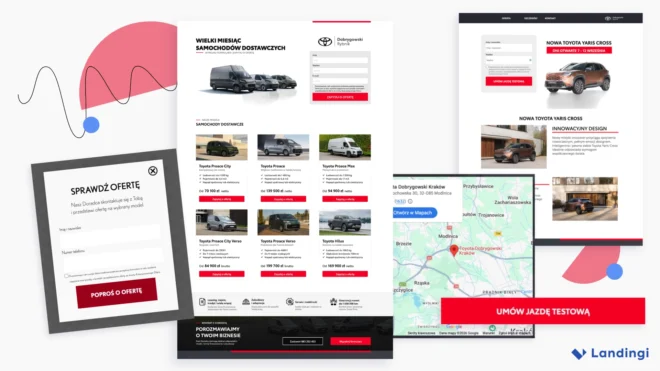
Toyota Dobrygowski runs campaigns for individual car models, dealership events, seasonal sales, and commercial vehicles. Each targets a different customer need, but all share one objective: turn online interest into a conversation with the dealership.
Using Landingi, the company creates dedicated landing pages for campaigns across locations, including Kraków and Rybnik.
The pages share recognizable branding, but their structures change with the offer. And the performance data shows why a single landing page format isn’t always the answer.
The Approach: Different Offers Need Different Pages
Buying a car involves different decisions at different stages.
Someone interested in a Toyota Yaris Cross may want to schedule a test drive. A visitor exploring a year-end sale may compare several models and financing options. A business owner looking for a commercial vehicle may prioritize payload capacity and operating costs.
Toyota Dobrygowski builds its landing pages around these differences.
Its campaigns use multiple domains and dedicated URLs, while pages in Landingi are organized by dealership location. This helps separate local promotions and manage different offers without losing brand consistency.
The landing pages follow three distinct approaches.
Model-specific pages: one car, one action
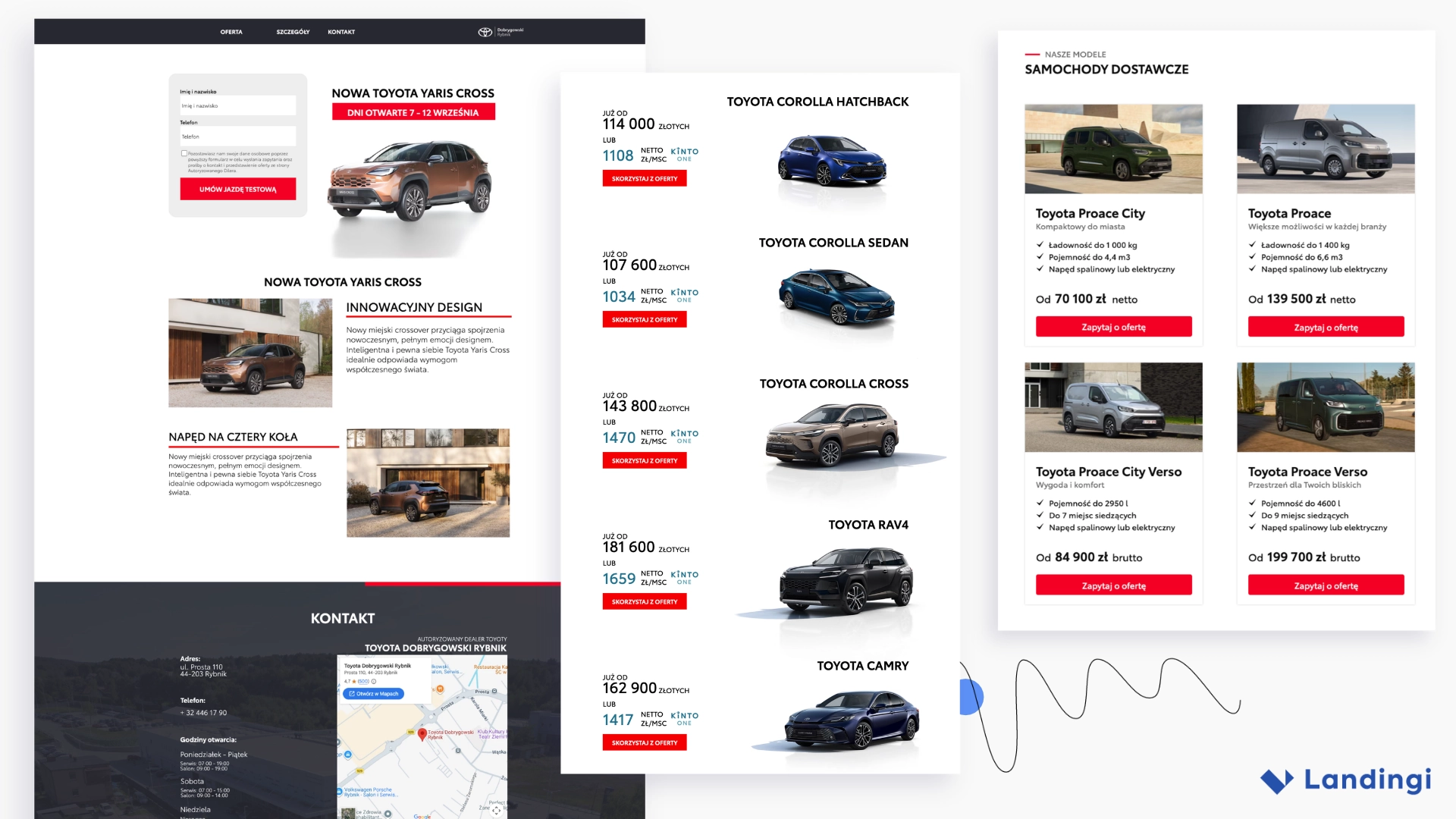
The Yaris Cross and Hilux campaigns put the vehicle and test-drive form directly in the hero section. Supporting sections introduce the model’s design, features, and technical specifications without distracting visitors with unrelated offers.
The result is a focused experience for people who already know which car interests them.
The lesson: When visitors arrive from an ad promoting a specific model, show that exact vehicle and make the next step immediately available.
Seasonal sales: make comparison easy
The year-end sale pages feature multiple Toyota models, each with an image, starting price, financing information, and CTA. Visitors can compare options directly on the page instead of navigating through a dealership’s full inventory.
Although the page presents many vehicles, the CTAs support one conversion goal: requesting an offer.
This is particularly useful for campaigns where the promotion covers an entire range rather than a single product.
The lesson: Multiple products don’t have to mean multiple conversion goals. Help visitors compare options while keeping the action consistent.
Commercial vehicles: focus on practical value
The commercial vehicle campaign takes a different approach. Vehicle cards highlight payload capacity, cargo volume, seating configurations, and pricing. Additional sections explain financing, customization, warranty, and service benefits.
The page also offers direct contact with an advisor who can help match a vehicle to business needs.
The lesson: Show specifications that support the actual buying decision. Commercial customers need different information from visitors browsing passenger cars.
The Results: Similar Campaigns, Different Outcomes
The clearest performance difference appears between the Kraków and Rybnik year-end sale pages.
Both campaigns promote multiple Toyota models with similar pricing information and offer-related CTAs. Yet the Kraków landing page recorded a conversion rate more than three times higher than the Rybnik version. Visitors also spent nearly twice as much active time on the Kraków page.
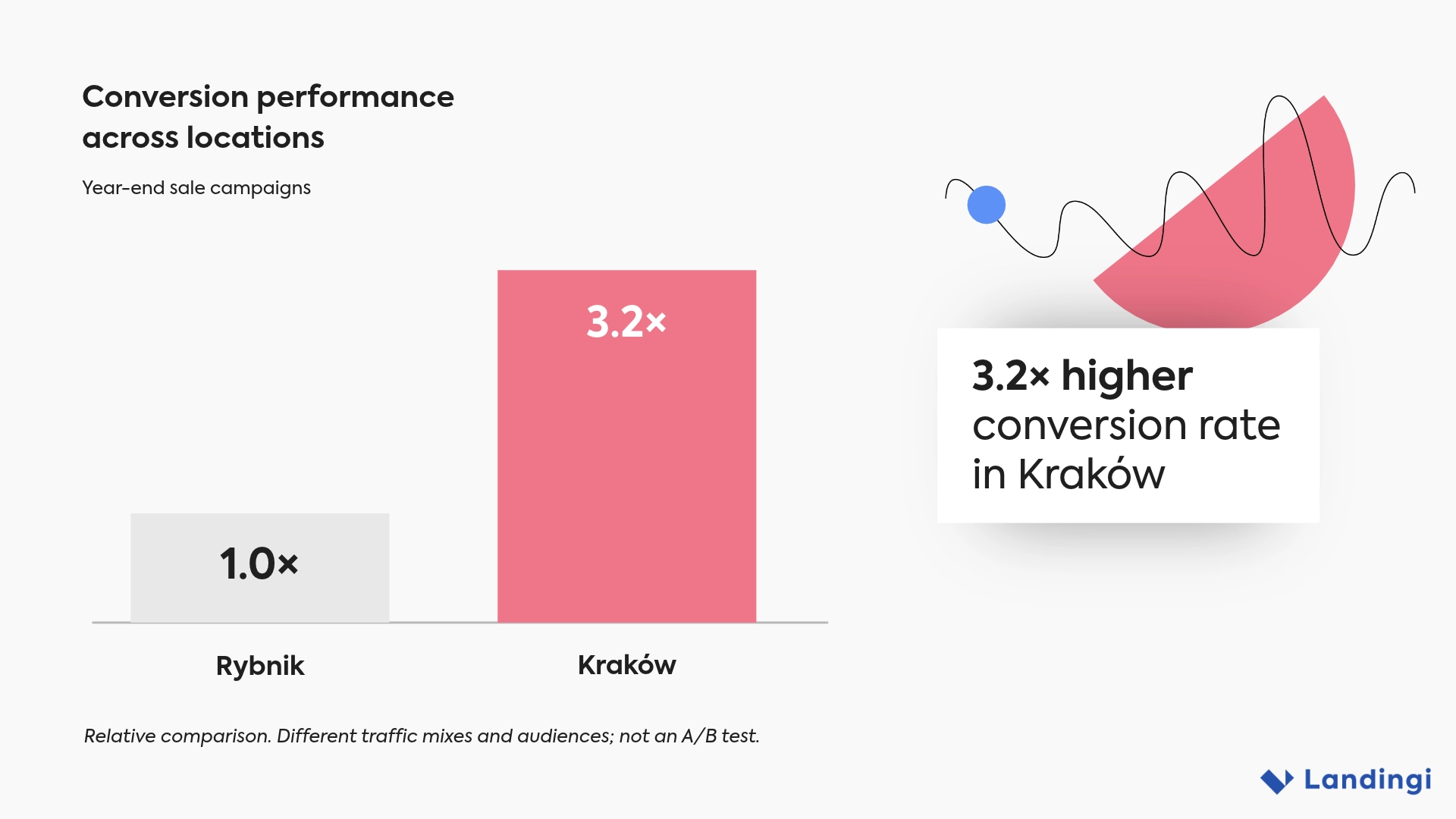
The layouts differ, but so can local demand, traffic quality, and visitor intent. The comparison doesn’t prove which factor drove the results.
It does demonstrate why performance should be evaluated separately for each location, even when campaigns share the same theme.
Form behavior provides another useful insight.
The used-car open-days page converted more than half of visitors who started filling out its form. The Kraków year-end sale page achieved a form completion rate of approximately 45%, while the Rybnik campaign recorded a substantially lower rate.
With Landingi’s EventTracker, marketers can look beyond the overall conversion rate to see how visitors interact with each page. Form starts and submissions, CTA clicks, and scroll depth help identify where visitors engage and where they may encounter friction.
These insights are particularly useful when comparing campaigns across locations, where similar offers can lead to very different visitor behavior.
Conversion Paths: Forms, CTAs, and Lightboxes
Toyota Dobrygowski makes lead forms available early on its landing pages, often directly beside the vehicle or promotional offer.
The forms request basic contact details, while the CTA reflects the campaign’s purpose: scheduling a test drive, checking an offer, or requesting a quote.
Some pages also use lightboxes with additional forms.
Instead of placing a separate form beside every vehicle, the team uses offer-related buttons that open a lightbox. Visitors can explore the available models first and request contact when they find something relevant.
The lightbox explains that an advisor will follow up with information about the selected vehicle.
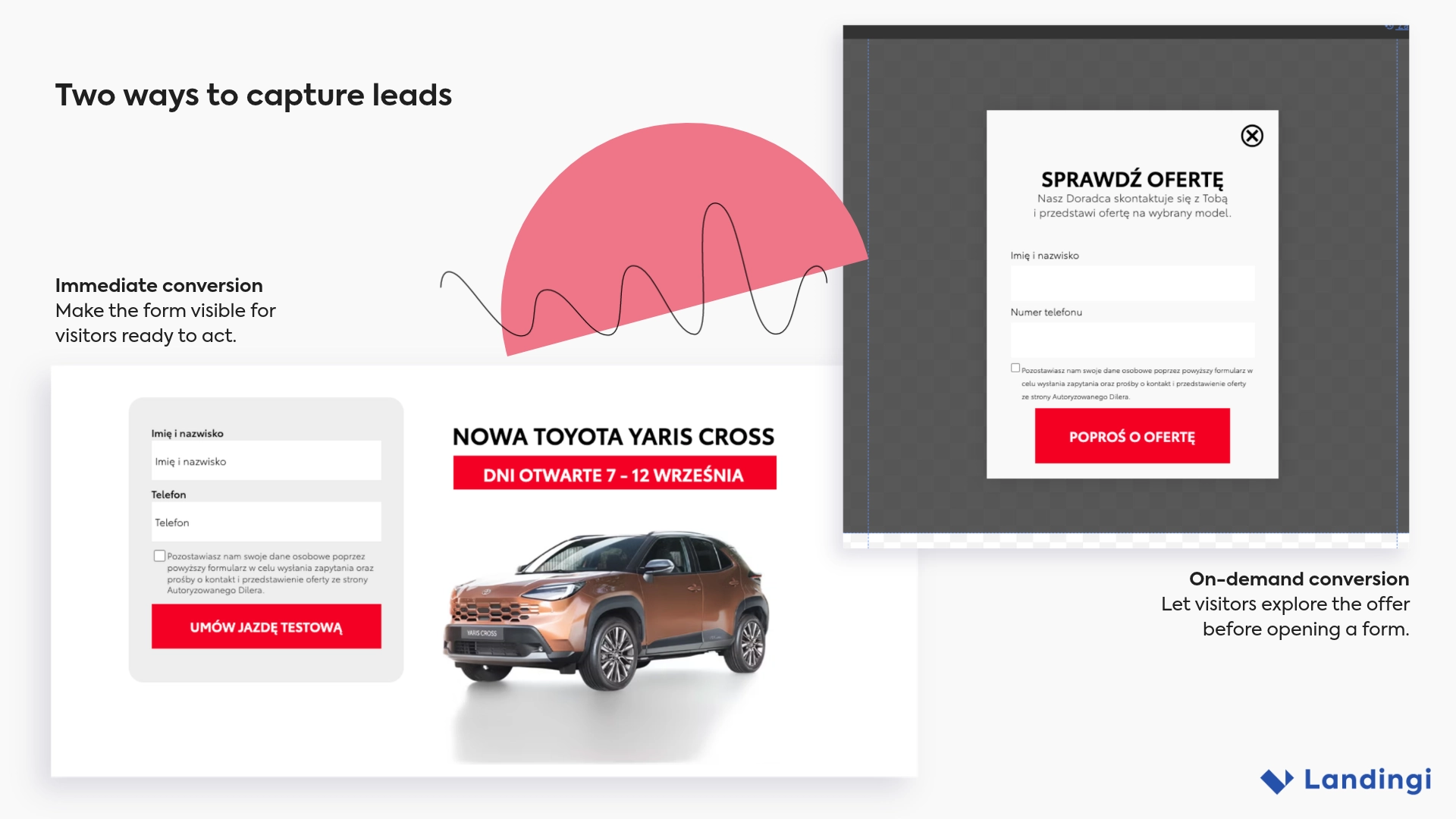
This creates a useful balance: immediate conversion for visitors ready to act, and an accessible inquiry path for those who need to compare options first.
For automotive campaigns, this approach fits the buying process. The landing page rarely completes the sale. Its job is to connect interested visitors with the dealership.
Consistency and Local Trust
Despite different campaign structures, the pages share recognizable visual elements: Toyota branding, red CTAs, prominent car photography, white backgrounds, and straightforward navigation.
The layout adapts to the offer, but visitors can still recognize the dealership.
Another recurring element is the contact section at the bottom of each page. It includes the local dealership’s address, phone number, opening hours, and an embedded Google Map, with options to call or get directions.
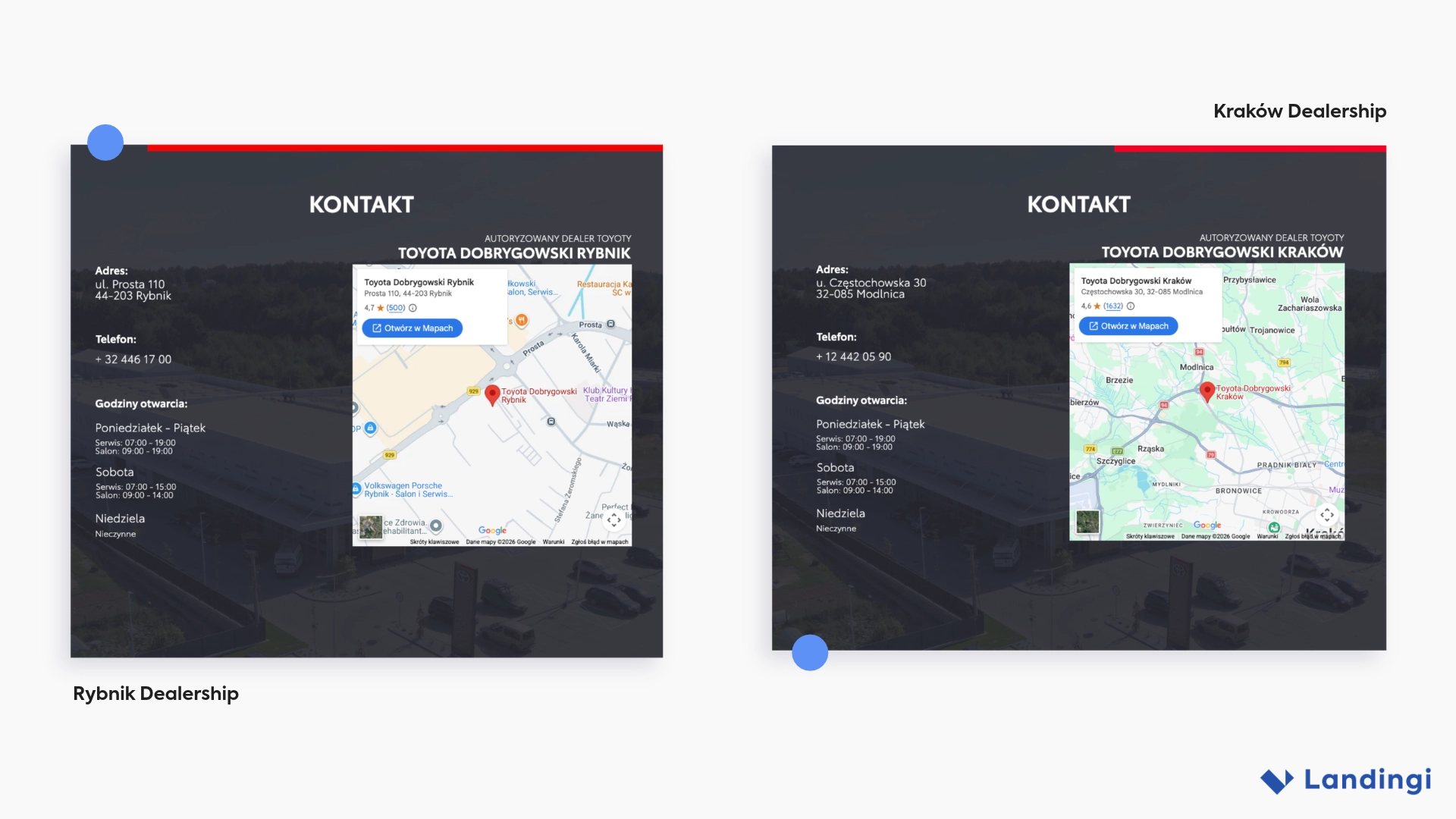
For automotive marketing, location information is part of the conversion path, not just a footer requirement. Someone registering for an open-days event or scheduling a test drive needs to know where to go and how to reach the dealership.
Using consistent contact sections with location-specific information on landing pages helps connect online campaigns with physical showrooms.
Traffic: Connecting Ads and Emails to the Right Offer
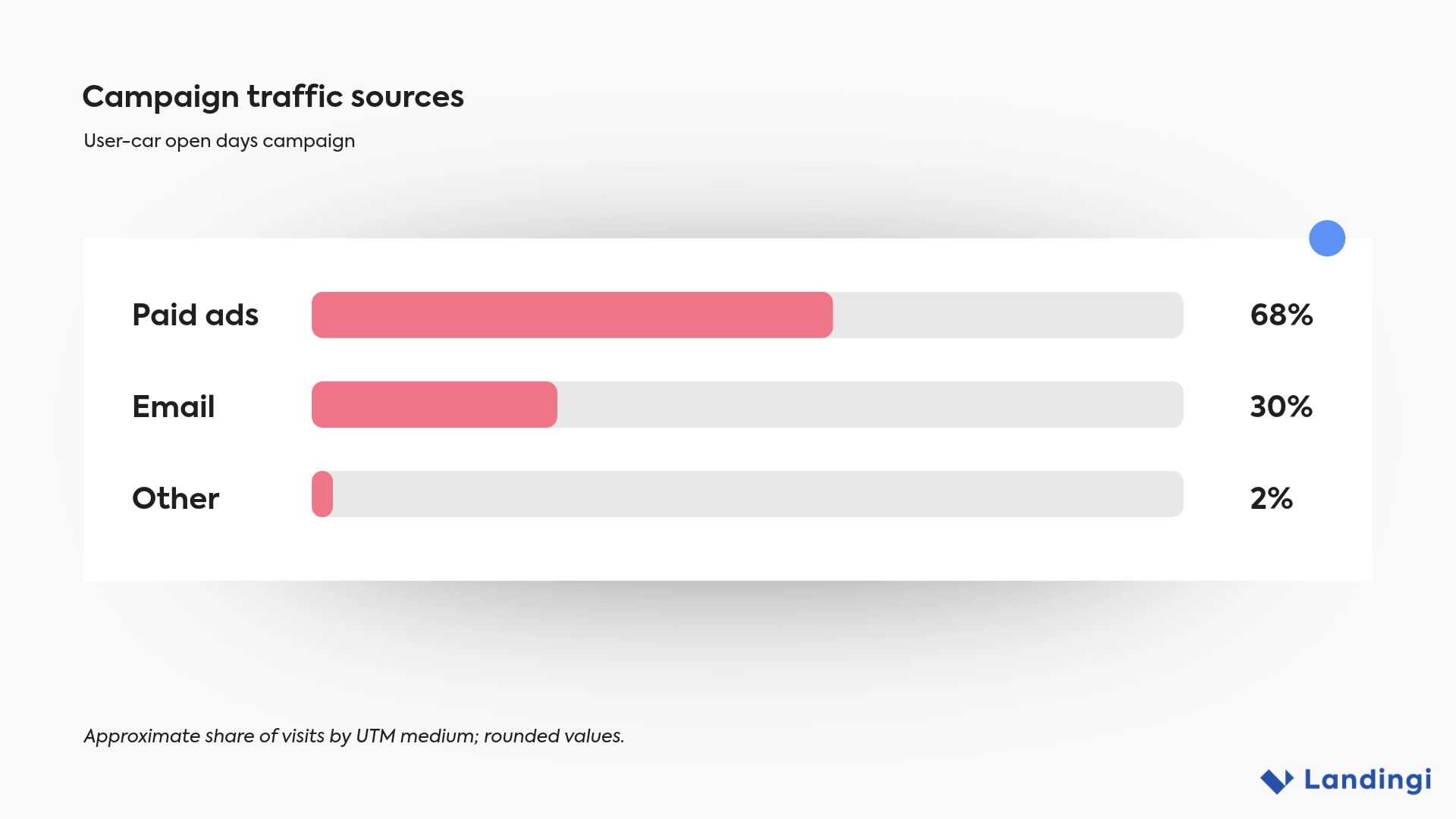
Toyota Dobrygowski uses landing pages as dedicated destinations for different marketing channels.
The available UTM data shows that paid campaigns generate a substantial share of traffic to dealership event pages. One event campaign also receives a significant proportion of visits attributed to email.
Year-end sales pages attract traffic from other sources, including Meta.
The underlying strategy is clear: each promotion has a destination that matches its message.
A model-specific ad leads to a page featuring that vehicle. An event email sends visitors to an event offer. A seasonal promotion directs them to a page where they can compare available models.
This reduces the need to search through a general dealership website after clicking an ad.
What Automotive Marketers Can Learn
Toyota Dobrygowski’s approach provides six practical lessons:
- Match the structure to the offer. Use focused pages for individual vehicles and comparison-friendly layouts for broader sales.
- Keep the primary action consistent. Multiple models can share one conversion goal, such as requesting an offer.
- Use forms where they fit the journey. Display them immediately for high-intent visitors and use lightboxes to support inquiries after product exploration.
- Prioritize decision-making information. Show pricing and financing for passenger cars, and practical specifications for commercial vehicles.
- Build local trust. Include the correct dealership details, opening hours, and map on each location-specific page.
- Compare behavior across campaigns. Monitor conversion rates, form completion, CTA clicks, and engagement instead of relying on traffic volume alone.
The Bigger Lesson: One Brand, Different Buying Journeys
Toyota Dobrygowski demonstrates that automotive landing pages can follow one consistent visual identity without using the same layout for every campaign.
A test-drive page focuses on one vehicle. A year-end sale makes comparison easier. A commercial vehicle campaign emphasizes practical specifications and advisor contact.
The results also show that similar promotions can perform very differently across locations.
The strongest approach isn’t to copy one successful page everywhere, but to adapt the experience to the offer, audience, and dealership.
With Landingi, Toyota Dobrygowski creates and organizes campaign-specific pages, uses forms and lightboxes to collect inquiries, and tracks results through built-in analytics and EventTracker.
Together, these elements help turn digital campaigns into clear paths toward a real dealership conversation.
Use the following Landingi features to achieve similar results:
Visual Builder

Infrastructure