Key takeaways:
- Workflow depth decides the value of an AI landing page tool: AI that only writes copy saves drafting time, while AI that creates, publishes, and tests pages raises campaign throughput.
- Human review and defined success metrics are buying requirements for AI landing page tools: the WFA reports that 75% of major brands require human oversight of AI content, while Basis finds only 6.5% of organizations measure AI investments against set metrics.
- Landingi MCP Orbit lets marketing teams create, publish, and analyze Landingi landing pages from ChatGPT, Claude, or Gemini, while the CMO can keep AI access limited to 1 account and blocked from lead data.
- Figma and Vercel generate strong landing pages but rely on other tools for A/B testing and lead routing.
AI landing page tools for CMOs are platforms that use artificial intelligence to create, publish, test, and analyze landing pages within a marketing team’s existing processes and data. Also called AI landing page builders or agentic landing page platforms, they range from single-task copy assistants to multi-agent workflows.
CMOs allocate 15.3% of marketing budgets to AI, yet only 30% of the 401 leaders in Gartner’s 2026 CMO Spend Survey report mature readiness to scale it. Budget is not the bottleneck; fitting AI into existing campaign processes is. For that reason, this guide compares the best AI landing page tools by how much of the campaign workflow their AI runs, not by page quality alone.

How to Evaluate AI Landing Page Tools as a CMO?
To evaluate AI landing page tools as a CMO, score each system on 6 checks before purchase and on 4 business metrics after rollout. Run both on one real campaign brief instead of a vendor demo script.
- Score workflow depth. List which of 5 steps the AI performs: copy, full page, publishing, A/B test, and results analysis.
- Check human approval. Confirm that roles, permissions, and a review step apply to AI actions, including actions started from ChatGPT or Claude.
- Map data connections. Trace a test lead from the form to the CRM, since every manual export adds delay and data loss.
- Verify native testing. Look for built-in A/B testing and analytics on the same page the AI created.
- Confirm stack fit. Make sure the tool works with existing systems, such as Figma, HubSpot, or the team’s LLM workspace.
- Model total cost. Add seats, AI credits, domains, traffic limits, and developer hours into an annual figure.
Which metrics prove the value of an AI landing page tool?
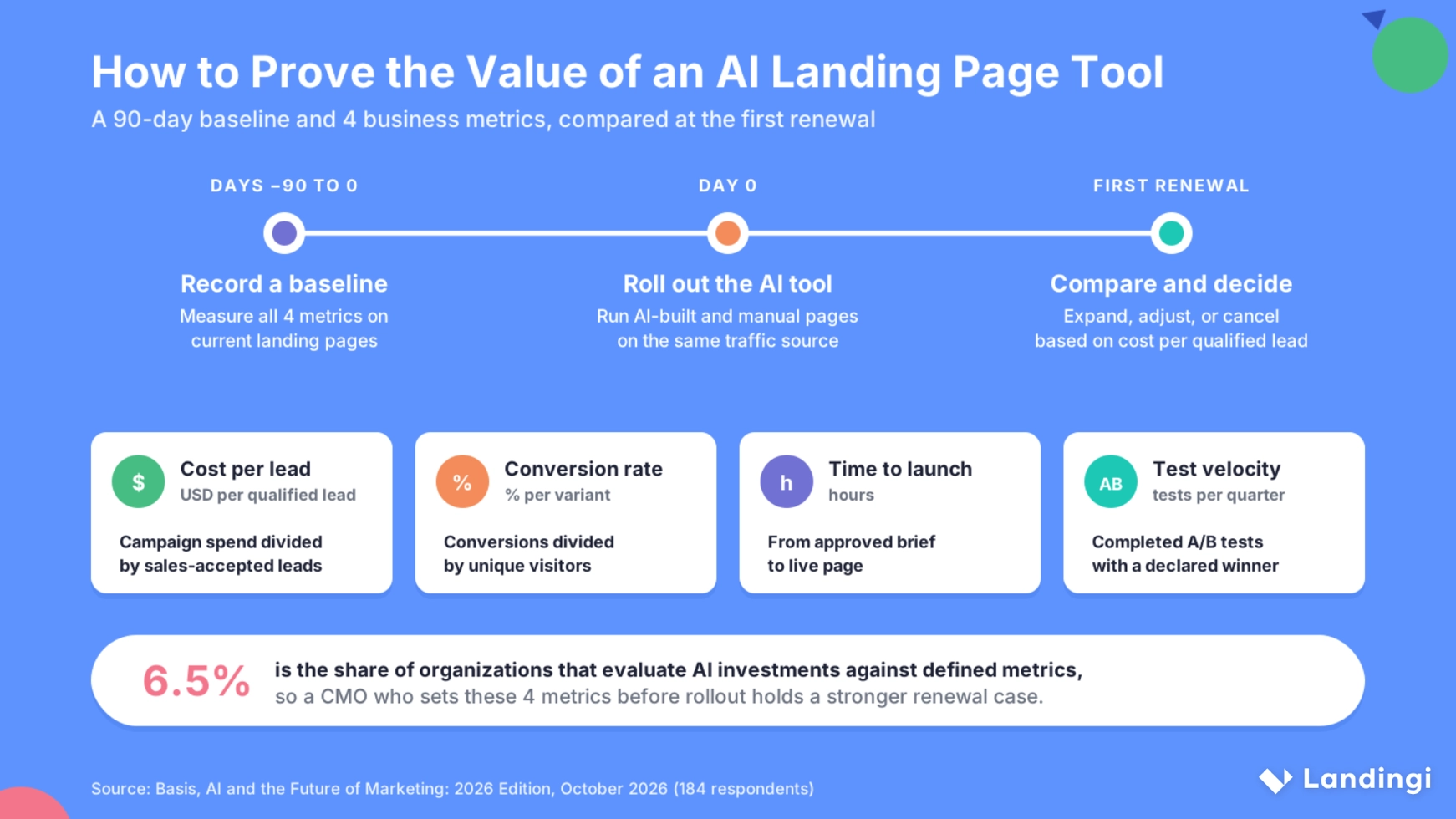
Cost per qualified lead, conversion rate, time to launch, and test velocity prove the value of an AI landing page tool. Only 6.5% of organizations evaluate AI investments against defined metrics, according to Basis’ AI and the Future of Marketing (184 marketing and advertising professionals, October 2026), so a CMO who sets them before rollout holds a stronger renewal case.
| Metric | How to measure |
|---|---|
| Cost per qualified lead (USD) | Campaign spend divided by sales-accepted leads, per page |
| Conversion rate (%) | Conversions divided by unique visitors, per variant |
| Time to launch (hours) | Hours from approved brief to live page |
| Test velocity (tests per quarter) | Completed A/B tests with a declared winner |
Record a 90-day baseline for all four metrics before rollout, then compare the results at the first renewal.
7 AI Landing Page Tools for CMOs in 2027
The 7 AI landing page tools for CMOs in this guide are Landingi, Heyflow, Figma, Unbounce, Vercel, HubSpot, and Leadpages. Each profile states what the AI handles, where the workflow leaves the tool, and which marketing organization gets the most value from it.
| Landing page tool | Where the AI works | Publishing and hosting | Native A/B testing | Governance and review | Best fit |
|---|---|---|---|---|---|
| Landingi (Lunar + MCP Orbit) | Full page generation in Landingi, or from ChatGPT, Claude, and Gemini through Orbit MCP | Yes, publish and unpublish from the AI chat | Yes, A/B/X | Account and subaccount scoping, audit logs, AI cannot access leads | Teams running many campaigns across brands or markets |
| Heyflow | Funnel generation from a prompt, plus full Meta ad campaigns | Yes, hosted funnels published with Meta campaigns | Yes | Not detailed on public pages; verify in a demo | Performance teams running Meta and TikTok lead gen |
| Figma (Make + Sites) | Page generation from prompts or existing designs | Yes, on paid Full seats | No | Org and Enterprise admin and library controls | Design-led teams shipping brand-heavy campaign pages |
| Unbounce (MCP Server) | Page builds, edits, A/B tests, and reports from ChatGPT or Claude | Yes, MCP pages stay unpublished until reviewed | Yes, plus Smart Traffic on Optimize and higher | Actions bound to account permissions | Paid-traffic teams focused on conversion testing |
| Vercel (v0) | Code generation for Next.js pages and multi-page sites | Yes, one-click deploy to Vercel | No marketer-facing test builder | Code review in GitHub | Teams with in-house front-end developers |
| HubSpot (Landing Page Creator GPT) | Copy and page structure from 5 to 7 guided questions in ChatGPT | Yes, through HubSpot CMS | In HubSpot on paid tiers | Approval workflows on Content Hub Enterprise | Teams already running CRM and email in HubSpot |
| Leadpages | Full page generation, plus an MCP server for AI agents | Yes, with custom domains | Yes, on every plan | Workspaces and audit logs on Scale | Small to mid-size teams that need testing on a fixed budget |
1. Landingi (Lunar & MCP Orbit): full AI workflow inside a governed landing page platform
Landingi runs the entire landing page workflow with AI, from the first draft to performance analysis. Lunar, Landingi’s AI landing page generator, builds complete and editable pages from a prompt. Solis analyzes visitor behavior and returns optimization recommendations, while EventTracker records clicks and form interactions.
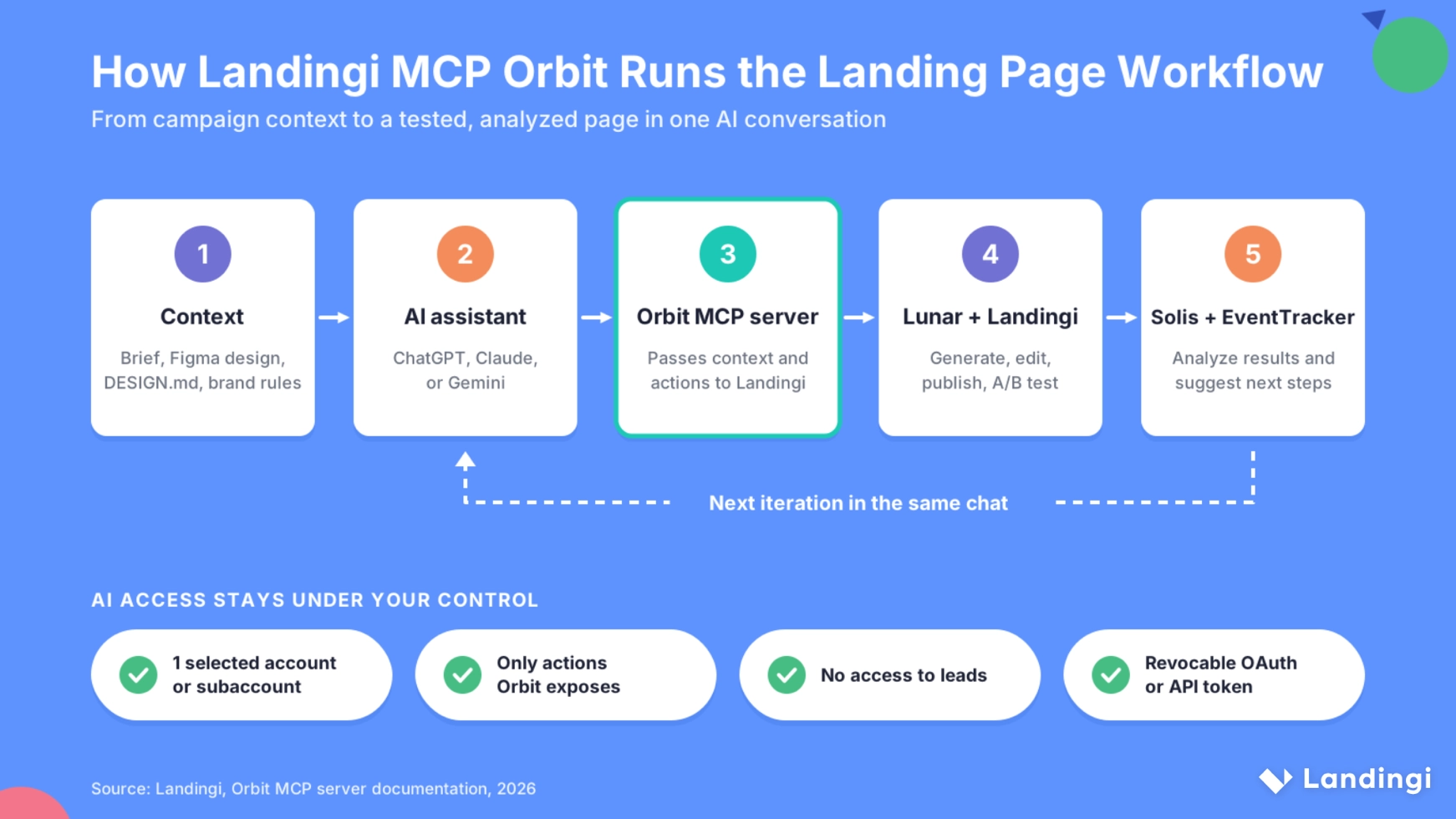
Orbit, Landingi’s MCP server, moves that workflow into the AI assistant a team already uses, such as ChatGPT, Claude, or Gemini. From one conversation, a marketer generates a page from a brief, applies brand rules from a DESIGN.md file, duplicates a page for a new market, publishes it to a domain, and asks for EventTracker results. Combined with Figma’s MCP server, Orbit turns a selected Figma design into a Lunar page in the same chat.
Orbit keeps AI access narrower than user access. An AI agent performs only the actions Orbit exposes, even when the connected user holds broader permissions in Landingi. The connection runs through OAuth or an API token that an admin revokes at any time, and Landingi MCP cannot read, export, or modify leads and form submissions.
Let AI handle the heavy lifting! From the first draft to ongoing optimization, Landingi helps you move faster.
Landingi strengths for CMOs:
- Full loop: generation, editing, publishing, version restore, and performance analysis run from 1 AI conversation.
- Scoped AI access: each connection works within a selected account or subaccount, with lead data excluded.
- Scale features: the Scale plan adds Programmatic Landing Pages, client subaccounts, and audit log records, according to Landingi’s pricing page.
Landingi limits:
- Credit usage: Lunar generation in the Landingi editor consumes monthly AI credits, while page work through Orbit does not, so teams that generate mostly in-app budget credits alongside seats.
- Lunar-specific actions: form actions, autoresponders, and version restore through Landingi MCP apply to AI pages, not to pages built in the classic editor.

2. Heyflow: AI funnels tied to paid social campaigns
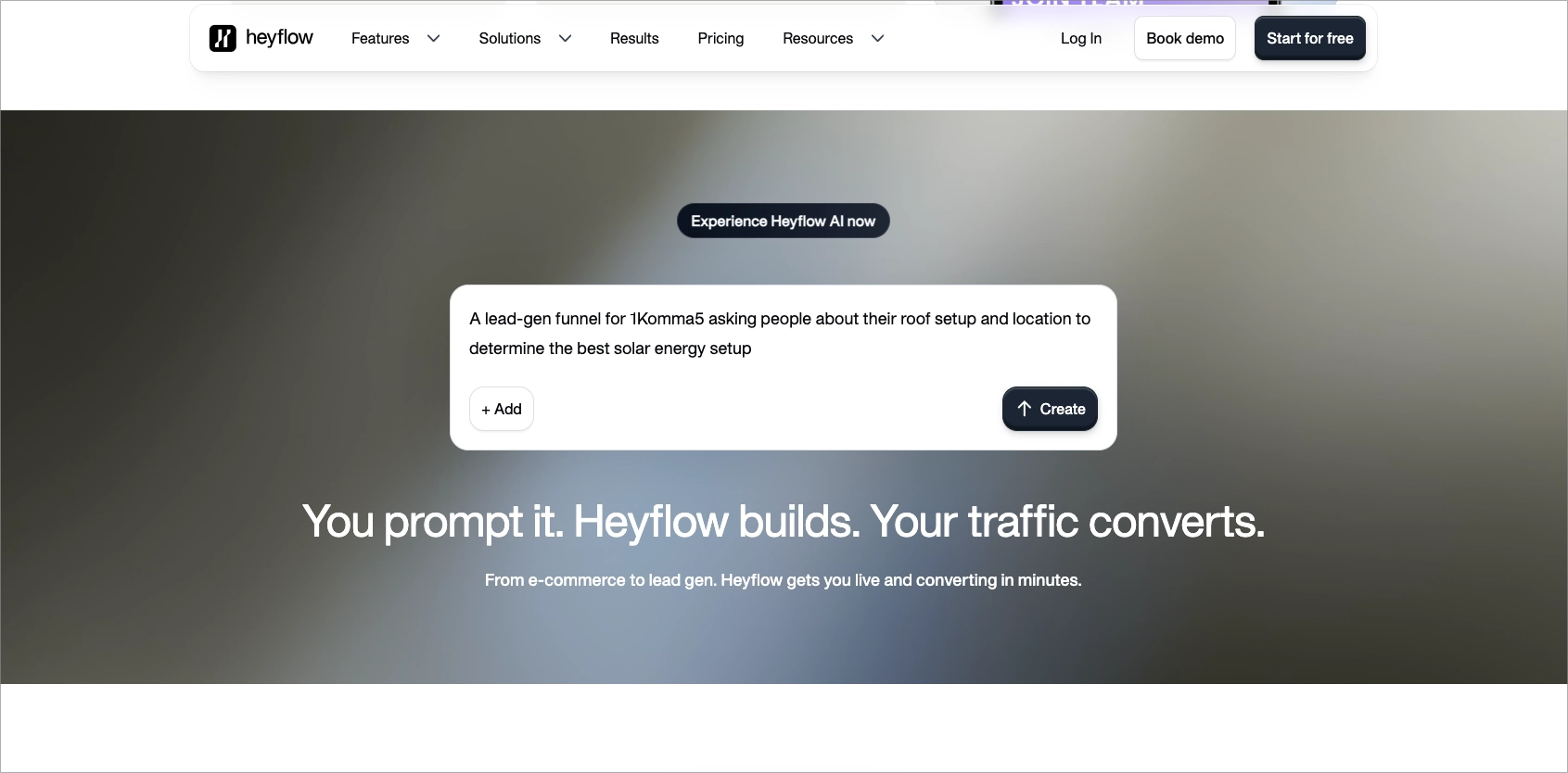
Heyflow generates multi-step lead funnels and the paid social campaigns that send traffic to them. Its AI Campaigns feature builds ad copy variations, image and video creatives, a conversion funnel with a landing page, and server-side tracking from a text prompt, then publishes the set to Meta Ads.
Heyflow’s AI Insights, released in February 2026, analyzes funnel performance inside the editor. Native A/B testing and server-side tracking for Meta, TikTok, and Google Ads keep attribution in the same system that built the funnel.
Heyflow strengths for CMOs:
- Ad-to-funnel continuity: one prompt produces the ad, the funnel, and the tracking setup.
- Lead qualification: conditional logic routes visitors by their answers before a lead reaches the CRM.
Heyflow limits:
- Format focus: Heyflow builds question-based funnels, not long-form landing pages for SEO or product launches.
- Governance detail: public pages do not document approval workflows or audit logs, so verify both in a demo.
3. Figma: AI page generation for design-led teams
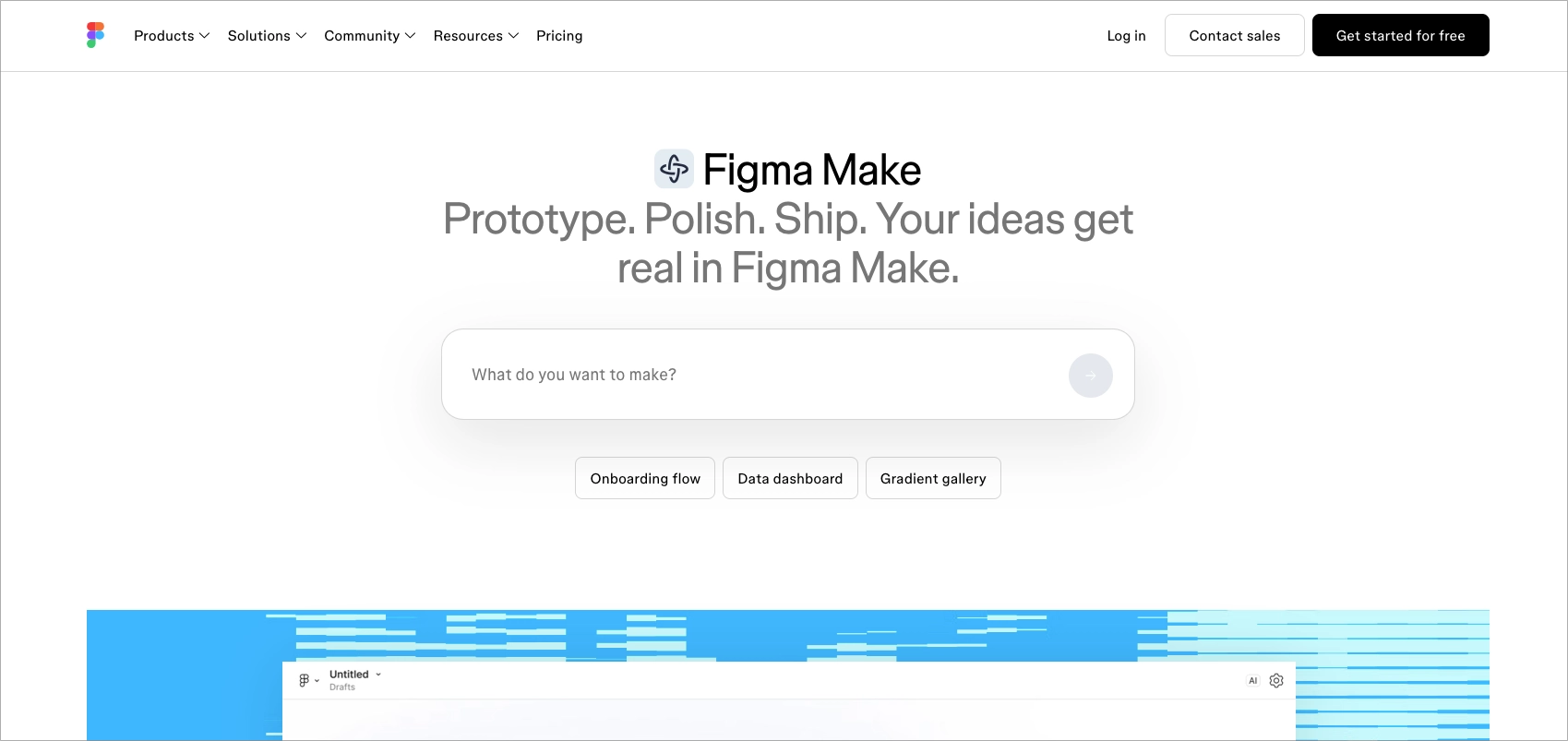
Figma turns prompts and existing designs into published websites through Figma Make and Figma Sites. Designers generate layouts, refine them in the canvas, and publish to a custom domain without a developer handoff.
Publishing requires a paid Full seat: $16 per month on Professional, $55 on Organization, and $90 on Enterprise, according to EveryDev’s Figma Sites listing. Figma’s MCP server also passes a selected design to an AI assistant as context, which lets landing page platforms such as Landingi and Unbounce rebuild that design as a hosted, testable page.
Figma strengths for CMOs:
- Brand fidelity: pages start from the same design libraries the brand team already maintains.
- Design-to-page speed: approved mockups become live pages without a rebuild in another tool.
Figma limits:
- No native testing: Figma has no built-in A/B testing, so conversion work moves to another platform.
- Lead handling: CRM routing, lead notifications, and campaign analytics sit outside Figma’s core product.
4. Unbounce: conversion testing driven from an AI assistant
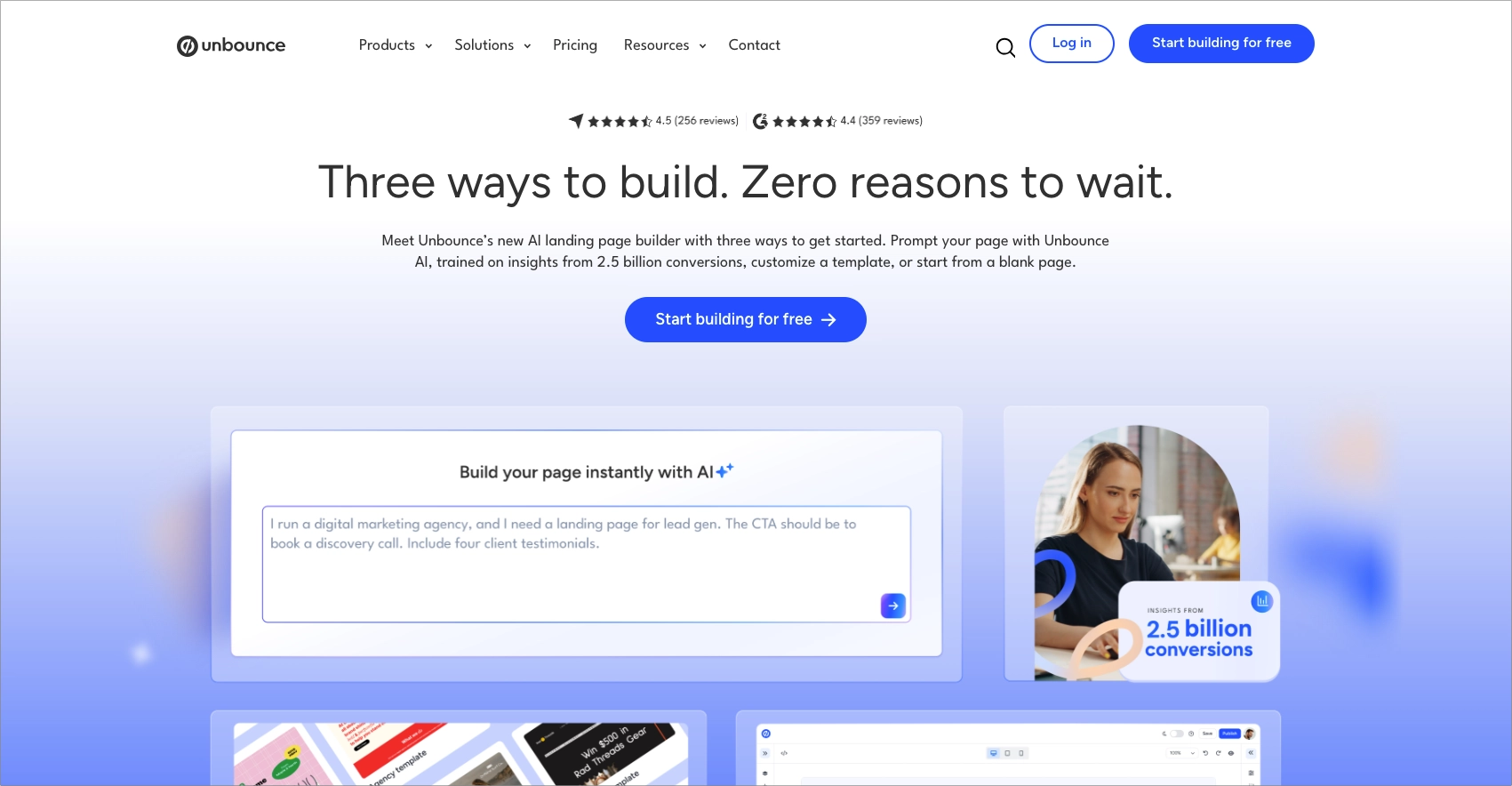
Unbounce connects its landing page and testing platform to ChatGPT and Claude through the Unbounce MCP Server, launched on August 11, 2026 across all plans, according to Unbounce’s launch announcement. Marketers build pages from briefs, brand guidelines, or Figma designs, update content, compare conversion rates, and launch A/B tests through prompts.
Unbounce adds a review step by default. The assistant creates each MCP page and leaves it unpublished for a person to check. MCP actions stay limited to the permissions of the connected Unbounce account.
Ubounce strengths for CMOs:
- Testing depth: assistants create variants, start A/B tests, and adjust traffic allocation; Smart Traffic activation works from the Optimize plan upward.
- Review before launch: AI-built pages never go live without a human publish action.
Unbounce limits:
- Two page types: the MCP server reads and edits only MCP-readable pages, so classic builder pages need conversion first.
- Split library: teams with large classic page libraries run 2 parallel workflows during migration.
5. Vercel: AI-generated code for teams with developers
Vercel’s v0 generates production-ready Next.js pages from prompts and deploys them to Vercel in one click. A June 4, 2026 update added multi-page generation, shadcn UI v3 components, and a direct-manipulation editor.
The output is source code, which gives engineering teams full control over performance, hosting, and integrations. The same property shifts work back to developers after launch, because every form, tracking pixel, and experiment is code.
Vercel strengths for CMOs:
- Front-end quality: generated pages use modern component libraries and Vercel’s hosting infrastructure.
- Engineering fit: GitHub sync lets developers review AI output in their normal pull request process.
Vercel limits:
- Developer dependency: v0 has no CMS and no marketer-facing A/B test builder, so campaign changes wait for engineering time.
- Lead routing: forms, CRM sync, and lead notifications require custom setup.
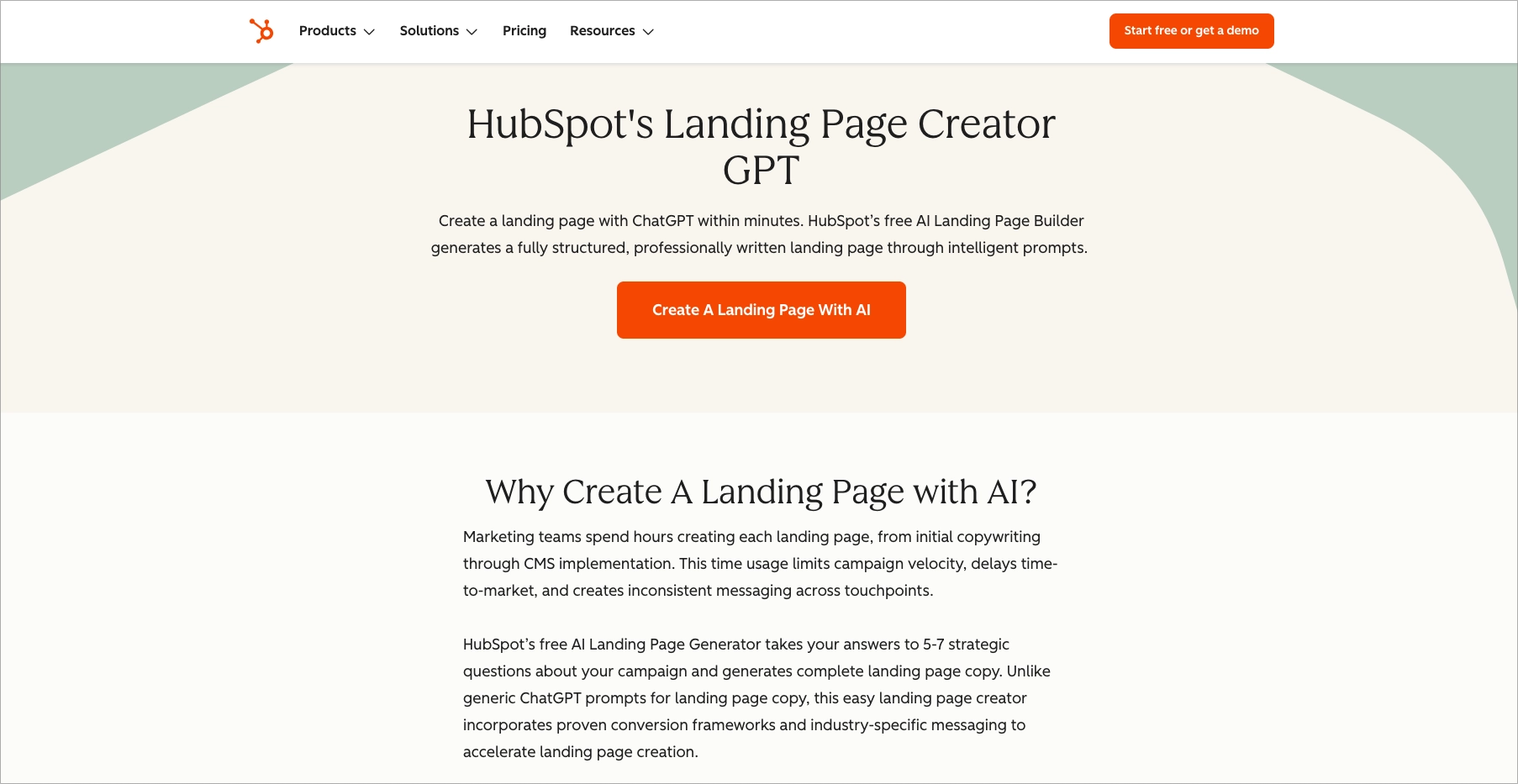
6. HubSpot (Landing Page Creator GPT): AI drafts for HubSpot CMS
HubSpot’s Landing Page Creator GPT drafts landing page copy and structure inside ChatGPT and sends the result to HubSpot CMS. The GPT asks 5 to 7 questions about campaign goals, value proposition, brand voice, and call to action, and HubSpot states the process takes under 5 minutes.
The HubSpot GPT is free, and its value grows with the HubSpot stack behind it. Form submissions from the published page land in HubSpot CRM records and trigger existing email workflows.
HubSpot strengths for CMOs:
- CRM continuity: pages publish into the same system that scores, routes, and nurtures leads.
- Zero tool cost: the GPT adds no license fee for teams already on HubSpot.
HubSpot limits:
- Draft-only AI: the GPT stops at copy and structure; design, testing, and analysis happen manually in HubSpot.
- Tiered controls: content approval workflows require a Content Hub Enterprise subscription.
7. Leadpages: AI page creation and testing on every plan
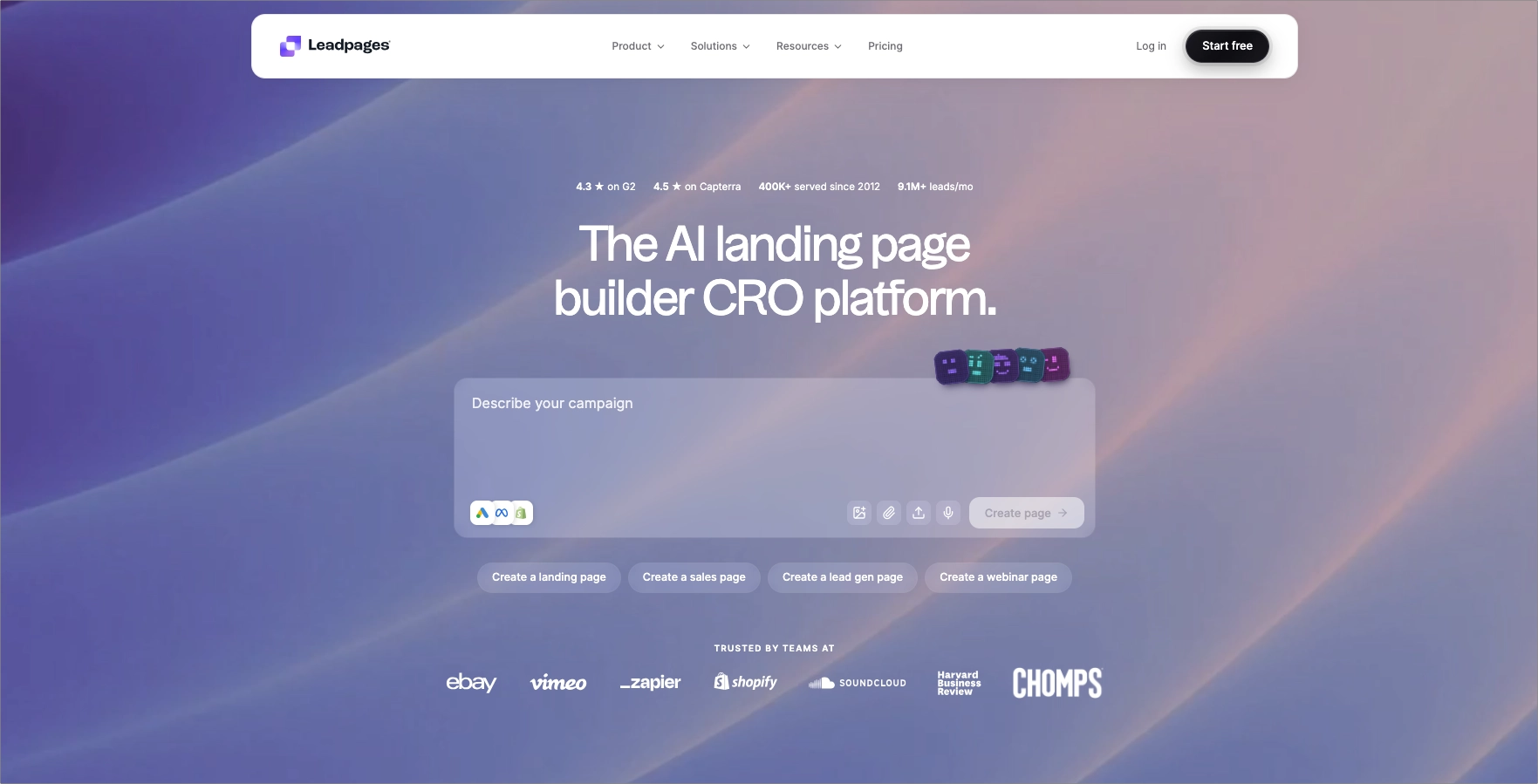
Leadpages bundles AI page creation, an MCP server, and A/B testing into every plan. Plans cost $99, $199, and $399 per month for Grow, Optimize, and Scale, with 5, 10, and 25 team seats.
Leadpages closes part of the optimization loop automatically. The platform reads scroll and click heatmaps, rebuilds the section that loses visitors with AI, and launches the revised variant as a new A/B test. Heatmaps and Smart Traffic start on the Optimize plan.
Leadpages strengths for CMOs:
- Predictable cost: unlimited traffic on every plan removes visitor-based overage fees.
- Programmatic pages: the MCP server connects to Claude, ChatGPT, or n8n to create location or product pages in bulk.
Leadpages limits:
- Governance tier: workspaces and audit logs exist only on the $399 Scale plan.
- Seat caps: large marketing departments outgrow the 25-seat Scale limit.
Why Do CMOs Evaluate AI Landing Page Tools by Workflow, Not Output?
CMOs evaluate AI landing page tools by workflow because the gap between AI spending and AI results sits in process, not in content generation. Almost every tool on the market now writes a headline or drafts a page layout. Far fewer tools carry that draft through publishing, testing, and analysis without a manual handoff.
Single-task AI vs. agentic landing page workflows
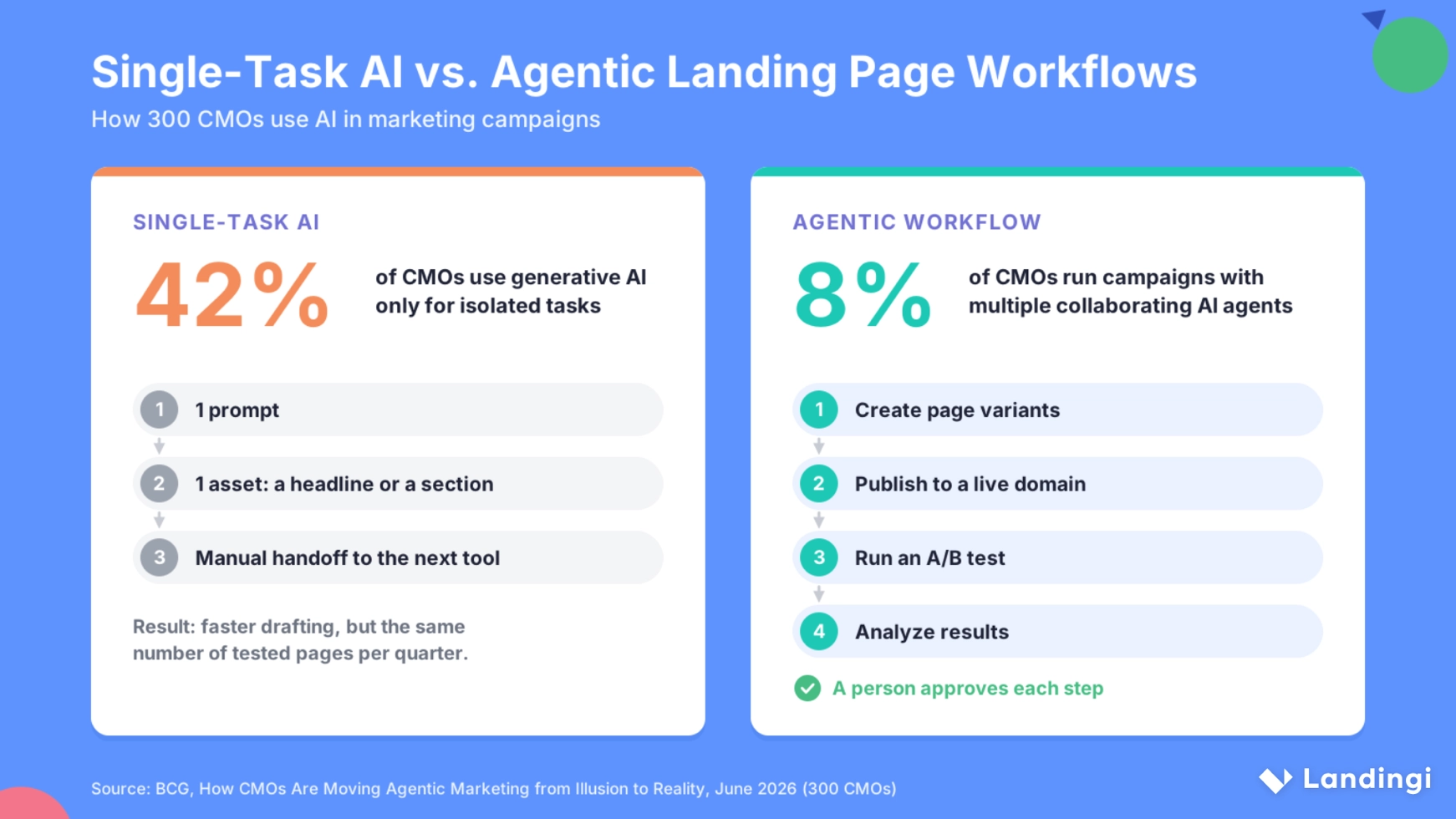
Single-task AI still dominates marketing teams. Among 300 CMOs surveyed in BCG’s How CMOs Are Moving Agentic Marketing from Illusion to Reality (June 2026), 42% used generative AI only for isolated tasks, while 8% ran campaigns through autonomous collaboration between multiple AI agents.
The two models produce different business outcomes. In this article, the terms mean:
- Single-task AI: one prompt returns one asset, such as a headline, a hero image, or a page section, and a person moves it into the next tool.
- Agentic landing page workflow: an AI agent creates page variants, publishes them to a live domain, starts an A/B test, and reads the results within one connected system, with a person approving each step.
A single-task tool cuts drafting time. An agentic workflow raises the number of tested landing pages a team ships per quarter, which is the number that moves cost per lead.
Human oversight as a buying requirement
Human oversight is a standard policy at large brands, not an exception. According to the World Federation of Advertisers’ State of AI in Marketing 2026 (September 2026), 75% of surveyed major brands require human review of AI-generated content, and 70% maintain lists of approved or banned AI tools. The WFA sample covers 54 respondents from 46 large companies, so the figures describe enterprise brands rather than the whole market.
For a CMO, those policies turn into concrete selection criteria. An AI landing page tool must support user roles, approval before publishing, and checks that keep pages consistent with brand guidelines. A tool that publishes AI output with no review step fails procurement at most enterprise brands before its page quality is even tested.
Human oversight starts with defining what the campaign should achieve. In his conversation with Błażej Abel about B2B marketing and AI, Konrad Wróbel explains where he draws the line:

Before asking AI to generate landing page variants, define the audience, the offer, and the business outcome each test should improve.
Which AI Landing Page Tool Fits Your Marketing Organization?
The right AI landing page tool depends on 2 facts about the marketing organization: where campaign work already happens, and who owns the page after launch. Match the landing page tool to that operating model instead of the feature list.
- Choose Landingi if the team runs dozens of campaigns across brands, markets, or clients and wants AI to create, publish, and test pages from ChatGPT or Claude with scoped access.
- Choose Heyflow if most leads come from Meta or TikTok ads and the team needs qualifying funnels launched together with the campaign.
- Choose Figma if the brand team owns campaign pages and visual fidelity outweighs testing, with a landing page platform handling experiments.
- Choose Unbounce if paid search and paid social budgets depend on continuous A/B testing and the team works in ChatGPT or Claude.
- Choose Vercel if front-end developers own the marketing site and every page change already goes through code review.
- Choose HubSpot’s GPT if HubSpot runs the CRM and email program and the team needs fast first drafts more than deep page testing.
- Choose Leadpages if a team of up to 25 people needs AI creation and testing at a fixed monthly cost.
Many CMOs combine two tools instead of picking one. One practical setup pairs Figma for design with a landing page platform such as Landingi for AI generation, hosting, testing, and analytics, connected through both MCP servers in the same AI assistant.
Turn AI-generated ideas into live, testable landing pages with Landingi. No complicated handoffs required.
FAQs About AI Landing Page Tools for CMOs
The questions below cover definitions, AI access, human review, and pricing for AI landing page tools in 2027. Each answer starts with the short version.
What is an AI landing page tool?
An AI landing page tool is software that uses artificial intelligence to generate, publish, test, or analyze landing pages. Basic tools write copy for one section, while full platforms such as Landingi build the page, host it, run A/B tests, and report results.
What is an MCP server for landing pages?
An MCP server for landing pages is a connector that gives an AI assistant controlled access to a landing page platform through the Model Context Protocol. Landingi’s Orbit, the Unbounce MCP Server, and the Leadpages MCP server let ChatGPT or Claude create, edit, and publish pages from a chat.
Can AI landing page tools publish pages without human review?
AI landing page tools can publish pages without human review when the connected account allows it, so the controls around publishing decide the risk. Landingi’s MCP keeps those controls with the marketing team: AI agents work only in the account or subaccount the team selects, perform only the actions Orbit exposes, never touch lead data, and lose access the moment an admin revokes the connection.
How much do AI landing page tools cost?
AI landing page tools cost from $0 to over $1,000 per month at list price, depending on traffic, seats, and governance needs. Landingi plans start at $24 per month for Build, which already includes Lunar and Orbit, and the Scale plan with Programmatic Landing Pages, subaccounts, and audit logs starts at $229 per month, billed annually. Among the other tools, HubSpot’s Landing Page Creator GPT is free, Unbounce’s Starter plan begins at $29 per month, Figma’s publishing seats cost $16 to $90 per month, and Leadpages plans cost $99 to $399 per month. For hosting, design, and tool fees beyond the subscription, see the full breakdown of landing page cost.
What is the biggest difference between AI landing page tools in 2027?
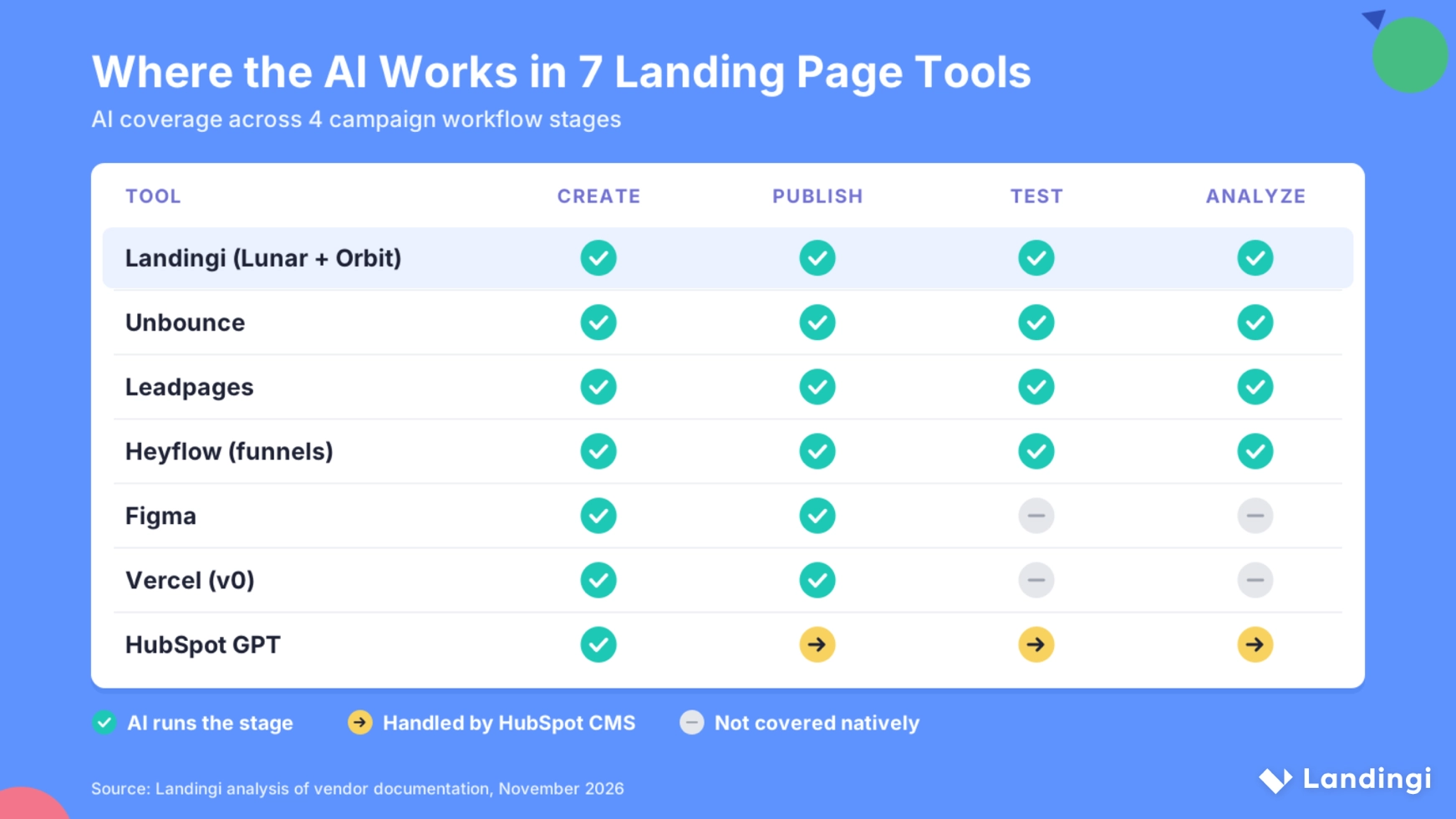
Workflow coverage is the biggest difference between AI landing page tools in 2027, measured by how many of the four stages (create, publish, test, analyze) the AI performs. Landingi, Unbounce, and Leadpages cover all 4 stages, while HubSpot’s GPT covers creation and hands off publishing to HubSpot CMS, and Vercel covers creation and publishing.
Great landing pages shouldn’t mean complicated workflows. Let AI help you build faster with Landingi.
Choose an AI Landing Page Tool That Runs the Whole Workflow
AI landing page tools pay off for CMOs when the AI runs the full workflow beyond the first draft. Score every shortlisted tool on workflow depth, human approval, data connections, native testing, stack fit, and total cost, then prove its value with cost per qualified lead after 90 days.
Landingi covers the full loop in one governed platform: Lunar generates pages, Orbit brings creation and publishing into ChatGPT or Claude with scoped access, and Solis and EventTracker show what to improve next. Start a free Landingi trial to run the evaluation on a live campaign!